

By Slobodan Tomic

“Not everyone who holds the key possesses the house.”
( A wisdom rooted in the centuries-old experience of the Church)
What took place in Moscow in recent days should not be viewed as an ordinary protocolary encounter.
Its significance reaches far beyond a ceremonial ecclesiastical gathering. It raises fundamental questions about contemporary relations within the Orthodox world, the nature of ecclesiastical diplomacy, and, above all, the place and role of the Macedonian Orthodox Church – Ohrid Archbishopric.
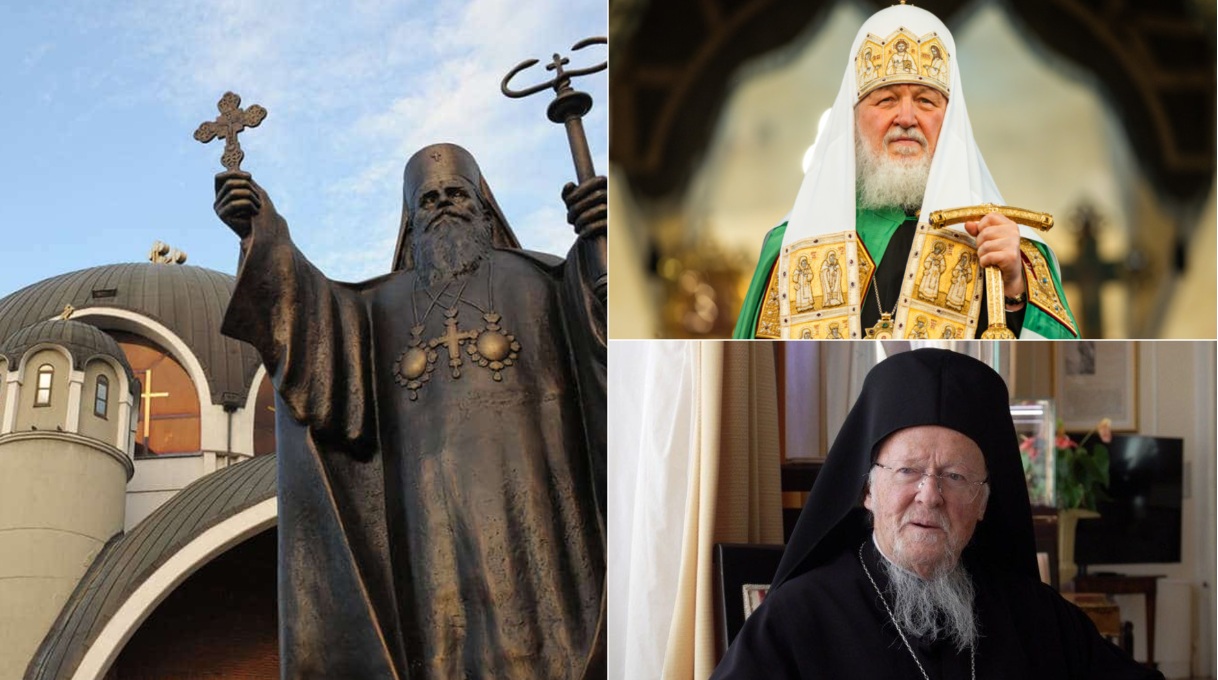
On November 20, at the Cathedral of Christ the Saviour in Moscow, Patriarch Kirill marked his 80th birthday in the presence of primates and representatives of several autocephalous Orthodox Churches. Among them was a delegation of the Macedonian Orthodox Church – Ohrid Archbishopric, led by Metropolitan Georgij of Debar and Kichevo and Bishop Kliment of Heraclea.
On November 21 came the second act of this ecclesiastical encounter: Patriarch Kirill received the Macedonian delegation at the Danilov Monastery.
That was no longer merely attendance at a solemn liturgy.
It was an ecclesiastical dialogue.
It was a symbol.
And, for Macedonia, it was a message.
But there was another element that gave the Moscow encounter an even greater significance.
Archbishop Stefan sent Patriarch Kirill a birthday greeting on the occasion of his 80th birthday.
And this was not merely a formal courtesy.
In his message, the head of the Macedonian Orthodox Church spoke of the Russian Patriarch’s “spiritual wisdom” and “fatherly care,” praised his “self-sacrificing service” to the Church, and described his ministry as a testimony to steadfastness in faith and to the responsibility entrusted to one who guides the people of God toward salvation.
Those words matter.
Particularly because they came from the Archbishop of the Macedonian Orthodox Church to the head of the Russian Orthodox Church.
There is a difference between a protocolary meeting and an expression of genuine ecclesiastical respect.
And there is an even greater difference when that respect is expressed in terms such as spiritual wisdom, fatherly care, steadfastness in faith and self-sacrificing service.
This shows that relations between Moscow and the Macedonian Orthodox Church are not merely formal diplomatic contacts.
They also possess a spiritual, historical and human dimension.
But precisely for that reason, the relationship must be analysed with greater care.
Respect for a church leader does not automatically mean the adoption of his political positions.
Ecclesiastical dialogue is not the same as political alignment.
And that is the line the Macedonian Church must know how to preserve.
THE FIRST TRUTH: MOSCOW DID NOT “DISCOVER” THE MACEDONIAN CHURCH — IT RECOGNIZED IT
This must be the starting point of any serious analysis.
The Russian Orthodox Church did not recognize the Macedonian Orthodox Church – Ohrid Archbishopric yesterday.
On August 25, 2022, the Holy Synod of the Russian Orthodox Church decided to recognize the Macedonian Orthodox Church – Ohrid Archbishopric as an autocephalous sister Church and to include the name of Archbishop Stefan in the diptychs.
That decision followed the historic ecclesiastical developments of 2022.
The Serbian Orthodox Church blessed the autocephaly of the Macedonian Church, and on June 5, 2022, Patriarch Porfirije handed the Tomos to Archbishop Stefan.
Therefore, the Moscow encounter is neither a Russian “experiment” nor a newly discovered Macedonian Church.
It is a continuation of already established ecclesiastical relations and of a reality that has its own history, institutional framework and canonical weight.
And here an uncomfortable but necessary question arises:
If the Macedonian Orthodox Church is regarded by the Russian Orthodox Church as an autocephalous sister Church, why do certain Macedonian voices behave as though its presence in Moscow were somehow controversial, unacceptable or even shameful?
THE SECOND TRUTH: THERE IS NOTHING WRONG WITH THE MACEDONIAN CHURCH SPEAKING TO MOSCOW
On the contrary.
In the Orthodox world, the Church must not become hostage to day-to-day political interests or geopolitical confrontation.
If every ecclesiastical relationship is to be judged according to whether Moscow, Washington, Brussels, Kyiv or Istanbul approves of it, then we are no longer talking about ecclesiastical diplomacy.
We are talking about geopolitics dressed in ecclesiastical robes.
The Macedonian Orthodox Church – Ohrid Archbishopric therefore has every right to speak with everyone.
With Belgrade.
With Moscow.
With the Phanar.
With Athens.
With Jerusalem.
With Antioch.
With Bucharest.
With Tbilisi.
With all autocephalous Orthodox Churches.
But dialogue does not mean submission.
Friendship does not mean vassalage, and ecclesiastical contact does not imply political allegiance.
The Macedonian Church should build relations with all, but those relations must rest on mutual respect, canonical dialogue and the preservation of its own ecclesiastical independence.
That is why Archbishop Stefan’s greeting to Patriarch Kirill should neither be portrayed as proof that Macedonia has become “Moscow’s Church” nor dismissed as something that should be hidden.
It should be understood as part of ecclesiastical diplomacy.
But ecclesiastical diplomacy has meaning only when the Church conducting it knows who it is.
THE THIRD TRUTH: THE MOSCOW LITURGY CARRIED ANOTHER KIND OF WEIGHT
On November 20, Moscow was not merely hosting representatives of the Russian Orthodox Church.
Primates and representatives of several autocephalous Orthodox Churches were present, including Patriarch John X of Antioch, Patriarch Theophilos III of Jerusalem, Patriarch Porfirije of Serbia, and Metropolitan Rostislav of the Orthodox Church of the Czech Lands and Slovakia.
Hierarchs from several Orthodox Churches also concelebrated, including representatives of the Macedonian Orthodox Church.
Anyone attempting to portray this event as exclusively a Russian affair therefore misses its broader significance.
What took place was an Orthodox gathering reflecting a far more complicated reality: the Orthodox world is not a single political or institutional monolith.
And this is precisely where the substance of contemporary inter-Orthodox challenges lies.
Today, Orthodoxy faces not only theological questions but also profound disagreements over canonical order, ecclesiastical primacy and the authority to grant autocephaly.
Who has the authority to grant autocephaly?
What are the limits of the Ecumenical Patriarchate’s authority?
What role should the other autocephalous Churches play in decisions affecting the wider Orthodox world?
These are not questions invented by Moscow, nor can they simply be reduced to political disagreement.
They are among the most significant contemporary challenges facing Orthodox ecclesiology.
MOSCOW AND THE PHANAR — TWO DIFFERENT ECCLESIASTICAL VISIONS
Here, we must be principled and honest.
It is not enough to say:
“Moscow is good, the Phanar is bad.”
That would be just as superficial as the opposite claim:
“The Phanar is good, Moscow is bad.”
The truth is more complicated and requires serious historical and ecclesiastical analysis.
The Phanar, that is, the Ecumenical Patriarchate, emphasizes its particular role and primacy within the Orthodox world.
Moscow, by contrast, strongly maintains that questions of autocephaly and canonical order cannot depend exclusively on the decisions of a single patriarchate.
The difference became especially pronounced in the Ukrainian ecclesiastical question.
In 2019, Ecumenical Patriarch Bartholomew issued the Tomos of Autocephaly to the Orthodox Church of Ukraine following the decisions of the Ecumenical Patriarchate in 2018.
Moscow rejected that process.
From that moment, the Ukrainian ecclesiastical question became one of the deepest and most serious inter-Orthodox disputes of the modern era.
The dispute cannot be understood without examining the historical, canonical and political circumstances that preceded it.
But neither can it be resolved through simplistic political labels.
AND HERE COMES MACEDONIA
Therefore, the essential question is not:
“Moscow or the Phanar?”
The real question is:
“Where does the Macedonian Orthodox Church stand within this broader ecclesiastical balance?”
The answer should be clear.
The Macedonian Church must remain its own.
Not Moscow’s.
Not the Phanar’s.
Not Belgrade’s.
Not Athens’.
Not Bucharest’s.
Not political.
But:
MACEDONIAN.
This is one of the greatest strategic tasks facing our Church.
Its international ecclesiastical position must emerge from its own identity, from the historical legacy of the Ohrid Archbishopric, and from the interests of the Macedonian Orthodox people.
The Macedonian Church must not become anyone’s instrument or anyone’s extension.
It must be the subject of its own ecclesiastical diplomacy.
And this is precisely why Archbishop Stefan’s birthday message matters.
If the Macedonian Archbishop can publicly and dignifiedly express respect for the Russian Patriarch, then the same Church must have the right — with equal dignity — to speak to the Phanar, Belgrade, Athens, Jerusalem and every other Orthodox centre.
Closeness to one must never become a reason for hostility toward another.
That is the maturity Macedonian ecclesiastical life requires.
WHAT ABOUT UKRAINE?
Here, every simplification must be rejected.
The Orthodox Church of Ukraine has an official Tomos of Autocephaly issued by the Ecumenical Patriarchate and is recognized by some autocephalous Orthodox Churches, while others have not accepted its autocephaly.
That means there is no single pan-Orthodox consensus on the Ukrainian ecclesiastical question.
That is a fact.
It is also a fact that the war between Russia and Ukraine transformed the ecclesiastical issue into something much broader than a theological dispute.
Church structures, monasteries, property and the religious affiliation of believers became part of one of the greatest geopolitical tragedies in twenty-first-century Europe.
The Ukrainian state has taken measures against church structures it associates with Moscow, while the Russian side interprets those measures as persecution of Orthodox believers and restrictions on religious freedom.
The Ukrainian position, meanwhile, argues that these measures concern national security and the severing of Russian influence over religious institutions.
Therefore, any serious analysis must distinguish between facts, political interpretations and ecclesiastical arguments.
We should not be naïve.
But neither should we be blinded by any side.
AND HERE AN INDICATIVE PICTURE EMERGES
In Moscow, on November 20, something happened that deserves particular attention.
Primates and representatives of several Orthodox Churches gathered in one place.
Among them was the delegation of the Macedonian Orthodox Church.
At the same time, on November 19, the Orthodox Church of Ukraine held a meeting of its Holy Synod and announced that it was continuing to develop cooperation with the World Council of Churches.
That represents a different ecclesiastical and international direction.
Taken together, these developments point to a period of significant realignment within the Orthodox world.
And that is precisely why Macedonia must understand one essential truth:
THE MACEDONIAN CHURCH MUST NEVER BECOME SOMEONE ELSE’S PIECE ON SOMEONE ELSE’S CHESSBOARD.
THE GREATEST MISTAKE WOULD BE FOR THE MACEDONIAN CHURCH TO BECOME “ANTI-MOSCOW” IN ORDER TO PLEASE THE PHANAR
But an equally serious mistake would be for the Macedonian Church to become an extension of Moscow.
This is where the proper measure lies.
Independence from all.
Respect for all.
Canonical dialogue with all.
Submission to no one except Christ.
That is the ecclesiastical diplomacy Macedonia needs.
Not a diplomacy of exclusion, but a diplomacy of dignity.
Not a policy built around other people’s interests, but a policy of its own ecclesiastical responsibility.
The Macedonian Church must know how to speak with everyone, while also knowing where the boundaries lie — boundaries that no one should cross when its independence is at stake.
And once again, Archbishop Stefan’s birthday message becomes relevant.
Because it demonstrates that ecclesiastical closeness can be expressed without political capitulation.
A birthday greeting is one thing.
Surrendering one’s ecclesiastical identity is another.
Those two things must never be confused.
WHY, THEN, DO SOME ATTACK THE MACEDONIAN CHURCH BECAUSE OF MOSCOW?
Here we enter the territory of media and political analysis.
If someone argues:
“The Macedonian Church should not go to Moscow because Patriarch Kirill is there,”
then one logical question must follow:
Why is dialogue with Bartholomew described as ecclesiastical diplomacy, while dialogue with Kirill is portrayed as political propaganda?
If the principle is that the Church should speak with everyone, then that principle must apply to everyone.
If the principle is that the Church should not become an instrument of politics, then that principle must apply equally to Moscow, Kyiv and Istanbul.
If the principle is that the Orthodox Church should seek unity, then efforts must be made toward unity rather than toward the creation of new trenches.
Selective interpretation of ecclesiastical contacts is not principled consistency.
It is a double standard.
And precisely such an approach distances the Orthodox community from its true spiritual mission.
ONE MORE THING MUST NOT BE FORGOTTEN
The Macedonian Church did not receive autocephaly because Moscow decided so.
That is essential.
Autocephaly was granted by the Serbian Orthodox Church in 2022, after which the Russian Orthodox Church recognized the Macedonian Church as an autocephalous sister Church.
This chronology must be respected.
Macedonian ecclesiastical identity should not be built upon Moscow.
But neither should it be dismantled because of Moscow.
It has its own historical roots, spiritual heritage and institutional tradition.
The Ohrid Archbishopric is not a product of contemporary geopolitical relations.
It is part of the centuries-old ecclesiastical history of this region.
Therefore, any serious analysis of the Macedonian Church must begin with its historical continuity, rather than with the current interests of the major ecclesiastical centres.
IS THERE A GREATER MESSAGE BEHIND THE MOSCOW JOURNEY?
There is.
It is this:
THE MACEDONIAN CHURCH MUST NO LONGER BE SOMEONE ELSE’S SUBJECT.
For decades, others spoke about us.
Belgrade spoke about us.
Sofia spoke about us.
The Phanar spoke about us.
Moscow spoke about us.
Athens spoke about us.
Others interpreted our history, our ecclesiastical tradition and our right to exist as an independent Church.
Now it is time for Macedonia to speak for itself.
And for the Macedonian Church to speak with its own voice.
Not borrowed positions.
Not foreign political formulas.
Not predetermined geopolitical expectations.
But with the dignity of a Church that knows its history and protects its future.
WHAT SHOULD THE MACEDONIAN CHURCH EXPECT FROM THE PHANAR?
Respect.
Brotherly love.
Understanding.
Ecclesiastical dialogue.
Recognition of the dignity and historical identity of the Macedonian Orthodox Church – Ohrid Archbishopric.
This is not a demand for privilege.
It is not a demand for special treatment.
It is not a demand that anyone surrender his own dignity in order to respect the Macedonian one.
It is a demand for reciprocity, for a fraternal relationship, and for respect toward a Church with its own history, spiritual tradition and institutional continuity.
The Phanar should demonstrate toward the Macedonian Church and the Macedonian Orthodox people brotherly love and respect, rather than silence, disregard or denial of their ecclesiastical and national identity.
The Macedonian Orthodox people are not an anonymous religious collective.
They have their own spiritual history, their own ecclesiastical tradition, their own churches, saints and centuries-old heritage.
The Macedonian Church is not an ecclesiastical phenomenon without historical roots, nor is it an institution that must constantly justify its existence before others.
Its history did not begin with contemporary geopolitical relations, nor does its dignity depend upon anyone’s political mood.
Therefore, the Phanar’s relationship with the Macedonian Church should be grounded in brotherly love, mutual respect and recognition of its dignity, including the historical heritage associated with the Ohrid Archbishopric and Justiniana Prima.
One cannot speak of Orthodox unity while simultaneously ignoring the identity of an Orthodox people.
One cannot preach brotherhood while disregarding the dignity of a sister Church.
One cannot invoke love while leaving the impression that Macedonian ecclesiastical and national distinctiveness is something that must be silenced or relativized.
The Macedonian Orthodox Church does not ask the Phanar to surrender its own historical place or dignity.
But it has every right to expect the same dignity to be extended to it.
And one more point must be absolutely clear:
Macedonia and the Macedonian Church owe their loyalty to no one, nor should they have to purchase ecclesiastical independence through political or institutional gratitude.
Ecclesiastical relations must not be relations of dependency.
They must be relations of mutual respect.
Therefore, the message to the Phanar should be clear:
RESPECT FOR THE MACEDONIAN CHURCH.
BROTHERLY LOVE FOR THE MACEDONIAN ORTHODOX PEOPLE.
RESPECT FOR THE HISTORICAL AND SPIRITUAL HERITAGE OF THE OHRID ARCHBISHOPRIC AND JUSTINIANA PRIMA.
That is a demand for brotherhood, not privilege.
For dignity, not patronage.
For respect, not submission.
MACEDONIAN MEDIA MUST NOT BECOME THE PHANAR’S ERRAND BOYS
This question deserves special attention.
The attitude of Macedonian media toward the Phanar, just as toward every other ecclesiastical centre, must be professional, independent and critical.
Macedonian journalists are not obliged to become anyone’s mouthpieces.
Neither Moscow’s.
Nor Belgrade’s.
Nor the Phanar’s.
Nor those of any other centre of ecclesiastical or political power.
They must not become obedient transmitters of foreign positions, media advocates for interests that are not their own, or servants of another Church’s political agenda.
The Phanar has the right to present its views.
Moscow has the right to present its views.
Belgrade, Athens and other ecclesiastical centres likewise have the right to defend their positions.
But Macedonian media have an obligation to present those positions with professional distance, to verify them, analyse them and place them within the context of Macedonia’s historical, spiritual and national interests.
It is not journalism when someone else’s position is simply adopted as one’s own.
It is not professionalism when questions concerning the dignity of the Macedonian Church are deliberately ignored.
It is not independence when criticism is directed only at Moscow while the same scrutiny disappears when the subject is the Phanar or another centre of power.
If a Macedonian journalist has critical questions about the Russian Orthodox Church, that journalist should also have the courage and professional integrity to ask critical questions of the Ecumenical Patriarchate.
If Moscow’s decisions are analysed, the Phanar’s decisions should also be analysed.
If transparency is demanded from one side, it must be demanded from the other.
The standard must be the same.
Macedonian media must not allow the Macedonian ecclesiastical question to be presented exclusively through foreign interpretations and foreign interests.
They must not reduce the Macedonian Church to an object about which others decide while the Macedonian public merely listens to their judgments.
Our Church has the right to its own voice, and the Macedonian public has the right to complete, objective and impartial information.
A journalist is not a patriarchate’s errand boy.
A journalist is not an ecclesiastical institution’s diplomatic courier.
A journalist is not a propagandist for geopolitical interests.
A journalist’s obligation is to truth, professional standards and the public.
Therefore, any media attempt to portray the Macedonian Church as guilty merely because it speaks with Moscow, while presenting contacts with the Phanar as the only acceptable form of ecclesiastical diplomacy, deserves serious professional scrutiny.
That does not mean every criticism of the Macedonian Church is unjustified.
On the contrary, every institution, including the Church, should be subject to legitimate questions and public scrutiny.
But criticism must be independent, reasoned and equally applied to everyone.
MACEDONIAN JOURNALISTS MUST NOT SERVE THE PHANAR — NOR ANY OTHER ECCLESIASTICAL CENTRE.
THEIR DUTY IS TO DEFEND PROFESSIONAL INDEPENDENCE, RESPECT THE TRUTH AND REFUSE TO ALLOW THE MACEDONIAN ECCLESIASTICAL QUESTION TO BECOME A HOSTAGE TO FOREIGN INTERESTS.
CHRIST IS NOT A GEOPOLITICAL BLOC
This is the most important message.
Christ is neither East nor West.
Christ is not Moscow.
Christ is not the Phanar.
Christ is not Kyiv.
Christ is not Belgrade.
Christ is Christ.
And if the Church is to remain faithful to its essence, it must place the Gospel above political blocs and above the interests of state power centres.
The Apostle Paul does not teach that there is one Christ for those aligned with Moscow and another for those aligned with Constantinople.
His message is the opposite:
«“One Lord, one faith, one baptism.”»
That is the measure.
That is the spiritual truth above all human divisions.
And precisely that truth should form the foundation of every ecclesiastical relationship, including the relations of the Macedonian Church with the other autocephalous Orthodox Churches.
WHAT HAPPENED IN MOSCOW ALSO HAS A QUIET DIMENSION
Patriarch John X of Antioch, in his congratulatory message, spoke of Kirill’s 80 years of life, 50 years of episcopal service and 17 years as Patriarch.
But perhaps even more significant was another moment in Moscow: the first concelebration of Patriarch John X of Antioch with Patriarch Theophilos III of Jerusalem after years of impaired communion connected with the issue of Qatar.
That may be one of the most meaningful symbols of the entire Moscow ceremony.
Orthodoxy can have wounds, disagreements and historical disputes, but it must never abandon the search for paths toward reconciliation.
And here lies another message for Macedonia.
If Antioch and Jerusalem can once again stand before the same Chalice, then the Orthodox world must also seek a way out of division and back toward dialogue.
Unity is not created through mutual accusations.
It is created through patience, ecclesiastical responsibility and the willingness to speak.
LET NO ONE TAKE THE MACEDONIAN CHURCH AWAY FROM US
Because that, too, is possible.
We can lose ourselves by moving from one extreme to another.
From Belgrade to Moscow.
From Moscow to the Phanar.
From the Phanar to Kyiv.
From Kyiv into geopolitics.
And in the process, never arrive at the essential point:
the Macedonian Orthodox people.
The Church does not exist to serve as decoration for interstate relations.
The Church exists for the human being.
For faith.
For prayer.
For hope.
For the soul.
For salvation.
It is not an instrument of political influence, nor a mechanism for advancing the interests of foreign states.
Its mission is spiritual, not geopolitical.
Therefore, the Macedonian Orthodox people have every right to expect from their Church a dignified, wise and independent position in its relations with every Orthodox centre.
AND THAT IS WHY MOSCOW SHOULD NOT BE FEAR — BUT EXPERIENCE
The Macedonian Church should speak with Moscow.
It should speak with the Phanar.
It should speak with the Serbian Orthodox Church.
It should speak with everyone.
But at every door, it should enter carrying the same calling card:
“I AM THE MACEDONIAN ORTHODOX CHURCH – OHRID ARCHBISHOPRIC.”
Not Russian.
Not Serbian.
Not Phanariote.
Not Ukrainian.
Macedonian.
That is not a matter of pride.
It is a matter of ecclesiastical identity and institutional dignity.
Only a Church that knows its own identity can speak to others as an equal.
And this is precisely where the true significance of Archbishop Stefan’s message lies.
He did not send a message of submission.
He sent a birthday greeting.
He expressed respect for the Russian Patriarch’s ecclesiastical service.
That is the right of one Church to maintain relations with another.
But from the Macedonian perspective, one principle must remain unmistakably clear:
Respect is not submission.
Closeness is not dependence.
Dialogue is not vassalage.
And that is precisely why Macedonia should not fear its own ability to speak with everyone.
AND HERE LIES THE GREATEST PARADOX
Those who attack the Macedonian Church today simply because it travelled to Moscow may fail to understand that, by doing so, they themselves push the Church into the very geopolitical logic from which it should be liberated.
Why?
Because they are effectively saying:
“Do not go there. Go to us.”
But the Orthodox Church must not become anyone’s geopolitical branch office.
Not the Kremlin’s.
Not Brussels’.
Not Washington’s.
Not the Phanar’s.
Not anyone else’s centre of political or ecclesiastical power.
The Church must remain faithful to its own spiritual mission, not to other people’s expectations.
And precisely for that reason, the presence of the Macedonian Church in Moscow should not automatically be interpreted as political alignment, just as its contacts with the Phanar should not automatically be interpreted as acceptance of every decision of the Ecumenical Patriarchate.
THERE IS A THOUGHT ATTRIBUTED TO ST PHILARET OF MOSCOW THAT RESONATES HERE LIKE A BELL
“Love for the Church is shown not by words, but by faithfulness.”
The faithfulness of the Macedonian Church must not be directed toward a political centre or a geopolitical alliance.
It must be directed toward:
CHRIST, THE GOSPEL, THE ORTHODOX FAITH AND THE MACEDONIAN PEOPLE.
That is the foundation upon which all its ecclesiastical relations should be built.
EPILOGUE: WHAT WILL THE MACEDONIAN VOICE BE IN THE NEW ORTHODOX WORLD?
On November 20, Moscow became a meeting place for Orthodox primates and representatives of several autocephalous Churches.
On November 21, the Macedonian delegation was again received at the Danilov Monastery.
And perhaps the greatest mistake would be to reduce this entire event to the simplistic formulas:
“Moscow is good.”
Or:
“Moscow is bad.”
No.
The question is much greater.
WHAT WILL THE MACEDONIAN VOICE BE IN THE NEW ORTHODOX WORLD?
That is the real question.
Because the Orthodox world is changing.
Ukraine has transformed the ecclesiastical and political landscape.
The Phanar defends its understanding of primacy.
Moscow defends its canonical vision.
Belgrade carries its historical burden.
Athens, Bucharest, Tbilisi, Antioch, Jerusalem and the other autocephalous Churches have their own positions and ecclesiastical interests.
In such a world, Macedonia must not become anyone’s pawn.
The Macedonian Church must become a genuine ecclesiastical subject.
Not someone else’s instrument.
Not someone else’s prize.
Not someone else’s sacrifice.
Not someone else’s wing.
But an independent Orthodox Church that speaks with everyone, hates no one, submits to no one, and never sells its own identity.
And if someone asks:
“Where does Macedonia stand — with Moscow or with the Phanar?”
The answer should be:
“MACEDONIA STANDS WITH CHRIST.”
And if someone asks:
“Then with whom will the Macedonian Church speak?”
The answer should be:
“WITH EVERYONE.”
Because the true strength of a Church does not lie in having a powerful patron.
Its true strength lies in spiritual maturity and independence — in the ability to speak with everyone without becoming anyone’s object of patronage.
As the well-known saying attributed to St John Chrysostom puts it:
“Where the Church is, there is Christ.”
And Macedonia has one sacred obligation:
NEVER TO ALLOW ANYONE TO TURN THE CHURCH OF ITS PEOPLE INTO SOMEONE ELSE’S GEOPOLITICAL FLAG.
That is the ecclesiastical path.
That is the Macedonian path.
And that is the path of freedom.
