

By Slobodan Tomic

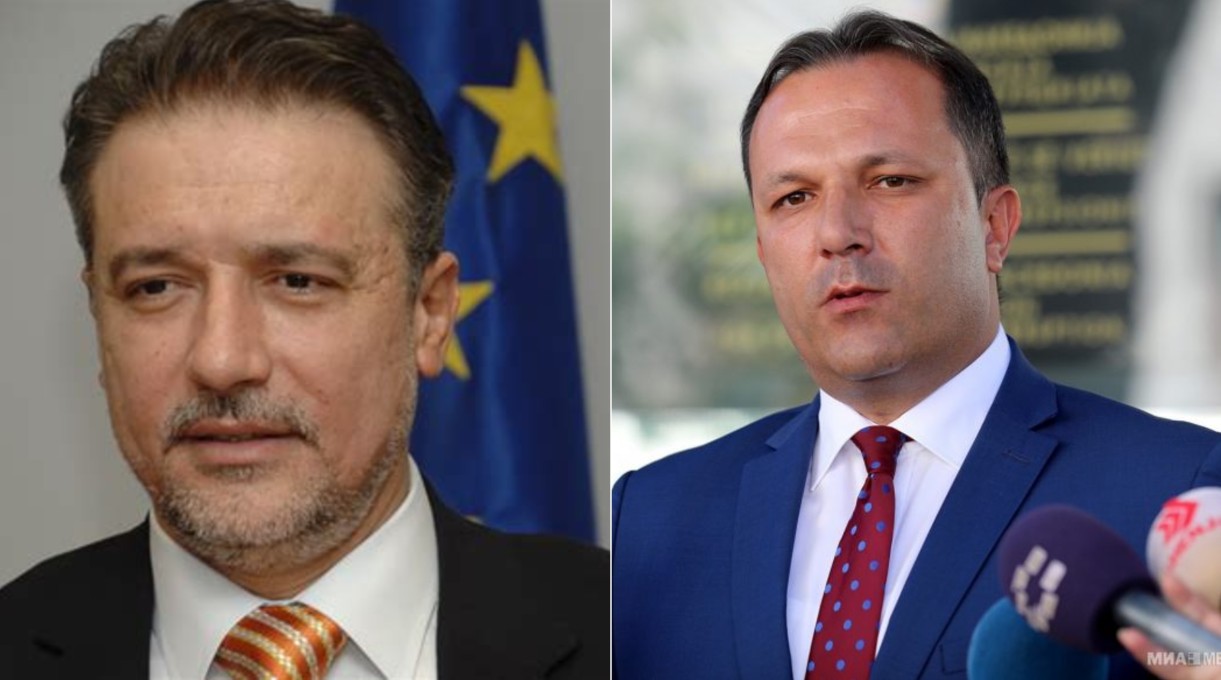
From Branko Crvenkovski’s political school to the new generations within the party: respect for political legacy, personal integrity, and the question of whether SDSM still knows how to recognise its own values.
Sometimes the most compelling political stories do not unfold at election rallies, inside party headquarters, or in front of television cameras.
They emerge in the way individuals relate to their own past, to those from whom they have learned, and to the principles they carry throughout their political lives.
That is precisely why Oliver Spasovski’s political profile has attracted my attention.
Not because he comes from SDSM. Not because he should be granted political absolution for everything he has done or failed to do in the past. And certainly not because we should abandon critical scrutiny of his political legacy.
Quite the contrary.
There is something in politics that is increasingly difficult to recognise today: a political tradition, respect for those who came before, and an awareness that no one begins entirely from scratch.
BRANKO CRVENKOVSKI: THE TEACHER AND THE POLITICAL LEGACY
Branko Crvenkovski is one of the most significant figures in Macedonia’s recent political history.
His policies, decisions, achievements and mistakes may all be debated, but his role in establishing and shaping SDSM, as well as in influencing the country’s political landscape, cannot simply be erased.
This is precisely where the interesting question concerning Oliver Spasovski arises.
He belongs to a political generation that came of age during Crvenkovski’s era and built its political career within a party possessing a distinct historical and political background.
I am not suggesting that Spasovski must agree with every decision made by his political predecessor. Nor that a student must remain forever in the shadow of his teacher.
But there is a difference between political disagreement and a lack of respect.
You may surpass your teacher, hold different views, and criticise his political legacy. But you do not have to humiliate your own political past to prove that you have become a leader.
That is precisely the value I wish to raise as a question in Spasovski’s case.
Today, as SDSM undergoes generational and leadership realignments, it is worth asking whether the party sufficiently respects its own political heritage.
Why does political history so easily become unwanted baggage whenever the leadership changes?
Why are political predecessors, rather than being treated as subjects of serious analysis and consultation, sometimes regarded as individuals whose time has passed?
Politics is not a family photograph that gets replaced with every new leadership team.
ZAEV, FILIPCHE AND THE RELATIONSHIP WITH THE PARTY’S PAST
Zoran Zaev and Venko Filipche are part of SDSM’s more recent political story. Both have their own political responsibilities, decisions and legacies that deserve serious scrutiny.
But the question of the party’s relationship with Branko Crvenkovski extends far beyond personal relationships.
When a new political generation assumes leadership positions, its maturity is also measured by the way it treats those who came before it.
It is not an act of political courage to tell a predecessor that his time has passed.
Political maturity means being able to listen to him, examine his arguments and acknowledge that there is still much to learn from older generations.
And this is where I find Spasovski interesting as a potentially different political profile.
I would not wish to attribute to him positions that he himself has not publicly confirmed. Nevertheless, his relationship with the political tradition from which he emerged deserves to be part of the public conversation.
After all, one should not renounce one’s roots merely to accommodate the prevailing political climate within one’s party.
PARTY PROTÉGÉS AND THE RESPONSIBILITY THAT COMES WITH PUBLIC OFFICE
Every political party has individuals who have grown under the support of its leadership, received positions, public visibility and opportunities to advance their political careers.
But public office is not a reward for party loyalty.
It is an obligation to the citizens.
In this context, it is also worth mentioning Darko Kaevski, former Director of the Agency for Youth and Sport and former SDSM spokesperson, whose name became associated with the case concerning sports vouchers.
Naturally, an indictment is not a conviction, and every accused person is entitled to a fair trial and the presumption of innocence.
Nevertheless, public office carries public accountability. Citizens have the right to ask questions, and politicians have an obligation to provide answers.
The same standard must apply to everyone.
Some politicians cannot be subjected to constant scrutiny while others are shielded merely because they belong to a particular political circle.
That is precisely why Spasovski should not be judged by the question of whose protégés his fellow party members may have been, but by his own conduct, positions and political accountability.
BIHAĆKA, PARTY GATEKEEPING AND MY FREEDOM AS A JOURNALIST
Here, I would also like to share a personal journalistic experience.
For years, I have been inviting politicians to appear on my programme, The Voice of the People with Slobodan Tomic.
Some accept, others decline, while some, judging by the impression I have formed over the years, seem uncomfortable with the prospect of sitting opposite a journalist who does not belong to their political circle.
On one occasion, according to information conveyed to me, Spasovski had expressed an interest in appearing on my programme, but party communication gatekeepers at Bihaćka reportedly stood in the way.
I do not present this as an officially verified statement, but as an experience that raises a further question about politicians’ freedom to decide independently where and with whom they engage in public debate.
Why should a politician need permission from the party headquarters to speak with a journalist?
Do citizens not deserve to hear their elected representatives beyond carefully controlled and pre-arranged media appearances?
My programme has never been a comfort zone for politicians.
But that does not make it a hostile environment.
Quite the opposite.
It is a platform where everyone is given the opportunity to express their views, while also being expected to answer questions they may not necessarily find comfortable.
I DO NOT SUPPORT PARTIES. I SUPPORT WHAT IS GOOD FOR MACEDONIA!
I have also had the opportunity to invite other prominent political figures.
Branko Crvenkovski, for example, responded to me in a personal exchange that he could not appear because he regarded my programme as excessively critical of SDSM.
That is entirely his prerogative.
But I have never understood journalism as an obligation to make myself comfortable or agreeable to anyone.
I am nobody’s party spokesperson.
I am not part of any political clique.
I do not depend on political donations, nor do I receive instructions from party headquarters.
I am an independent voice, answerable to my own journalistic principles.
My programme has featured people with whom I have agreed politically, as well as individuals with whom I have had serious disagreements.
I also remember an interview with a representative of pensioners’ organisations. Despite the uncomfortable and direct questions, he shook my hand after the conversation and thanked me for the interview.
That is the kind of journalism I respect.
You can disagree with your guest, confront him with the most difficult questions, and still preserve your humanity and professional dignity.
It is easy to speak about someone, describing them as one thing or another, from a safe distance.
It is considerably more difficult to sit opposite that person, engage in a genuine conversation and allow them to present their arguments.
That is why I do not wish to pass judgement on Spasovski without first speaking to him.
I want to hear him.
MACEDONIA IS NOT EUROPE’S BACKWATER
The portrait of a politician cannot be separated from the times in which we live.
Europe is facing major security, economic and geopolitical challenges.
The war in Ukraine, relations with Russia, energy dependence, food prices, inflation and the security of supply are reshaping the European political landscape.
Yet, in the midst of major European geopolitical calculations, the Balkans are frequently overlooked.
But the Balkans are not Europe’s backwater.
Nor are they a peripheral region whose sole purpose is to accept decisions made elsewhere.
The Balkans represent a strategic crossroads between Europe, Asia and the Mediterranean. Macedonia has its own geographical, historical, security and economic significance.
That is why Macedonia needs statesmen with foresight, economists with vision and politicians capable of safeguarding the country’s interests in an era of major international upheaval.
We do not need politicians who wait for a crisis to erupt before explaining why energy resources are being purchased at the highest prices, why food is becoming more expensive, and why ordinary citizens are left paying the price for other people’s political and economic mistakes.
Macedonia needs people who think ahead.
THE NATIONAL INTEREST AND RELATIONS WITH BULGARIA
In this context, questions concerning national identity, relations with Bulgaria and European integration are particularly important.
In 2022, Spasovski publicly advocated mechanisms to prevent the registration of clubs that offend the national sentiments and dignity of Macedonian citizens.
That position deserves attention and examination.
We may hold different views about SDSM’s policies, the Prespa Agreement, negotiations with neighbouring countries and the way European integration was conducted.
But when it comes to the national interest, there must be principles that transcend party boundaries.
Macedonian identity, language, historical dignity and the right to self-determination must never become bargaining chips in day-to-day political negotiations.
We expect politicians to articulate clear positions, not to send ambiguous messages depending on whether they are in government or opposition.
And this is another subject on which I would like to hear Spasovski.
FAITH, THE CHURCH AND THE HUMAN DIMENSION
A politician is more than a public office, a party biography or a television statement.
He is also an individual with personal values, upbringing, family, beliefs and a relationship with the wider community.
In Spasovski’s case, I have also taken note of his public presence in church life and his relationship with the Macedonian Orthodox Church – Ohrid Archbishopric.
I do not wish to mix faith with party politics, nor do I claim that being a believer automatically makes someone a better politician.
Nevertheless, I believe it is worth discussing spiritual values, respect for tradition, humanity and personal responsibility.
I would also like Spasovski himself to speak about what faith, family and the Church mean in his life.
For politics without moral values can easily degenerate into nothing more than a naked struggle for power.
WHY DO I WANT TO HEAR OLIVER SPASOVSKI?
Not to offer him a comfortable television appearance.
Not to ask him pre-arranged questions.
Not to become his political ally.
Rather, I want us to discuss his political journey, Branko Crvenkovski, Zoran Zaev, Venko Filipche, the situation within SDSM, national questions, relations with neighbouring countries and the future of Macedonia.
I would like him to address several fundamental questions:
What did you learn from Branko Crvenkovski?
In what ways do you differ from his political school?
Does SDSM today respect its own historical legacy?
Should politicians be free to appear in the media without having to obtain party approval?
How do you envisage Macedonia’s future amid major geopolitical and economic upheavals?
And, most importantly, are you prepared to place the interests of the state above those of your party?
These are questions that deserve answers.
INSTEAD OF A CONCLUSION: A POLITICAL OPPONENT DOES NOT HAVE TO BE AN ENEMY
I am not someone who measures people by their party membership card.
I do not believe in political blindness. Nor do I believe in the uncritical glorification of politicians.
If someone does something good for Macedonia, I will acknowledge it.
If someone does something wrong, I will criticise it.
Regardless of whether they belong to SDSM, VMRO-DPMNE, DUI or any other political formation.
That is why Oliver Spasovski interests me as a political figure who merits particular attention and a serious conversation.
I do not claim that he is without fault.
I do not claim that he is a political saviour.
But I believe that Macedonia must once again establish a political culture in which personal integrity, political tradition, respect for predecessors and the willingness to engage with those who hold different views are genuinely valued.
Because someone can be your political opponent without necessarily being your enemy.
And perhaps that is precisely the greatest distinction between politics as a struggle for power and politics as a responsibility towards the state.
A teacher does not always have to be right. But a student who forgets his teacher risks forgetting where he came from.
M.A. Slobodan Tomic
Author and Host of The Voice of the People with Slobodan Tomic
