

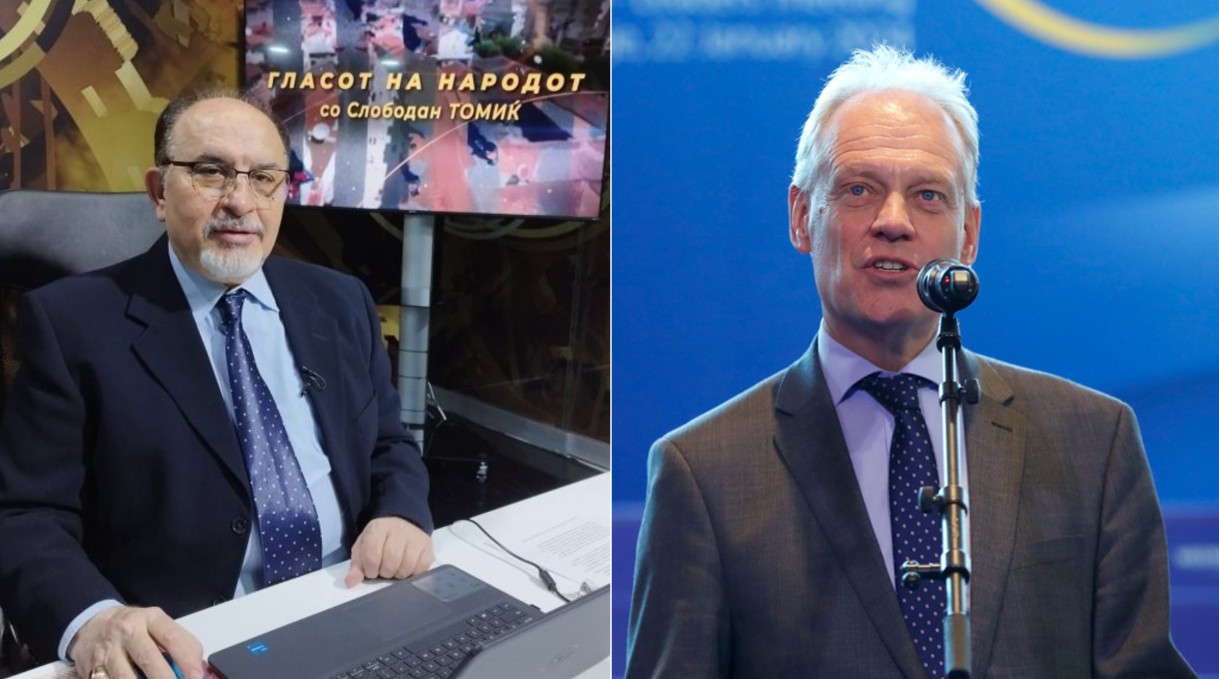
Dear Mr Koopman,
Your statement that “the obstacle to Macedonia’s European integration lies in Skopje, not in the European Union” deserves a serious, reasoned and unequivocal response.
Not because Macedonia is seeking to evade its own obligations. Not because its citizens do not aspire to become part of Europe. But because responsibility for a prolonged impasse cannot be placed entirely on one country while the role of the institutions that formulate the conditions — and turn them into obstacles along its European path — is simultaneously overlooked.
In your interview with the Atlantic Council, you stated that the blockage lies in Skopje rather than in the European Union.
Yet, in that same interview, you acknowledged that constitutional amendments are not merely a Bulgarian demand, but also a position of the European Union, incorporated into the Council’s conclusions.
This is precisely where the fundamental question arises: if this condition forms part of the European Union’s own conclusions, how can the Union claim that it bears no responsibility for the resulting deadlock?
You cannot impose a condition, incorporate it into your own conclusions, insist that it be fulfilled, and then maintain that responsibility for the impasse rests exclusively with Skopje.
That is not principled conduct.
It is the shifting of responsibility.
WHERE ARE THE COPENHAGEN CRITERIA?
For years, the European Union has invoked the Copenhagen criteria: the rule of law, democracy, functioning institutions, human rights and economic preparedness.
Macedonia is not asking to be exempted from these criteria.
On the contrary, it is asking that they be applied equally to every candidate country.
But can it truly be considered a European principle to place one country in a position where it must continually prove that it deserves even to begin negotiations, while the conditions are repeatedly revised, expanded and linked to issues touching upon its history, language and national identity?
Is the European perspective genuinely a merit-based process, or has it become one in which the political will of a neighbouring state can determine the European future of another sovereign country?
If accession is contingent upon compliance with European rules, those rules must be clear, measurable and equally applicable to all.
European integration cannot be transformed into an endless succession of concessions, in which every fulfilled obligation merely gives rise to another demand.
Europe must not become a promise that perpetually recedes into the distance.
THE MACEDONIAN LANGUAGE AND IDENTITY ARE NOT SUBJECTS FOR NEGOTIATION
Mr Koopman,
Macedonia has the right to its own history, its own language, its own culture and its own national dignity.
The Macedonian language is neither an administrative formula nor a temporary political construct. It is a living language spoken by millions, the language of literature, science, spirituality, family life and everyday communication.
Identity is not an item on a negotiating agenda.
No country should be expected to relinquish its historical memory in order to earn the right to a European future.
Macedonia has already made substantial concessions.
The change of the country’s constitutional name under the Prespa Agreement was a historic and political act with profound consequences for Macedonian society.
Subsequently, further conditionalities emerged in connection with the Treaty of Friendship, Good Neighbourliness and Cooperation and demands originating from the Bulgarian side, which were subsequently incorporated into the European integration process.
And now, with constitutional amendments once again being demanded, Macedonia is entitled to ask: where does this process of compromise end?
Who can guarantee that fulfilling this demand will not be followed by another?
Where is the assurance that historical and identity-related issues will not reappear as conditions in subsequent stages of the accession process?
The European Union must understand that Macedonian citizens are not rejecting Europe.
They are rejecting a European perspective that appears to require them to continually compromise their own sense of identity.
EUROPEAN PRINCIPLES AND THE QUESTION OF THE JUDICIAL EXAMINATION
The broader debate has also brought the question of the judicial examination into focus.
On 13 November 2026, Prime Minister Hristijan Mickoski explained that the theoretical component of the examination could be taken in Albanian, Turkish or English, whereas the practical component, involving the simulation of court proceedings, is conducted in Macedonian and in the Cyrillic script.
This issue should not be presented as a condition imposed by the European Union.
It concerns the constitutional order, the functioning of the judicial system and the use of the official language within state institutions.
Precisely for that reason, however, it deserves serious public debate.
The judicial examination is not simply a language exercise.
Its purpose is to establish whether candidates possess the professional competence required to practise law within the country’s institutional and legal framework.
The question is straightforward: how can the judicial system function effectively if the practical application of the law is not grounded in clear, consistent and operational standards?
Multi-ethnicity is a defining reality of Macedonian society and must be respected.
However, respect for diversity must not come at the expense of institutional functionality.
The state must operate according to clear rules, and those rules must be consistent with the Constitution and the law.
Not every issue can be turned into a political wish list, in which everyone demands something for themselves while no one assumes responsibility for the effective functioning of the state.
European standards require functioning institutions, not merely political compromises.
THE QUESTIONS SURROUNDING 2021 MUST NOT BE FORGOTTEN
Mr Koopman,
There is another matter that deserves a public answer.
On 10 November 2021, the then Dutch Prime Minister, Mark Rutte, visited Macedonia and held meetings with the then Prime Minister, Zoran Zaev, and President Stevo Pendarovski.
Just one day later, on 11 November 2021, the Macedonian Parliament was due to vote on a motion of no confidence in Zaev’s government.
A total of 61 votes were required for the motion to succeed. Sixty members of parliament were present. The absence of MP Kastriot Rexhepi proved decisive in the initiative’s failure.
In his public explanation, Rexhepi referred to strong signals from senior diplomatic representatives of strategic partners, including the United States and EU member states.
Subsequently, questions emerged in the public domain concerning diplomatic contacts, Rutte’s visit and the political circumstances surrounding this episode.
Commentary also emerged linking these events to Rexhepi’s previous professional engagement with the Dutch Embassy.
Let us be precise: the close timing of the visit and the parliamentary vote does not, in itself, establish that Mark Rutte personally contacted Rexhepi or organised any particular political intervention. Such an assertion would require concrete evidence.
Nevertheless, the questions remain legitimate.
Who were those senior diplomatic representatives?
What signals were conveyed?
Why did the MP refer to pressure from strategic partners?
Did diplomatic representatives of Western countries respect the political autonomy of Macedonia’s institutions?
Were discussions taking place behind closed doors at the time that had an impact on Macedonia’s internal political processes?
These questions do not constitute a presumption of guilt against any particular individual.
They are a demand for transparency and accountability.
Mark Rutte is now the Secretary General of NATO. Radmila Shekerinska serves as NATO’s Deputy Secretary General.
Their present positions further underscore the importance of relations between Macedonia and the Euro-Atlantic institutions.
However, public office does not eliminate the need to address legitimate questions about the past.
Trust cannot be demanded through authority.
Trust is built through transparency.
MACEDONIA’S STATE POSITION AND THE RESPONSIBILITY OF ITS GOVERNMENT
In this complex situation, the responsibility of Macedonia’s institutions is immense.
Prime Minister Hristijan Mickoski has publicly insisted on clear guarantees and predictability in the European integration process, particularly regarding identity-related issues and the risk of further bilateral conditionalities.
President Gordana Siljanovska-Davkova, within the scope of her constitutional powers, has an important role in safeguarding the constitutional order and representing the country’s national interests.
Foreign Minister Timcho Mucunski bears the diplomatic responsibility of presenting Macedonia’s arguments to international partners and insisting on equal treatment.
Nevertheless, no government must substitute a coherent state strategy with the demands of day-to-day politics.
Macedonia needs a clear, consistent and long-term position. It must remain prepared to implement reforms, meet European standards and address its domestic shortcomings.
At the same time, it must understand where the limits of political compromise lie.
The national interest does not belong to one political party, one government or one politician.
It is an obligation to present and future generations.
WHAT, IN FACT, IS MACEDONIA ASKING OF THE EUROPEAN UNION?
We are not asking for privileges.
We are not asking to be exempted from reforms.
We are not asking for shortcomings in the judiciary, public administration, the economy or the fight against corruption to be overlooked.
We are asking for something far simpler, yet fundamentally important: fairness.
We are asking for European rules to apply equally to every country.
We are asking that bilateral disputes not be transformed into endless European conditionalities.
We are asking for guarantees that the Macedonian language and identity will not become subjects of further political negotiations.
We are asking for an accession process based on merit, rather than on the political will of neighbouring countries.
We are asking for a clear and predictable path towards membership, with specific obligations and measurable results.
Above all, we are asking that the dignity of Macedonian citizens be respected.
Therefore, Mr Koopman, we put the following questions to you:
If the blockage lies exclusively in Skopje, why are the conditions incorporated into the conclusions of the Council of the European Union?
If the process is merit-based, why do bilateral disputes exert such a decisive influence on its progress?
If the European Union respects linguistic and cultural diversity, why must Macedonia continually fear that its identity will become subject to political conditionalities?
If the European perspective is genuine, where are the guarantees that one demand will not simply be followed by another?
And finally: does the European Union want Macedonia to become a full member on the basis of European values, or does it expect Macedonia first to surrender part of its own historical and national dignity?
This is not a question of hostility towards Europe.
It is a question of respect for European principles.
EUROPE MUST RECOGNISE THE DIFFERENCE BETWEEN COMPROMISE AND SELF-ABNEGATION
The European Union must not forget that Macedonia did not come into existence yesterday.
It has its own history, its own statehood, its own people, its own language and its own cultural traditions.
Macedonia has the right to a European future, but it also has the right to build that future without renouncing its past.
Compromise is an integral part of diplomacy.
But compromise must never become a one-way process in which one side is expected to make concession after concession while the other continues to impose demands.
The European Union must demonstrate that it is a community founded on principles, not merely an alliance shaped by political interests.
If it aspires to become a genuine geopolitical actor, it must demonstrate the capacity to resolve disputes rather than perpetuate them as permanent obstacles.
If it wishes to restore the confidence of Macedonian citizens, it must prove that its declarations about European values have practical meaning.
Macedonia is not asking for a special path.
It is asking for a fair one.
It is not asking for European rules to be relaxed. It is asking that those rules not be used as instruments of political pressure.
And it is not asking anyone to give it a future.
It is asking that its right to shape that future independently not be taken away.
CONCLUSION
Mr Koopman,
Perhaps, from the offices in Brussels, Macedonia’s predicament appears to be a matter of unfulfilled obligations and insufficient political preparedness.
But for Macedonian citizens, this is not an administrative entry in a European progress report.
It is a question of dignity, identity, trust and the future.
Therefore, when you state that the blockage lies in Skopje, you must also be prepared to address the question of Brussels’ responsibility for the conditions it imposes.
Europe cannot demand that Macedonia demonstrate its commitment to European principles while failing to demonstrate consistency with those very principles itself.
It cannot demand respect for legal certainty from Macedonia while offering it a process in which political conditions are continually subject to change.
It cannot demand the trust of Macedonian citizens without providing them with clear and credible guarantees.
Marcus Aurelius wrote in his Meditations:
“If it is not right, do not do it; if it is not true, do not say it.”
That is a standard that should govern politics and diplomacy alike.
For injustice does not become justice simply because it is pronounced by the powerful.
Macedonia has obligations towards Europe, but Europe also has obligations towards its own principles.
And that is precisely why, Mr Koopman, responsibility for the European impasse cannot be sought in Skopje alone.
MACEDONIA IS NOT BLOCKING ITSELF. WHEN THE CONDITIONS ARE SET IN BRUSSELS, RESPONSIBILITY MUST ALSO BE SOUGHT IN BRUSSELS.
Respectfully,
SLOBODAN TOMIĆ
Journalist and Publicist
Author and Host of The Voice of the People with Slobodan Tomić
