

“Health is not everything, but without health, everything else is nothing.”
Arthur Schopenhauer
By M.Sc. Slobodan TOMIC
Analyst, Publicist and Author

Three decades of waiting are far too long for a country. For a patient, however, sometimes just one day is enough to understand the true value of a functioning healthcare system.
There are matters on which politics should fall silent and the state must speak.
Healthcare is one of them.
When a person finds themselves outside an operating theatre, confronted with a serious diagnosis or fighting for their life, nobody asks which political party they voted for.
Nobody asks whether they belong to the left or the right.
Nobody asks whom they know or which connections they have.
At that moment, they are simply a patient.
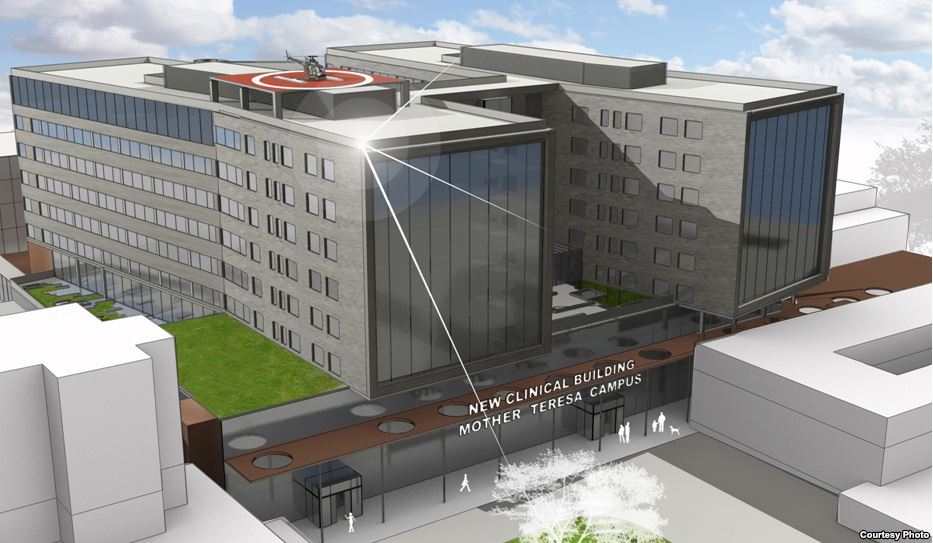
And that is precisely why, more than three decades after Macedonia gained its independence, the question of a new, modern and fully functional Clinical Centre can no longer remain another political promise.
It must become a national obligation.
Not the project of one government.
Not the achievement of one political party.
Not a private business venture.
Not political spoils.
It must become an institution that will serve generations to come.
“Medicine is an art founded upon science and humanity.”
— Hippocrates
WE CANNOT ERASE THE YEARS WHEN A PROJECT EXISTED — AND WAS SUBSEQUENTLY ABANDONED
Let us be honest.
Between 2015 and 2017, a concrete political and institutional initiative existed to construct a new Clinical Centre in Skopje.
There was a plan.
There was an agreement.
There was a financial framework.
There was political commitment.
Then came the change of government.
Venco Filipce, who had previously been part of the healthcare team during the period when the project was being prepared, subsequently became Minister of Health in the government led by Zoran Zaev and oversaw the termination of the agreement.
This raises one straightforward question:
What did Macedonia gain by cancelling the project?
Did we get a new Clinical Centre?
No.
Did we get a better hospital?
No.
Did we get a faster implementation of a superior alternative?
No.
Instead, the project remained unrealised, while the state became involved in an arbitration dispute.
According to the State Audit Office, the agreement for the construction of the Clinical Centre in Skopje was concluded in May 2017, with an estimated value of €95.5 million. Following its termination, an arbitration claim amounting to €23.5 million was initiated.
And this is not merely about money.
It is about years lost. And in healthcare, lost time is never simply lost time.
It can mean lost opportunities.
Lost trust.
And, in the most tragic circumstances, lost lives.
FILIPCE AND ZAEV CANNOT BE WRITTEN OUT OF THIS STORY
This is not a call for political revenge.
Nor is it an invitation to condemn anyone without a judicial finding.
It is, however, a call for political accountability.
When a government inherits a major strategic project, it has several options.
It can improve it.
It can revise it.
It can renegotiate it.
It can make it better.
But if it decides to terminate it, one obligation remains: it must present a better and realistic alternative.
That is the essence of the matter.
It is not enough to say:
“This agreement was not good.”
The public is entitled to ask:
“Very well. Where is your better alternative?”
And when years have been available to deliver one, that question becomes even more compelling.
Today, therefore, we should not ask only why Macedonia still lacks a new Clinical Centre.
We must also ask:
Who deprived the country of the years in which it could have had one?
SEVEN YEARS CANNOT BE LOST — AND THEN A MIRACLE DEMANDED WITHIN TWO
Here, however, we must also be fair to the present government.
Hristijan Mickoski cannot recover seven years of missed opportunities in just two.
A complex university medical centre cannot be built overnight.
Lost time cannot simply be restored.
The consequences of previous decisions cannot be erased.
But something much more important can be done:
The process can finally begin.
If the present government is genuinely committed to delivering the Clinical Centre, it deserves the opportunity to proceed.
It deserves support.
It deserves sufficient time for implementation.
But it must also accept something even more important:
accountability to the people.
It must explain:
How much will it cost?
Where will it be built?
Who will finance it?
Who will design it?
Which medical and technical standards will apply?
When will construction begin?
When will it be completed?
Who will manage it?
How will qualified personnel be recruited?
How will political interference be prevented?
How will medical quality be measured?
These are the questions that matter.
I DO NOT SUPPORT A GOVERNMENT SIMPLY BECAUSE IT IS IN POWER
I support every decision that serves Macedonia’s interests.
If Mickoski and his government deliver the Clinical Centre, it will represent a major national achievement.
Not because it is Mickoski.
But because it is Macedonia.
If the government makes mistakes tomorrow, they must be criticised.
If it gets things wrong, questions must be asked.
If public money is spent without results, accountability must follow.
But if it builds something that Macedonia has been waiting for over several decades, I see no justification for attacking the project simply because it is being delivered by a different political administration.
That is the difference between partisan politics and statesmanship.
WHAT KIND OF CLINICAL CENTRE DOES MACEDONIA NEED?
We do not need another enormous building designed merely for an impressive opening ceremony.
We need a complete medical system.
A Clinical Centre where doctors have the conditions necessary to perform their work.
Where nurses are treated with dignity.
Where patients can feel safe.
Where young medical specialists have a professional future.
Where diagnostic services are modern.
Where operating theatres meet the highest standards.
Where intensive care facilities are fully functional.
Where oncology has access to contemporary therapies.
Where cardiology has advanced technology.
Where transplantation services can develop.
Where university medicine is closely connected with research and scientific progress.
Where doctors have genuine opportunities for continuous professional development.
That is what a Clinical Centre should be.
Not merely concrete, glass and medical equipment.
THERE IS NO REASON WHY WE SHOULD NOT HAVE MORE WORLD-CLASS HOSPITALS
Macedonia must abandon the outdated Balkan assumption that public and private healthcare must be adversaries.
They do not have to be.
On the contrary.
If private capital can establish a modern hospital, let it do so.
If the state can build an outstanding university medical centre, let it build one.
If a private hospital has superior technology, the public sector should be encouraged to match and surpass it.
If the public university centre excels in education, research and medical expertise, the private sector should compete with it.
Ultimately, the patient must win.
That is the only competition that should matter.
ACIBADEM SISTINA — PROOF THAT HIGH STANDARDS ARE POSSIBLE
Macedonia already has an example demonstrating that serious investment, advanced technology, effective organisation and international medical cooperation can create healthcare institutions operating to high standards.
Acibadem Sistina is part of that story.
This is also why cooperation with Türkiye matters.
Türkiye has developed substantial medical expertise, modern clinical facilities and a strong medical tourism sector.
But the most important lesson is not simply that Macedonian patients should travel there.
The real lesson is that we should bring that knowledge here.
We should train our doctors.
Introduce advanced technologies.
Develop specialised medical teams.
Establish partnerships with leading international institutions.
And one day, patients in Macedonia should be able to receive world-class medical treatment without always having to travel to Istanbul, Vienna, Munich or another European metropolis.
AND THERE IS SOMETHING I ALSO WANT TO SAY ABOUT ORCE KAMCHEV
I am saying this openly, without any need for political calculation.
Orce Kamchev.
I am not mentioning his name to flatter him.
Nor am I attributing achievements to him that are not his.
I mention him because I believe Macedonia should recognise individuals who have demonstrated that capital, organisation, investment and international cooperation can contribute to the creation of healthcare institutions operating according to serious professional standards.
In this context, Acibadem Sistina is an important example.
But I would like to see even more.
More investment.
More medical technology.
More specialised centres.
More cooperation with Türkiye.
More outstanding doctors.
More scientific research.
More expertise that remains in Macedonia.
If someone has the capital and the capacity to invest in healthcare, we should not automatically regard that person as an adversary simply because the investment is private.
We should judge the results.
The standards.
The quality.
And what remains for society.
And therefore, Orce, if you ever read these words:
This is not an article written to win your favour.
It is an article in which I want to tell you that I recognise the potential you represent and would like to see that potential become an even greater part of Macedonia’s healthcare future.
Not as a substitute for the state.
Not above the state.
But as a strong private partner and investor in a system where the same rules apply equally to everyone.
I would like to see a Macedonia with an outstanding public Clinical Centre.
But I would also like to see private clinical institutions that are equally ambitious in their pursuit of excellence.
Competition in medicine should not destroy institutions.
It should challenge them to become better.
And if domestic capital can contribute to that progress, I welcome it.
FIVE REGIONAL MEDICAL CENTRES — SO THAT SKOPJE IS NOT THE ONLY DESTINATION
However, a new Clinical Centre in Skopje, by itself, will not solve Macedonia’s healthcare problems.
What is needed is a strong regional network.
Bitola.
Štip.
Tetovo.
Kumanovo.
Ohrid.
Strumica.
Veles.
And other centres, according to actual regional needs.
Not ordinary hospitals with new signs above their entrances.
We need regional medical centres with clearly defined specialisations, modern diagnostic facilities, surgical capacities and a serious personnel policy.
This would mean that patients from eastern Macedonia would no longer have to travel to Skopje for every major medical procedure.
Doctors would have opportunities to develop their careers outside the capital.
Pressure on the Clinical Centre in Skopje would be reduced.
And Macedonia would finally gain something it still lacks to a sufficient degree:
a properly functioning healthcare system.
BUILDING HOSPITALS IS NOT ENOUGH — WE MUST ALSO BRING BACK THE PEOPLE WHO WILL WORK IN THEM
Here we reach perhaps the greatest challenge facing Macedonian healthcare.
Who will work in these hospitals?
Who will treat the patients?
Who will lead the operating theatres?
Who will take responsibility for the most complex medical interventions?
We cannot speak about a modern Clinical Centre while simultaneously witnessing the departure of young doctors, nurses and other healthcare professionals.
In recent years, particularly during the seven-year period of governments led by Zoran Zaev and the Democratic Union for Integration under Ali Ahmeti, Macedonia experienced a serious outflow of medical personnel.
Young professionals, in whom the state had invested through education, specialist training and public resources, left in search of better working conditions, higher salaries, professional dignity and a more secure future.
Germany, France, Türkiye, Austria, Switzerland, the United States and other countries became their new professional destinations.
The state educated them, trained them and invested in their knowledge. Yet many eventually left.
This is human capital that Macedonia cannot afford to lose.
That is why, alongside the construction of the new Clinical Centre, the government should establish a dedicated national programme to encourage Macedonian doctors, nurses and medical specialists abroad to return.
But not through empty appeals.
Not through patriotic slogans.
Not through promises that their homeland is calling them back.
The offer must consist of concrete conditions.
Competitive salaries.
Assistance with housing.
Professional advancement.
Modern medical equipment.
Funded specialist training and further professional development.
A transparent system of recruitment and promotion, free from party-political interference.
Opportunities for cooperation with European and international medical institutions.
Nobody will return to an undefined system in which they do not know whether they will have a job tomorrow, whether their expertise will be recognised or whether their work will be properly valued.
The present government also has a responsibility here.
It cannot simply invoke inherited problems. It must create the conditions necessary for these professionals to return.
At the same time, political obstruction must not stand in the way of reforms and projects designed to improve those conditions.
If a measure is constructive, it should be supported, improved where necessary and implemented.
In this context, I would like to highlight three announced measures for young people that deserve serious consideration.
The first is the proposal to reserve at least 10 per cent of residential space in newly constructed housing developments for young married couples up to the age of 35, at prices at least 20 per cent below market rates.
The second is the proposed exemption from communal infrastructure fees for young married couples up to the age of 35 who wish to build their own homes.
The third is the introduction of a student card offering discounts of at least 20 per cent on various services through the M-Services application, together with additional benefits for students.
These are announced legislative proposals. Their real value, however, will be determined by their implementation.
Nevertheless, I would propose one important adjustment.
Why should the age limit for young married couples be restricted to 35?
Life does not begin at the same time for everyone.
Some people marry at 25, others at 32, while others establish their families at 38 or 39.
Some only manage to resolve their housing situation and start a family at that stage of life.
For that reason, I believe the age limit should be extended to 40, subject to clearly defined eligibility criteria.
And there is another important condition: this benefit should be intended for couples purchasing their first home, namely those who have not previously resolved their housing needs through property ownership.
This is not about luxury.
It is about a basic human necessity.
Young families should have the opportunity to build their lives without being condemned to decades of overwhelming debt.
This is particularly important for young doctors, nurses, engineers, teachers and other highly educated professionals.
We cannot expect them to remain in Macedonia if we fail to provide the conditions for a decent life.
If we want to bring them back from Germany, France, the United States, Türkiye and elsewhere, we must offer more than nostalgia.
We must offer them a future.
This is where housing policy, education, healthcare and economic development become interconnected.
They are not four separate problems.
They are part of one fundamental question:
What kind of country are we leaving to our young people, and what conditions are we offering them to stay?
My message is simple:
Do not build hospitals that will have nobody to work in them.
Build a system in which doctors want to stay, nurses enjoy professional dignity and young families have genuine reasons to see their future in Macedonia.
Because a country’s greatest investment is not in concrete and machinery.
Its greatest investment is in people.
And if we lose our people, even the most technologically advanced hospital risks becoming nothing more than an impressive building.
“The greatest wealth is health.”
Virgil
A DOCTOR MUST NEVER BE A PARTY POLITICAL SOLDIER
If we want a serious Clinical Centre, we must put an end to the politicisation of healthcare.
A minister may be a politician.
But a surgeon must never be appointed on the basis of a party membership card.
A hospital director must be a professional manager.
Not a political appointee.
A head nurse must be selected for professional ability.
Not political affiliation.
Medical teams must be assembled according to expertise, qualifications and results.
Not according to who knows whom.
Healthcare cannot tolerate political amateurism.
Because illness does not vote in elections.
THERE IS ONE SENTENCE WE SHOULD ALL LEARN BY HEART
I do not care who builds the hospital.
I care that it is built to the highest possible standard.
I do not care whether the capital behind it is public or private.
I care whether the patient is supported by an outstanding medical professional.
I do not care whether the equipment is German, Turkish, Italian, American or Japanese.
I care whether it is the best equipment we can reasonably afford.
I do not care which politician cuts the ribbon.
I care which patient survives an operation because the state has provided the necessary conditions.
That is the Macedonia we should be building.
“The whole is greater than the sum of its parts.”
— Aristotle
ENOUGH OF EVERY NEW GOVERNMENT STARTING FROM ZERO
If one government has initiated a project, the next must not destroy it simply because its predecessor started it.
If the project is good, continue it.
If it is flawed, improve it.
If it is too expensive, renegotiate it.
If a better model exists, present it.
But do not allow Macedonia to lose another seven years.
The state is not the property of any political party.
Governments come and go.
The Clinical Centre remains.
Patients remain.
Doctors remain.
And future generations remain.
THEREFORE, YES — I SUPPORT A NEW CLINICAL CENTRE!
I support the project.
I support public investment.
I support private capital.
I support Acibadem Sistina.
I support cooperation with Türkiye, Germany, France, the United States, Switzerland and Austria.
I support domestic investors.
I support foreign investment.
I support regional medical centres.
I support outstanding doctors and university medical professionals.
I support competition.
But I oppose one thing above all:
The patient being left last.
BECAUSE, IN THE END, THE PATIENT IS THE ONLY MEASURE THAT MATTERS
I do not want a Clinical Centre so that some politician can declare:
“I built it.”
I want a Clinical Centre where a father can take his son.
A mother can take her child.
A husband can take his wife.
A daughter can take her father.
And where they can all know:
“Here, I will receive the best possible medical care.”
That is the objective.
Not a victory of VMRO-DPMNE over SDSM.
Not a victory of the private sector over the state.
Not a victory of one investor over another.
But a victory of the patient over disease.
And that is why we must say this openly:
There must be political accountability for the years squandered.
There must be accountability for abandoned projects.
There must be accountability for public money spent.
But the future must become a shared national objective.
Mickoski needs time to deliver a project that cannot be completed overnight.
But he also needs a clear and transparent plan.
The opposition has a responsibility to scrutinise the government.
But it must also present alternatives.
Private capital needs the freedom to invest.
But it must also operate under the law and comply with the same standards as everyone else.
And what does the patient need?
The patient does not need excuses.
The patient needs a doctor.
Medical equipment.
A hospital.
A functioning system.
And hope.
“The very first requirement in a hospital is that it should do the sick no harm.”
— Florence Nightingale
LET THE CLINICAL CENTRE BECOME THE BEGINNING OF A NEW ERA IN MACEDONIAN HEALTHCARE
As Winston Churchill famously observed:
“The farther backward you can look, the farther forward you are likely to see.”
We have spent too long looking backwards.
Who made the mistake.
Who terminated the agreement.
Who made the promise.
Who failed to build.
Who was the minister.
Who was the adviser.
Who was the director.
Now it is time to look forward.
Towards a Clinical Centre that rises above political disputes.
Stronger than party interests.
More enduring than governments.
And closer to the needs of ordinary people.
Because one day, any one of us may become a patient.
And at that moment, we will not care who won the elections.
We will care whether the state has succeeded in protecting our lives.
“The greatest measure of a country’s worth is not what it builds to impress the world, but what it builds to protect its people.”
Therefore:
LET US BUILD THE CLINICAL CENTRE.
LET US RETAIN OUR DOCTORS.
LET US DEVELOP OUR REGIONAL MEDICAL CENTRES.
LET US OPEN OUR HEALTHCARE SYSTEM TO KNOWLEDGE, INVESTMENT AND COMPETITION.
And above all:
LET US PUT THE PATIENT WHERE THE PATIENT SHOULD ALWAYS HAVE BEEN — FIRST.
M.Sc. Slobodan Tomic
Analyst and Publicist
