

THE EU–WESTERN BALKANS SUMMIT, MICKOSKI, THE ACTION PLAN ON MINORITIES AND €338 MILLION: WHAT DID MACEDONIA GAIN, WHAT DID BRUSSELS OFFER, AND WHICH QUESTIONS REMAINED UNANSWERED?
By: Slobodan Tomic, Political Analyst and Publicist

“Politics is the art of the possible; statesmanship is the art of responsibility.”
BRUSSELS DECLARATION: A EUROPEAN PERSPECTIVE WITHOUT A TIMETABLE
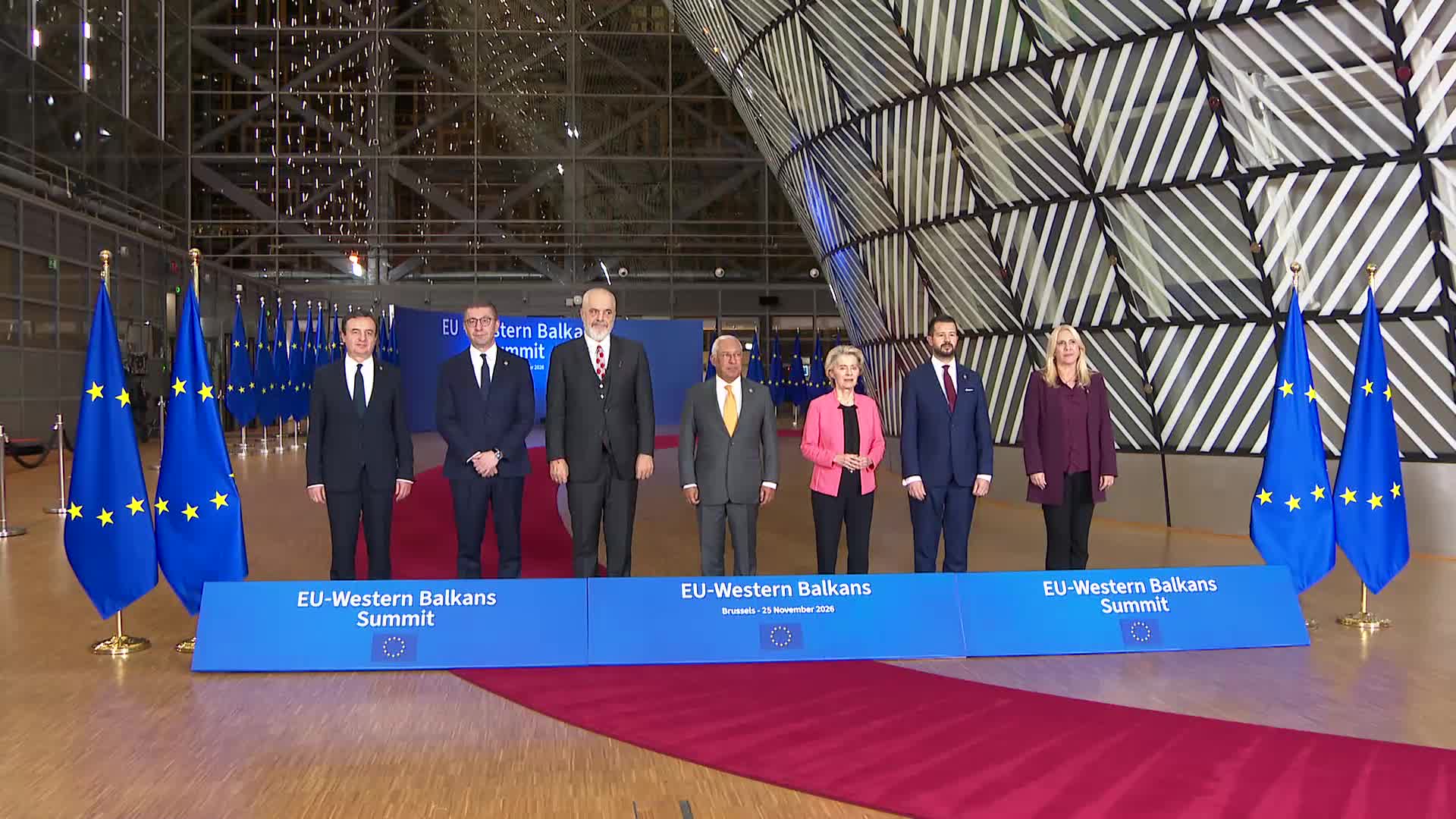
Brussels, 25 November 2026. Another European Union summit with the countries of the Western Balkans has concluded with familiar diplomatic language reaffirming the region’s European perspective, renewed support for enlargement, calls for reform and fresh pledges of gradual integration into the European Single Market.
Yet behind the diplomatic language, the carefully choreographed photographs and the meticulously crafted statements, one fundamental question remains: has Macedonia been given a clearer pathway towards full EU membership, or has it once again received confirmation that Europe’s door remains open, without any indication of when it might actually be allowed to cross the threshold?
This summit should not be analysed solely through the statements made by Macedonian Prime Minister Hristijan Mickoski.
Its significance is considerably broader.
It brings into focus an old but unresolved dilemma concerning the credibility of the European Union’s enlargement policy, the relationship between reforms and political conditionality, the equal treatment of candidate countries, and the EU’s ability to translate its own principles into a predictable and consistent policy.
For that reason, rather than settling for diplomatic rhetoric, it is necessary to examine the documents, the statements and the tangible outcomes.
The official Brussels Declaration of 25 November once again reaffirms the European perspective of the Western Balkans. Enlargement is presented as a geostrategic investment in Europe’s peace, security, stability and prosperity.
The document reiterates that each country advances on the basis of its own merits, achievements and fulfilment of the established criteria.
It emphasises the need for reforms in the rule of law, democratic institutions, fundamental rights, and the fight against corruption and organised crime.
Yet this is precisely where the most important analytical dilemma begins.
If progress is to be determined by individual merit, that merit must be measurable, verifiable and accompanied by clearly defined consequences within the accession process. European conditionality must not become unpredictable, nor should its criteria be transformed into a constantly shifting target.
The Declaration contains no specific date for Macedonia’s EU membership, nor does it announce a new decision to open negotiating chapters.
It reaffirms the political perspective, but does not resolve the institutional uncertainty surrounding Macedonia’s accession process.
That is the difference between reaffirming a European intention and establishing a concrete European pathway.
Brussels speaks of enlargement while simultaneously advancing the concept of gradual integration, designed to allow candidate countries to enjoy certain benefits of the Single Market even before full membership.
This process is conditional, merit-based and subject to the possibility of withdrawing benefits already granted.
Gradual integration can be a useful instrument.
However, it must not become a permanent substitute for membership. The European perspective cannot be reduced to economic approximation without the political and institutional completion of the accession process.
Europe must answer a fundamental question: is gradual integration a bridge towards membership, or does it risk becoming an indefinitely extended waiting room outside the Union?
MICKOSKI IN BRUSSELS: REFORMS AND THE QUESTION OF THE ACTION PLAN
Prime Minister Hristijan Mickoski’s intervention at the summit contained several substantive messages.
He maintained that Macedonia is among the leading performers in implementing the Reform Agenda and rejected the suggestion that Albania and Montenegro are ahead of his country in the European integration process. He grounded his position in the fulfilment of reform commitments rather than in political comparisons.
Of particular significance was his statement concerning the Action Plan on Minorities.
Mickoski reiterated that the Government is prepared to engage in dialogue, but insisted that this plan should be discussed before other issues are taken up.
According to his statement, the Government has already submitted a proposal and believes that an agreement remains possible, noting that 26 EU member states have no objection, while one has reservations.
This figure represents the Prime Minister’s account and should be understood as such, rather than treated as an independently verified position of all EU member states.
The most consequential part of his message was the hypothetical proposition that even if the constitutional amendments were adopted tomorrow, the question of the Action Plan would nevertheless remain unresolved.
With this statemen9t, Mickoski expanded the debate beyond the familiar formula of constitutional amendments, placing it within the broader context of future guarantees, monitoring mechanisms and the treatment of minority rights.
This requires serious legal and political scrutiny.
The protection of minority rights is a European value and a democratic obligation. It must never become a matter of political improvisation.
At the same time, minority-rights issues must be governed by clear standards, institutional mechanisms and principles applied equally to all.
The central issue, therefore, is not whether the Action Plan should be discussed.
It is its content, legal foundation, scope, implementation criteria and the guarantees that it will not become another open-ended condition without a clearly defined endpoint.
Macedonia has every right to demand predictability. The European Union has every right to insist on the fulfilment of commitments already undertaken.
These positions are not mutually exclusive, provided that a clear and legally grounded framework exists.
The most dangerous outcome would be for political mistrust to become a permanent condition in which every fulfilled obligation merely gives rise to another round of uncertainty.
BILATERAL AGREEMENTS AND THE EUROPEAN PRINCIPLE OF MERIT
In Brussels, the importance of good-neighbourly relations and the implementation of international agreements was once again reaffirmed.
The Declaration explicitly refers to the Prespa Agreement with Greece and the Treaty of Friendship, Good-Neighbourliness and Cooperation with Bulgaria, stressing that both should be implemented in good faith and translated into tangible results.
This is not an incidental diplomatic formulation.
It has direct implications for Macedonia’s accession process.
Mickoski, for his part, reiterated that the Government does not accept bilateral issues being allowed to obstruct full membership and that it remains willing to engage in dialogue, but not to see bilateral disputes turned into substitutes for European accession criteria.
An important distinction must be made here: international agreements constitute commitments, and their existence cannot simply be disregarded.
However, the European accession process must be governed by clear rules, objective benchmarks and institutional predictability.
The question is whether bilateral relations will be addressed within the framework of European principles and law, or whether they will continue to generate political blockages extending beyond the conventional accession criteria.
No country should be exempt from the obligations it has undertaken.
But neither should any candidate country be subjected to unlimited political uncertainty.
If the European Union wishes to preserve its credibility, it must demonstrate that the principle of merit is not merely declaratory language, but a genuine mechanism for decision-making.
ANTONIO COSTA: ENLARGEMENT IS NOT AN ILLUSION, BUT MEMBERSHIP IS NOT AUTOMATIC
One of the summit’s most significant political messages came from the President of the European Council, Antonio Costa.
His statement that enlargement represents a real opportunity that must be seized deserves particular attention.
Costa went beyond merely reiterating the general European perspective. He called on the region’s partners to maintain momentum and deliver the reforms necessary for membership.
His remarks on Montenegro and Albania were particularly significant.
According to Costa, the progress achieved by Montenegro and Albania demonstrates that accession to the European Union is not an illusion, but a genuine possibility for countries committed to the process.
He noted that work on drafting Montenegro’s accession treaty had begun during the course of this year, marking the first such step in more than a decade, while Albania had begun closing negotiating chapters.
This is a politically important message for Macedonia as well.
It demonstrates that enlargement is once again acquiring tangible momentum, but also that the accession process does not unfold identically for every country.
Montenegro and Albania are advancing within their respective negotiating frameworks, while Macedonia continues to face the political and institutional obstacle associated with constitutional amendments.
Costa also conveyed another essential message: the road to the European Union is not determined by reforms alone.
Regional cooperation, reconciliation and good-neighbourly relations are essential prerequisites for accession.
He called for overcoming challenges rooted in the past and turning towards the future.
This is precisely where a question arises that must also be asked in defence of Macedonia’s European interests: how can good-neighbourly relations be built without allowing history to become an endless political obstacle? How can reconciliation be a genuinely two-way process rather than a one-sided obligation? And how can the principle of individual merit be preserved when bilateral disputes are capable of influencing the accession process?
Costa portrayed the European Union as the region’s most reliable partner and pledged that it would remain so.
But partnership is not demonstrated through diplomatic statements alone.
It is demonstrated through consistency, predictability and institutional decisions.
The European Union cannot simultaneously demand that candidate countries trust the principle of merit while failing to provide sufficiently clear mechanisms for putting that principle into practice.
URSULA VON DER LEYEN AND €338 MILLION: A TANGIBLE OPPORTUNITY, NOT A FINAL DISBURSEMENT
One of the summit’s most concrete financial announcements came from the President of the European Commission, Ursula von der Leyen.
She announced that implementation of the reform steps under the Growth Plan had increased from 38 per cent in the previous year to 63 per cent at the time of the summit.
According to her statement, this progress could make an additional €338 million available to Albania, Montenegro and Macedonia in the coming weeks.
This is a significant financial announcement, but it must be interpreted precisely.
It concerns the possibility of releasing additional funds, not a final disbursement decision that has already been adopted.
At the time of the announcement, no definitive country-by-country allocation had been disclosed, nor had the complete breakdown between grants and loans been specified.
It is also important to understand that the 63 per cent figure refers to the fulfilment of reform steps that had fallen due among the partners under the Growth Plan. It is not an individual assessment of Macedonia alone.
The funds form part of the existing financial mechanism under the Growth Plan; they do not constitute a new financial package outside its established framework.
Nevertheless, the announcement carries broader political significance.
The European Commission is sending a message that fulfilling reform commitments can produce tangible financial benefits.
For Macedonia, this represents an opportunity to secure additional support for reforms and investment, but also an obligation to demonstrate that these resources will be translated into results that citizens can actually experience.
Financial assistance is no substitute for membership, just as a Reform Agenda is no substitute for the rule of law.
It is not enough for funds to be approved.
What matters is how they are spent, who oversees their implementation, which projects they finance and what concrete benefits they deliver to citizens.
Von der Leyen also highlighted the practical benefits of gradual integration.
Four Western Balkan partners are already part of the Single Euro Payments Area (SEPA), enabling faster and cheaper transfers.
She also announced that discussions had begun on extending the principle of “Roam Like at Home” to Albania, Montenegro, Macedonia and Kosovo.
The announcement that dialogue on gradual integration with each partner is expected to begin in early 2027 provides a further indication that Brussels intends to bring the region’s economies closer to the Single Market even before full membership.
Yet this is precisely where a clear distinction must be maintained: economic integration is a benefit, but it must never become a political substitute for membership.
ALBANIA AND MONTENEGRO: DIFFERENT SPEEDS OF EUROPEAN ACCESSION
Costa and von der Leyen placed particular emphasis on Albania and Montenegro.
Montenegro was presented as approaching the final stages of negotiations, with preparations for its accession treaty under way.
Albania was highlighted for the opening and closing of negotiating chapters and its accelerated pace of progress.
These are concrete accession indicators that should not be overlooked.
However, neither should they be used as a political substitute for a serious assessment of Macedonia’s position.
Every country has its own reform trajectory, its own obligations and its own political obstacles.
Mickoski is entitled to insist that Macedonia’s reform achievements be properly recognised. However, the Government must substantiate those achievements with concrete indicators and independently verifiable evidence.
European institutions, in turn, have an obligation to explain clearly how each country’s progress is assessed and precisely what follows once specific conditions have been fulfilled.
The comparison with Albania and Montenegro should serve as an incentive for faster reforms, not as a source of political self-defence or mutual recrimination.
Macedonia should not compete through statements.
It should compete through results.
ALBIN KURTI: KOSOVO SEEKS RECOGNITION OF ITS EUROPEAN PERSPECTIVE
The regional picture would be incomplete without considering the intervention of Kosovo’s Prime Minister, Albin Kurti.
Upon arriving at the Brussels summit, Kurti once again called for Kosovo to be granted candidate status for European Union membership.
He noted that December would mark four years since Kosovo submitted its application and argued that the process had been delayed for far too long.
His assertion that Kosovo is not seeking privileges, but recognition of the progress it has achieved, raises the same fundamental dilemma that confronts Macedonia’s accession process: the relationship between meeting the criteria and overcoming political obstacles.
However, the two situations are not identical.
Kosovo has yet to obtain candidate status and faces a specific difficulty: five EU member states do not recognise its independence.
Macedonia, by contrast, already holds candidate status but faces a blockage linked to constitutional amendments and the bilateral context.
Kurti also warned that electoral cycles in European countries could affect the pace of enlargement.
In his view, the existing political momentum should be used, because the European window of opportunity cannot be assumed to remain open indefinitely.
This is an important geopolitical observation.
The European Union is confronting the war in Ukraine, security challenges, economic competition and its own institutional preparations for enlargement.
Under these circumstances, the Western Balkans cannot treat its European perspective as something that will automatically materialise.
But neither can the European Union allow political cycles and internal disagreements to become permanent excuses for postponing the process.
SERBIA: ABSENCE AND NON-ALIGNMENT WITH THE DECLARATION
Particular attention should also be paid to the fact that Serbia was not represented at the summit at the level of regional leaders.
According to published reports, the institutional transition in Belgrade and the formation of a new parliamentary majority were cited as reasons for the absence of a Serbian representative.
However, there is another important fact: a footnote to the official Brussels Declaration states that Serbia did not align itself with the document.
This is not an insignificant diplomatic detail.
The Declaration contains messages concerning alignment with the European Union’s Common Foreign and Security Policy, regional cooperation, the Belgrade–Pristina dialogue and respect for international law.
Serbia’s absence and its non-alignment with the Declaration demonstrate that European integration in the region is not merely a matter of economic interests and reforms, but also of strategic orientation.
The normalisation of relations between Belgrade and Pristina remains an especially sensitive issue.
The European Union once again emphasised that the lack of normalisation is obstructing the European paths of both partners and called for constructive engagement in the dialogue and the full implementation of agreements already reached.
Brussels is therefore sending a clear message: regional stability is not a secondary concern, but an integral part of the European perspective.
EUROPE IS PREPARING FOR ENLARGEMENT, BUT THE WESTERN BALKANS MUST KNOW WHAT IT IS BEING OFFERED
In her remarks following the summit, von der Leyen spoke about the strategic necessity of enlargement and the need for the European Union to prepare its institutions, policies and budget for the admission of new members.
This is an important part of the broader picture.
Enlargement is not solely a question of the readiness of candidate countries.
It is also a question of the Union’s own readiness.
Europe must determine how it will function with additional members, how it will finance its new commitments, how it will preserve institutional effectiveness and political cohesion, and how it will reconcile its internal reforms with the geopolitical imperative of enlargement.
Yet another danger emerges here: if the Union’s internal preparations are not governed by a clear timetable, candidate countries may find themselves trapped in a prolonged process of approximation, with no certainty as to when it will be completed.
Gradual integration, access to the Single Market, SEPA, regional connectivity and the facilitation of trade are tangible benefits.
But they are not equivalent to full membership.
Citizens are not asking merely for cheaper transactions and easier travel.
They are asking for legal certainty, institutional stability, economic opportunities and an equal chance to live and work within Europe’s political and economic space.
Europe must demonstrate that enlargement is not merely a geopolitical necessity activated whenever a crisis emerges, but a long-term strategy governed by clear rules and predictable steps.
WHAT SHOULD MACEDONIA DO AFTER BRUSSELS?
Following the conclusion of the summit, Macedonia must not remain trapped in competing political interpretations of who was right, who received more attention or who delivered the stronger message.
What is needed are concrete answers and concrete action.
First, the Government should publish and explain the substance of its proposed Action Plan on Minorities, supported by clear legal arguments and institutional safeguards.
Second, a regular, publicly accessible and independently verifiable assessment of the implementation of the Reform Agenda should be provided, with specific indicators, deadlines and clearly identified responsible institutions.
Third, every form of financial assistance from the European Union should be subject to transparent allocation and public oversight.
Fourth, diplomatic engagement must continue with all European institutions and member states, rather than being reduced to occasional political meetings and public statements.
Fifth, Macedonia should demand a clear European methodology specifying what follows once particular conditions have been fulfilled. The country needs a predictable process, not an endless repetition of political declarations.
Sixth, judicial reforms, the fight against corruption and the effective functioning of institutions must continue regardless of the pace of accession negotiations. This is an obligation to the country’s own citizens.
This is not a question of political allegiance to one government or another.
It is a question of national responsibility.
Governments change. National interests endure.
EUROPE’S FUTURE IS NOT MEASURED IN PHOTOGRAPHS, BUT IN RESULTS
The Brussels Summit of 25 November did not produce a new date for Macedonia’s EU membership.
Nor did it result in a final decision on the additional €338 million.
It did not resolve the question of the Action Plan, nor did it remove the political uncertainty surrounding bilateral issues.
However, it delivered important signals: the European Union once again reaffirmed the European perspective of the region, emphasised the need for reforms and announced the possibility of additional financial support.
Costa reaffirmed the reality of the European perspective and underscored the necessity of reforms, reconciliation and good-neighbourly relations.
Von der Leyen highlighted the strategic importance of enlargement, gradual integration and the possibility of additional financial resources.
Kurti raised the issue of Kosovo’s candidate status and warned that political momentum cannot be taken for granted.
Serbia’s absence and its non-alignment with the Declaration revealed the wider complexity of the regional picture.
Mickoski reiterated the Government’s position on reforms, bilateral issues and the Action Plan on Minorities.
The real test now begins.
For the Macedonian Government, the question is whether it can translate its political positions into verifiable institutional results.
For the European Union, the question is whether it will apply the principle of individual merit consistently, fairly and predictably.
For citizens, the question is whether all these processes will finally produce better institutions, a stronger economy, a more effective judiciary and greater confidence in the future.
There must be no double standards.
CONCLUSION: MACEDONIA IS NOT ASKING FOR FAVOURABLE TREATMENT, BUT FOR A FAIR PROCESS
Macedonia’s European future cannot be held hostage to day-to-day politics, nor subjected to endless negotiations without clear rules and deadlines.
At the same time, the European perspective cannot serve as an excuse for postponing domestic reforms, tolerating institutional weaknesses or avoiding accountability.
Macedonia must deliver results.
Brussels must deliver predictability.
These are two sides of the same European obligation.
No country can demand membership without fulfilling the established criteria.
But no European institution can expect lasting trust if the rules are not applied consistently and political declarations are not translated into concrete decisions.
As the German philosopher Immanuel Kant observed in his essay An Answer to the Question: What Is Enlightenment?:
“Have the courage to use your own understanding.”
Macedonia needs precisely that courage: the courage to defend its legitimate interests, fulfil its obligations and refuse to replace national strategy with the shifting impulses of day-to-day politics.
Europe, in turn, needs the courage to demonstrate that its principles apply equally to everyone.
History does not remember only the promises made around diplomatic tables.
It remembers the decisions that changed the destiny of nations.
“Macedonia is not asking for a European privilege. It is asking for European principles. It is not asking for the criteria to be circumvented. It is asking for criteria that are clear, fair and equal. It is not seeking membership without obligations. It is demanding that those obligations lead to membership, rather than to yet another cycle of uncertainty.”
Europe must decide whether it regards the Western Balkans as part of its future or merely as a permanent political responsibility.
Macedonia, for its part, must demonstrate that its European future is defended not through words alone, but through institutions, knowledge, hard work, dignity and statesmanship.
For membership in the European Union is a political objective, but Macedonia’s dignity is an enduring national responsibility.
Europe is a choice about the future. Macedonia is a responsibility in the present. And justice is the standard by which both will ultimately be judged.
Slobodan Tomic, MA
Political Analyst and Publicist
Author of the political television programme The Voice of the People
