

By Slobodan TOMIC

On November 27, 2026, Ohrid was more than the host city of another regional political gathering.
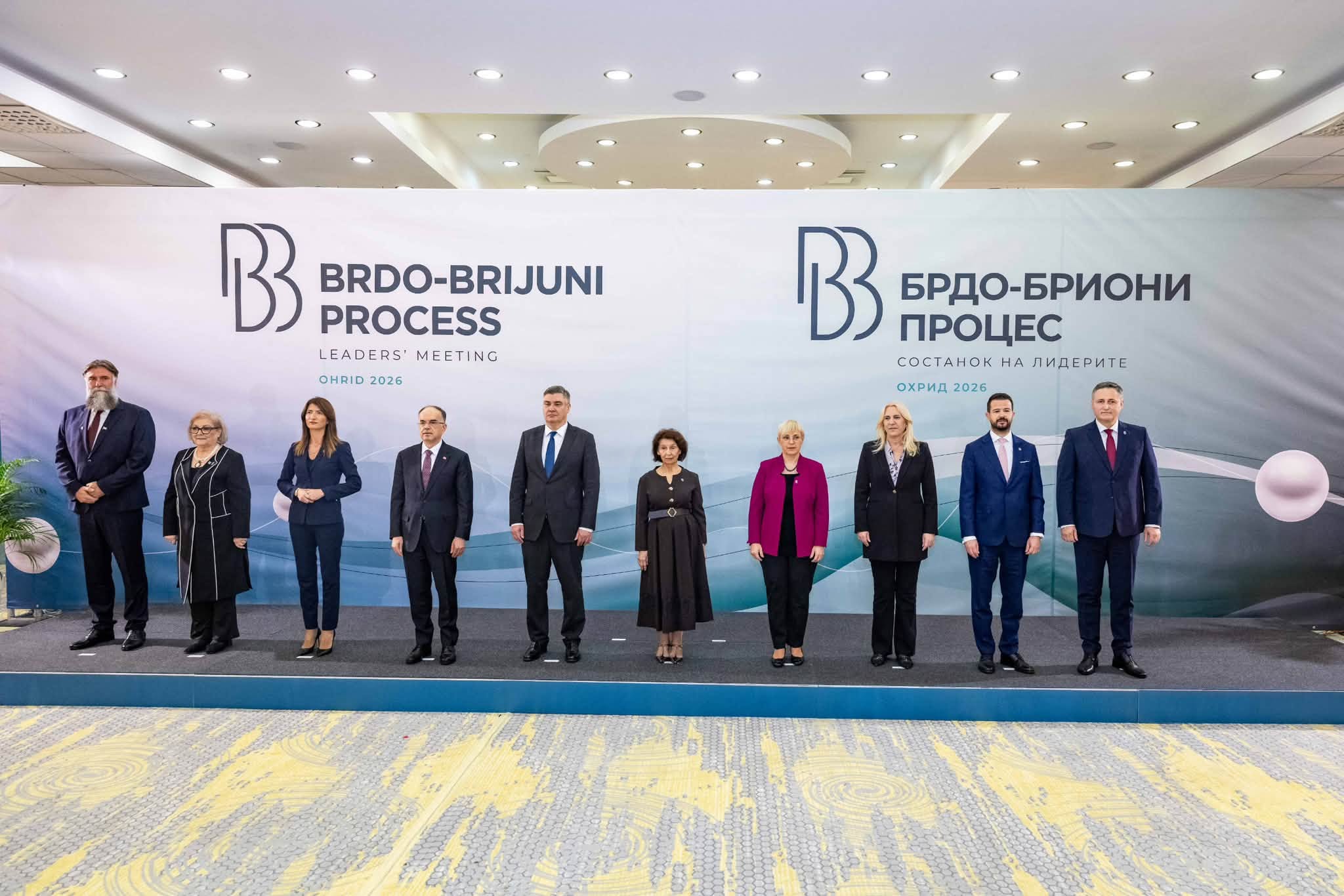
On the shores of the lake, in a city that for centuries has borne witness to the conflicts, upheavals and historic turning points of this part of Europe, the presidents of the countries of the region convened under the Brdo-Brijuni Process. Yet behind the diplomatic handshakes, carefully orchestrated photographs and meticulously calibrated statements, a far more consequential question emerged: what is the value of a European future if the European Union itself cannot guarantee the credibility of its own rules?
The summit, hosted by President Gordana Siljanovska-Davkova and co-organised by the presidents of Slovenia and Croatia, Nataša Pirc Musar and Zoran Milanović, placed the region’s European future at the centre of the discussions.
Representatives of Albania, Bosnia and Herzegovina, Kosovo, Montenegro and Serbia attended, alongside the host and co-organising countries.
It was the fifteenth summit of the process, which has brought regional leaders together at presidential level on a regular basis since 2013.
The real significance of this gathering, however, cannot be measured by the number of participants or the diplomatic protocol surrounding it.
Its importance lies in a question that has long troubled Macedonian society and is increasingly becoming a test of Europe’s own credibility: can a country that fulfils the political, economic and democratic requirements advance on the basis of its achievements, or will its future remain hostage to bilateral disputes and the political preferences of a neighbouring capital?
It was precisely against this backdrop that President Siljanovska-Davkova’s intervention acquired particular political significance.
SILJANOVSKA-DAVKOVA: EUROPEAN RULES MUST APPLY TO MACEDONIA, TOO
Siljanovska-Davkova articulated the essence of Macedonia’s position: bilateral disputes must not become a substitute for European accession criteria, nor should they transform enlargement into an endless political bargaining process over issues that fall outside the substance of the Copenhagen criteria.
This is not merely a Macedonian objection.
It is a matter of principle.
The Copenhagen criteria form the foundation of the European Union’s enlargement policy: stable democratic institutions, the rule of law, respect for human rights and the rights of minorities, a functioning market economy, and the capacity to assume the obligations arising from membership.
They exist to ensure an objective and predictable accession process. When additional political demands relating to historical interpretations, questions of identity or bilateral readings of the past are superimposed on that framework, the very nature of European enlargement is put at risk.
Macedonia is not asking for preferential treatment.
It is not asking anyone to overlook the reforms it still needs to implement.
Nor is it asking for membership to be handed to it as a gift. It is asking for something far more straightforward, yet fundamentally important: to be assessed according to the same rules that apply to every other candidate country.
That distinction encapsulates the entire political substance of Macedonia’s position.
In her public remarks, the president did not ask Slovenia and Croatia to take sides against Bulgaria. Rather, she called for their assistance in removing the issue from the bilateral arena and bringing it back within the framework of European principles. That is a significant distinction.
Macedonia does not need patrons prepared to confront its neighbours on its behalf. It needs European partners willing to help establish a fair, transparent and predictable process.
In 2025, the European Parliament, in one of its resolutions, reiterated that the accession process should not be used to settle bilateral disputes or obstruct progress based on merit and objective criteria.
That does not absolve Macedonia of its obligation to implement the commitments it has undertaken. It does, however, reaffirm the central dilemma: European integration must not become a mechanism for imposing limitless bilateral conditionality.
Herein lies the greatest paradox.
For decades, Macedonia has pursued its European future. Yet instead of discussing the next stages of integration, economic development, institutional modernisation and improving the quality of life, the country is repeatedly forced back to issues that should have been overcome through political maturity and sound European judgement.
Europe must understand that credibility cannot be demanded through declarations.
It must be earned through consistency.
PIRC MUSAR: MACEDONIA HAS WAITED TOO LONG
The message delivered by Slovenia’s President, Nataša Pirc Musar, was particularly significant. She spoke openly about the slow pace of enlargement and the fact that Europe cannot claim to be strong while leaving the region outside its institutional and political framework.
Her remarks on Macedonia carried both a human and a political dimension. She pointed out that Macedonia’s case is particularly disappointing: a country that overcame a longstanding dispute with Greece, made far-reaching political concessions and expected its European path to open, only to encounter another obstacle, this time in its relations with Bulgaria.
This was not an insignificant statement.
It came from the president of an EU member state that understands the region’s history and recognises the consequences of indefinitely postponing integration.
Pirc Musar emphasised the importance of reforms, regional cooperation and a credible enlargement process.
Yet the word credible is the key.
Citizens cannot reasonably be expected to believe in a process whose destination keeps shifting before their eyes.
Macedonian citizens are not tired of Europe as a civilisational, political and economic idea. They are tired of waiting without a clear end in sight, of promises without tangible results, and of the persistent feeling that every fulfilled obligation may simply be replaced by another demand.
When a country has held candidate status for two decades and still cannot begin the substantive opening of its negotiating chapters, the question is no longer simply what the candidate country must do.
The question is also what the Union is doing to preserve its own credibility.
MILANOVIĆ AND A EUROPE THAT MUST KNOW WHAT IT WANTS TO BE
Croatian President Zoran Milanović introduced a different, but equally important, tone into the discussion. He supported the European perspective of all countries in the region while raising a fundamental question about the future of the European Union itself.
His criticism centred on the danger of the Union evolving into a dysfunctional empire in which certain member states exercise disproportionate influence over collective decisions.
He also questioned whether the EU could realistically become a genuine geopolitical and military power without overcoming its own institutional and political fragmentation.
This is a serious issue.
Europe increasingly seeks to position itself as a global political actor. Yet its ability to make timely, collective decisions is frequently constrained by competing interests among its member states.
The Union possesses enormous economic potential, powerful institutions and considerable diplomatic influence. What it does not always possess is a unified political will.
Milanović described this as one of the most constructive and pleasant summits he had attended, despite the absence of concrete decisions.
That observation also points to one of the weaknesses of regional diplomacy: dialogue matters, but its real value is ultimately measured by the results it delivers.
Mutual respect in dialogue is indispensable.
But the region needs more than carefully crafted words.
It needs tangible infrastructure projects, energy interconnections, economic cooperation, improved transport networks and conditions that give young people a reason to build their future at home rather than abroad.
BRUSSELS AND THE QUESTION OF EUROPEAN PRIORITIES
The Ohrid summit took place amid profound geopolitical turbulence.
Russia’s aggression against Ukraine, mounting security challenges, wars and crises in Europe’s wider neighbourhood, and intensifying competition among the major powers have confronted the European Union with exceptionally difficult choices.
Support for Ukraine is a matter of European security, international law and the defence of the sovereignty of a country subjected to aggression.
Nevertheless, it is entirely legitimate to raise questions about the long-term financial sustainability of that support, the distribution of the burden among member states and the responsibility owed to European taxpayers.
European citizens have the right to know how their money is being spent, what the long-term consequences of financial commitments may be, and whether the Union has sufficient political and economic capacity to address the war, its own internal challenges and enlargement simultaneously.
Support for Ukraine and Ukraine’s accession to the European Union are not the same issue. Financial and military assistance do not automatically confer membership. Accession remains a separate process, governed by its own conditions and reform requirements.
Precisely for that reason, Brussels must demonstrate that it has a coherent strategy for Ukraine as well as for the countries of our region.
Enlargement cannot be elevated to a major geopolitical priority whenever it serves the immediate needs of European policy, only to be returned afterwards to an indefinite bureaucratic waiting room.
The latest declaration adopted at the EU–Western Balkans summit in Brussels on November 25, 2026, once again reaffirmed the region’s European perspective, describing enlargement as a geostrategic investment in Europe’s peace, security, stability and prosperity.
The same document calls on the partners to pursue reforms while stressing that the European Union itself must prepare for a larger membership.
In other words, the obligations do not rest solely with candidate countries.
The Union has work of its own to do.
This brings us directly to the question of political responsibility in Brussels and that of European Commission President Ursula von der Leyen.
The European Union must demonstrate that it can pursue several strategic priorities simultaneously without relegating one to the margins in order to accommodate another.
Europe must not lose sight of its own future while attempting to respond to every crisis of the present.
THE MESSAGE FROM MICKOSKI AND MACEDONIA’S NEGOTIATING POSITION
The political context of the Ohrid summit must also be viewed in light of the position taken by Prime Minister Hristijan Mickoski, who, in Brussels immediately before the gathering, once again underlined Macedonia’s readiness to implement reforms while making clear that the country cannot accept an endless succession of new conditions concerning national and identity-related issues.
Here, an important distinction must be drawn between reform obligations and the specific negotiating framework that has already been adopted.
The constitutional amendments form part of the 2022 compromise and the conditions for advancing the accession negotiations.
That is a political reality that cannot simply be erased by a statement.
Yet it is entirely legitimate to ask whether that compromise genuinely provides finality and predictability, or whether it leaves the door open to further political interpretations and additional demands in the future.
Macedonia has an obligation to implement reforms. The rule of law, judicial independence, the fight against corruption, a professional public administration, economic competitiveness and effective institutions must not be made contingent on the dispute with Bulgaria.
These are obligations owed to Macedonia’s own citizens, not services performed for Brussels.
At the same time, Macedonia has every right to seek assurances that its European integration will not remain hostage to disputes without a clearly defined endpoint.
This is where consistency in state policy becomes essential.
It is not enough for one government to adopt a position only for the next to change it according to the demands of day-to-day politics.
Nor is it sufficient for the opposition to criticise without offering a sustainable alternative strategy.
What is needed is a national consensus on the country’s fundamental interests, with a clear distinction between obligations already accepted within the European framework and demands that must not become a source of perpetual political conditionality.
Supporting European integration does not mean surrendering the right to think critically.
On the contrary, genuine partnership presupposes the right to disagree.
BULGARIA WAS ABSENT FROM OHRID, BUT THE QUESTION REMAINED
One important detail of the summit should not go unnoticed: Bulgaria was not among the participants listed in the officially announced composition of the gathering, even though the bilateral dispute with Sofia directly affects Macedonia’s European path.
This is not to suggest that every regional summit must include every neighbouring country.
But when the principal subject is the European future of the region, and one of the greatest obstacles to Macedonia’s progress is precisely its bilateral dispute with Bulgaria, a natural question arises: where is the active political initiative to overcome that dispute?
Where is the European initiative capable of offering a clear path towards mutual trust, respect and fulfilment of the commitments undertaken by both sides?
Macedonia brought to a close its dispute with Greece, which had blocked its path for years.
It was a difficult political process, with profound consequences for the state and for the sentiments of a substantial part of its population.
Yet instead of that compromise being followed by a predictable opening of the European perspective, another set of conditions emerged.
This creates a dangerous impression: that every concession does not bring a dispute to an end, but merely opens the way to the next one.
Such a situation serves neither Macedonia, nor Bulgaria, nor the European Union.
Good-neighbourly relations cannot be built on permanent mistrust, nor can history be turned into an instrument of political conditionality.
They must be built on respect for contemporary European standards, the protection of rights and a clear distinction between bilateral dialogue and the accession process.
SERBIA, ČUPIĆ AND THE MESSAGE BEHIND THE UNSIGNED DECLARATION
Serbia’s participation in the summit also deserves particular attention.
Serbia was represented by Aleksandar Čupić, acting president and Speaker of the National Assembly. He did not sign the joint declaration, explaining that he lacked the appropriate mandate and legitimacy to do so.
According to the explanation provided by Macedonia’s president, however, he agreed with the principles set out in the document.
This detail must be interpreted carefully.
The decision not to sign should not automatically be portrayed as a rejection of every position contained in the declaration. Equally, agreement with its principles should not be mistaken for full political endorsement of the document.
Nevertheless, the fact that one participant declined to sign the joint declaration underscores the importance of every country having a clear institutional mandate and accepting political responsibility for the positions it adopts.
Serbia is too important to regional stability for its domestic political developments to be viewed with indifference.
Its economic weight, geographical position and influence on regional relations are beyond dispute.
But economic development cannot substitute for democratic standards, just as geopolitical importance cannot justify the weakening of institutions, restrictions on media freedom or insufficient political accountability.
Every leader in the region must be judged by the same standards.
That applies to Skopje, Belgrade, Sarajevo, Tirana, Podgorica and Pristina.
Democracy cannot be a requirement for some and a privilege for others.
Regional stability means more than the absence of conflict. It requires institutions citizens can trust, genuine political competition, free media and the rule of law.
Macedonia and Serbia share a long tradition of good-neighbourly relations. Those relations should be strengthened through economic cooperation, transport, culture, education and mutual respect.
As was also emphasised at the summit, there is no reason for unresolved issues to become obstacles where the conditions for normal cooperation already exist.
THE REGION IS NOT EUROPE’S PERIPHERY
The term Western Balkans has long been part of Europe’s political vocabulary.
But it must never become a geographical or political label for some second-tier European space, a region permanently required to prove that it deserves to belong to the continent of which it is already an integral part.
These countries are not outside Europe.
They are part of its geography, history, culture and security environment.
Their stability is European stability. Their economic development contributes to Europe’s economic potential. Their political future directly affects the continent’s security and geopolitical standing.
When a young person from Macedonia, Serbia, Albania or Bosnia and Herzegovina leaves in search of a better life, it is not merely a personal decision.
It is also a consequence of conditions at home and of the wider political and economic framework in which the region has been trapped for far too long.
That is why the discussions on young people, employment, transport and energy connectivity, digital infrastructure and regional cooperation were particularly important.
These are issues that shape the everyday lives of citizens.
The European perspective cannot remain a political formula repeated in presidential speeches.
It must be reflected in jobs, wages, education, healthcare, roads, investment and legal certainty.
A Europe unable to offer a credible future to its immediate neighbourhood risks leaving room for other geopolitical powers.
That is not a threat. It is a reality of international relations.
A vacuum never remains empty.
OHRID’S SYMBOLISM AND MACEDONIA’S RESPONSIBILITY
Ohrid occupies a special place in Macedonia’s history and in Europe’s cultural memory.
A city of spirituality, literacy and centuries of civilisational connections, it was an appropriate setting for a discussion about the region’s European future.
But hosting a summit of this importance also carries responsibility.
Macedonia must not reduce its European policy to a reaction to the moves of its neighbours or to waiting for outsiders to resolve its problems.
Our country must demonstrate that it knows what it wants, that its institutions function effectively and that reforms are pursued not merely to satisfy the reporting requirements of the European Commission.
The fight against corruption must be genuine.
The judiciary must be independent.
The public administration must serve citizens rather than party headquarters.
Education and healthcare require long-term strategies.
The economy must create opportunities for young people and for everyone who wants to build a future in their own country.
That is the part of the European story for which responsibility rests exclusively with us.
The government has both the mandate and the obligation to implement reforms. The opposition has the right and the duty to hold the government accountable.
But national interests must never become the subject of endless partisan manoeuvring.
When the dignity of the state, European integration and the predictability of the accession process are at stake, a broader degree of political maturity is indispensable.
State strategy must not be confused with party propaganda.
Supporting the government’s position when it protects the national interest is one thing. Abandoning critical scrutiny of its shortcomings is quite another.
Macedonia needs a responsible government, a constructive opposition and citizens unwilling to accept either domestic injustice or external conditionality without a clear legal and political foundation.
EUROPE MUST RE-EXAMINE ITSELF
The European Union is a historic project that brought peace, cooperation and economic progress to a continent once devastated by wars and national conflicts.
Its significance must not be underestimated.
But no institution, however historically important, is exempt from the obligation to examine itself.
Today’s Europe faces questions that cannot be resolved through bureaucratic procedures and political declarations alone.
How will it preserve its economic competitiveness?
How will it ensure energy security?
How will it protect its citizens against security threats?
How will it maintain social cohesion?
How will it make decisions within a Union of an ever-growing number of member states, each with its own national interests?
And, ultimately, how will it enlarge its membership without undermining its own capacity to function?
These are questions that demand substantive reform, not cosmetic adjustments.
Europe cannot demand consistency from Macedonia while remaining inconsistent itself.
It cannot insist on the rule of law while allowing political disagreements to override the logic of objective criteria.
It cannot speak of equality while creating the impression that the rules depend on the size, influence or immediate political interests of a particular member state.
The German philosopher Immanuel Kant, in his reflections on perpetual peace, emphasised that international relations must be founded on law rather than on the arbitrary will of the more powerful.
That principle remains profoundly relevant to contemporary politics.
Rules have meaning only when they apply equally to everyone.
And this brings us back to Ohrid.
The Brdo-Brijuni summit did not produce a historic agreement capable of resolving all the region’s problems overnight.
But it opened a space for dialogue that must not end with the final press conference.
Its value will ultimately be measured by whether it leads to concrete initiatives, stronger political engagement in support of a fair enlargement process and deeper regional cooperation.
Macedonia needs Europe.
But Europe needs Macedonia and the entire region, too.
Not merely because of geography, but because of security, economic potential, human resources and a shared future.
Ohrid should therefore serve as a reminder that European integration is not a favour bestowed by someone else. It is a political process founded on commitments, rules and mutual trust.
Ultimately, the question is not whether Macedonia belongs in Europe.
The question is whether Europe will remain faithful to the values upon which it was founded.
We are not asking Europe to change its rules for Macedonia.
We are asking it not to change those rules when Macedonia is concerned.
That was the essential message from Ohrid.
And it must not remain merely another entry in the minutes of a summit.
