

(Inspired by the wisdom of Petre M. Andreevski:
“When a nation begins to bargain with its own name, it loses not only its state, but its soul.”)
By: Slobodan Tomic

Slobodan Tomic
Macedonia was not destroyed overnight.
It was not ruined by one government alone. It was not betrayed by one agreement alone. And it was not weakened by one politician alone.
What happened to the Macedonian people over the last three decades was a systematic process of political, economic and identity dismantling of the state itself.
While the people were divided through party propaganda, ideological manipulation, “colorful revolutions,” endless compromises and promises of a so-called “European future,” Macedonia was economically bleeding.
Today, this is no longer only a matter of suspicion.
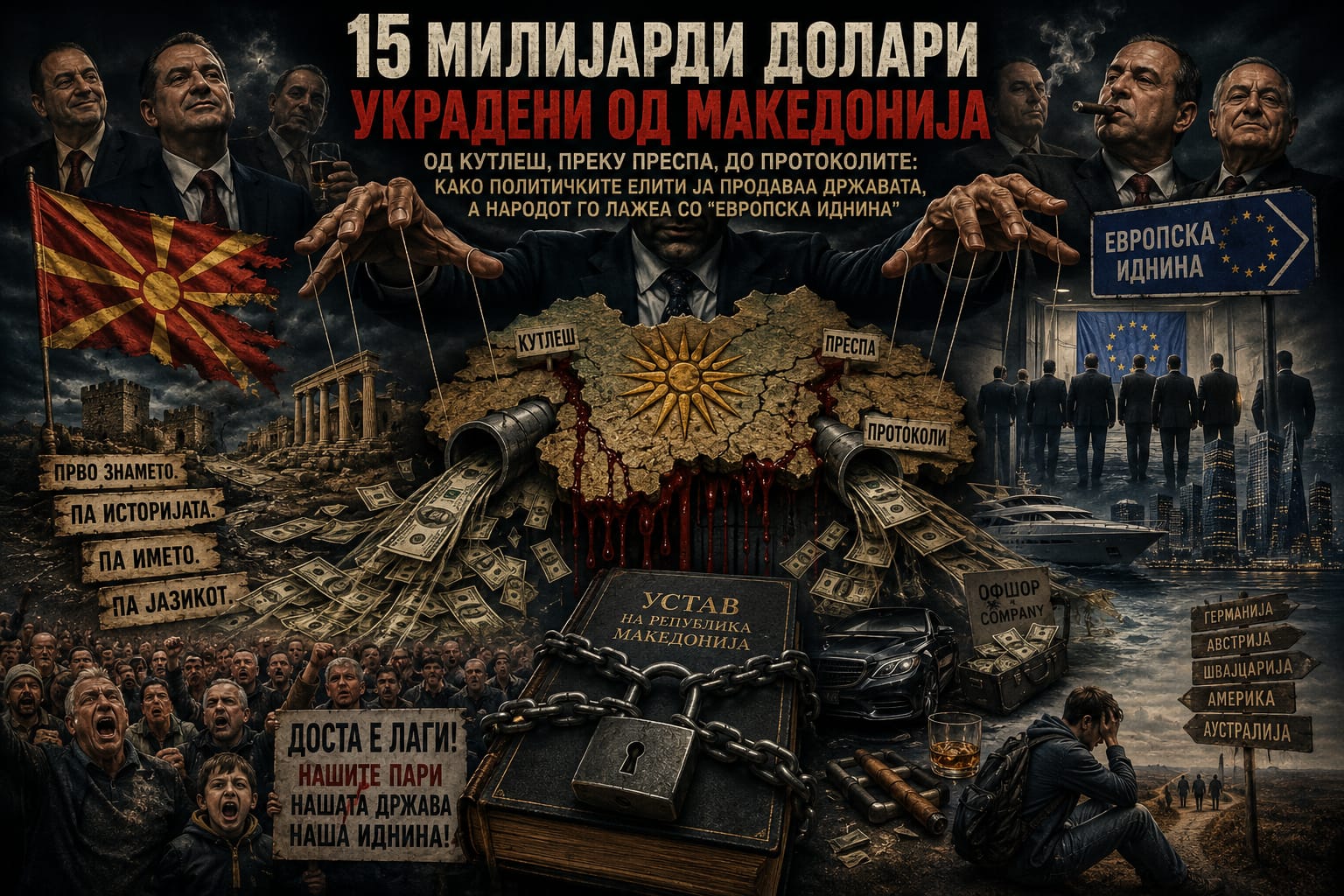
According to estimates and analyses concerning Illicit Financial Flows (IFFs), between 13 and 16 billion US dollars left Macedonia illegally during the period from 2001 to 2025.
Yes — billions.
Not party money.
Not private money. These were the people’s resources, the money of workers, farmers, pensioners, struggling families and young generations who were forced to leave the country because their future was stolen.
THE GREATEST THEFT IN MACEDONIA WAS NOT ONLY FINANCIAL — IT WAS NATIONAL
Because while billions disappeared from Macedonia, something even more dangerous was disappearing together with them: national confidence, historical continuity and faith in the state itself.
Everything began in the early 1990s.
At the very moment Macedonia became independent, powerful pressures emerged demanding that the country abandon its own national symbols in order to survive internationally.
The first target was the Kutlesh flag, the sixteen-rayed golden sun on a red background.
That flag was not merely a state symbol. It represented historical continuity, identity and civilizational memory.
But precisely that continuity disturbed those who wanted Macedonia to become a state without roots, without historical confidence and without resistance.
And so the language of “compromise” began.
Compromise for survival. Compromise for stability. Compromise for Europe.
But the Macedonian people gradually realized that every compromise only produced another demand.
FIRST THE FLAG. THEN HISTORY. THEN THE NAME. THEN THE LANGUAGE.
This was not accidental.
It was the slow construction of a psychology of surrender.
The Macedonian people were expected to accept that everything connected to their identity could become negotiable.
And while society was trapped in endless identity disputes, powerful political-business networks were growing behind the scenes.
WHERE DID THE MACEDONIAN BILLIONS GO?
This is the question that frightens many people even today.
Because money does not disappear by itself.
Someone transfers it. Someone signs the contracts. Someone approves the schemes. Someone protects the system.
According to analyses concerning illicit financial flows, enormous sums left Macedonia through fake invoicing, corruption networks, offshore structures, tax evasion, money laundering channels and politically protected business operations.
And that is why Macedonia today faces a tragic paradox:
A country permanently sinking into debt while billions simultaneously disappear abroad.
PRESPA BECAME THE SYMBOL OF A STATE READY TO TRADE EVERYTHING
For many Macedonians, the Prespa Agreement represented more than a diplomatic compromise.
It represented the moment when people began to feel that absolutely everything could become negotiable:
The name. The identity. The historical narrative. Even the language itself.
And after Prespa came the protocols, the new demands, the new conditions and the permanent pressure upon Macedonia to constantly justify its own existence.
WHILE THE PEOPLE WERE FIGHTING EACH OTHER — THE ELITES WERE GETTING RICHER
This is perhaps the greatest tragedy of all.
Ordinary citizens were divided politically and emotionally. Families argued. Society became polarized.
Meanwhile, billions were leaving the country.
Money that should have built factories. Money that should have modernized infrastructure. Money that should have kept young people inside Macedonia. Money that should have created a strong national economy.
Instead, much of it allegedly ended in foreign banks, offshore destinations and criminal financial channels.
THAT IS WHY PEOPLE NO LONGER BELIEVE IN FALSE MORALISM
You cannot participate in a system that impoverished Macedonia for decades and then suddenly present yourself as the defender of morality, democracy and European values.
You cannot speak about “progress” while entire generations abandon the country.
You cannot demand sacrifices from ordinary citizens while nobody answers for the billions that disappeared.
MACEDONIA CANNOT SURVIVE AS A STATE OF IMPUNITY
That is why one question is becoming louder and louder:
Who will answer for the 15 billion dollars stolen from Macedonia?
Who will answer for the corruption? Who will answer for the political bargains? Who will answer for the destroyed economy? Who will answer for the generations that left their homeland?
Because a state that refuses to punish those who robbed it slowly ceases to function as a true state.
And a nation that remains silent while its homeland is being sold risks losing not only its future, but its dignity as well.
Macedonia remained silent for too long.
Perhaps that is why the truth hurts so much today.
