

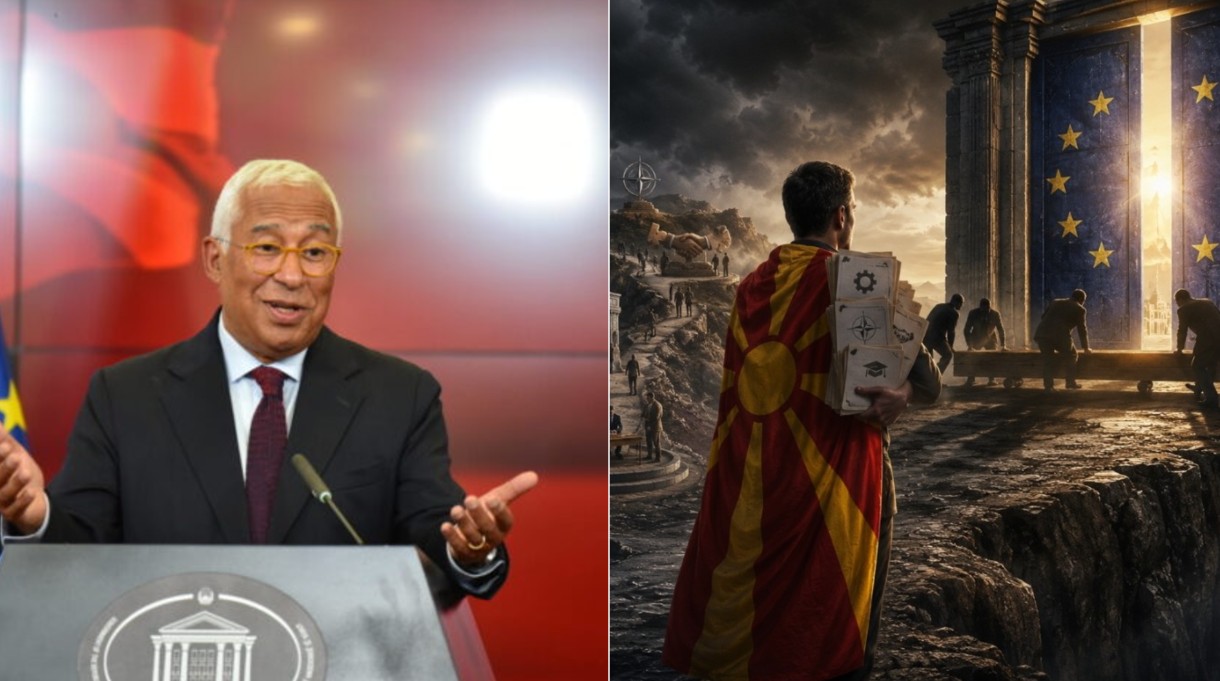
“WHEN JUSTICE IS CONSTANTLY DELAYED, A NATION BEGINS TO WONDER WHETHER IT EXISTS AT ALL”
(Seneca)
By: Slobodan TOMIC
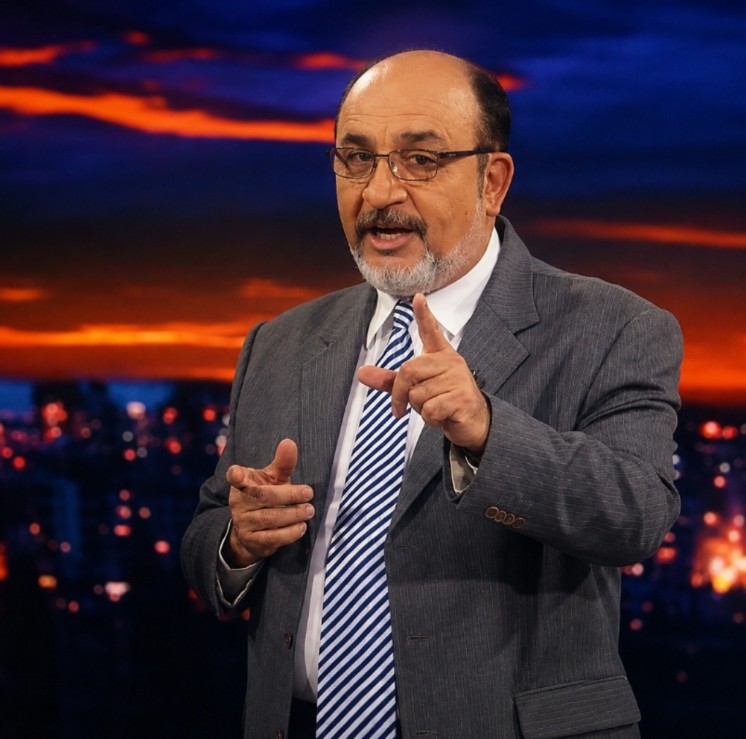
Slobodan TOMIC
The visit of European Council President Antonio Costa to Skopje was expected to bring new momentum, renewed hope, and perhaps some long-awaited answers for Macedonian citizens. Instead, Macedonia once again heard the familiar message it has been hearing for decades: fulfill the agreed obligations, and then the next step can be discussed.
This is where the real problem begins.
Not because Macedonia is against Europe.
Not because Macedonia opposes reforms.
Not because Macedonia rejects good-neighborly relations.
The problem is that for three decades Macedonia has been repeatedly told that the next compromise would be the last one, that the next concession would open the European door, and that the next fulfilled condition would finally bring deserved progress.
History, unfortunately, tells a different story.
From the change of the national flag, through the Ohrid Framework Agreement, through obtaining candidate status in 2005, and through some of the most significant political compromises in its modern history, Macedonia consistently moved forward believing that the European perspective was real and attainable.
Yet every time the country approached its goal, the horizon seemed to move further away.
That is why the central question today is not whether Macedonia wants to become part of the European Union.
The real question is whether the European Union remains faithful to its own principles.
In Skopje, Antonio Costa praised the government’s reform efforts, progress in the rule of law, public administration reforms, and alignment with the Union’s foreign policy. These acknowledgments are important and should not be ignored.
At the same time, however, the familiar position was repeated: constitutional amendments remain the key condition for opening the next stage of accession negotiations.
What particularly attracted public attention was the fact that when asked whether there were guarantees that no new conditions would follow after the fulfillment of existing obligations, no clear and definitive answer was provided.
This is precisely where public distrust originates.
Not because Macedonians do not want Europe.
But because they have already heard promises many times before that a certain concession would remove the final obstacle.
On the other hand, Prime Minister Hristijan Mickoski delivered a message that deserves careful consideration.
He did not ask for privileges.
He did not ask for shortcuts.
He did not ask for special treatment.
He asked for a process based on principles, merit, credibility, and predictability.
In reality, that is the essence of every European system.
If reforms are the benchmark, then they must be the benchmark for everyone.
If merit matters, then it must matter equally for all candidates.
If the European Union is a community of rules, then those rules should not change in the middle of the process.
Particularly significant were the messages coming from Slovakia. During President Gordana Siljanovska-Davkova’s visit, it was emphasized that Macedonia has remained in the European waiting room for far too long and that bilateral disputes should not become conditions for membership.
This is a position increasingly shared by voices across Europe.
Because if historical disputes, interpretations of the past, textbooks, identity questions, and national narratives become part of the accession criteria, then enlargement ceases to be a process based on objective standards and becomes a political precedent.
At the same time, Europe continues to speak about new forms of integration, accelerated enlargement, and the geopolitical necessity of expansion.
Costa repeated this message during his visit to Tirana.
Yet this is where a fundamental paradox emerges.
If enlargement is truly a geopolitical necessity, then Europe’s strongest argument is not another speech.
It is consistency.
Macedonia is a NATO member.
Macedonia is a factor of regional stability.
Macedonia continuously aligns its foreign policy with that of the European Union.
Macedonia continues to implement reforms.
And for that reason, Macedonian citizens have every right to ask a simple and legitimate question:
After all these years, is there finally a clear and predictable path forward, or will new conditions continue to appear after old ones are fulfilled?
The greatest danger today is not stagnation.
The greatest danger is the erosion of trust.
Because when a nation begins to believe that the rules are not applied equally to everyone, trust is lost not only in politics.
Trust is lost in the idea itself.
And the European idea has always been strongest when it represented justice, equality, and predictability.
Therefore, the real question after Costa’s visit is not whether Macedonia is ready for Europe.
The question is whether Europe is ready to demonstrate that Macedonia truly belongs within it.
Because a nation that has waited for more than two decades at the door has every right to ask whether the problem lies with itself—or with those who keep moving the threshold further away.
