

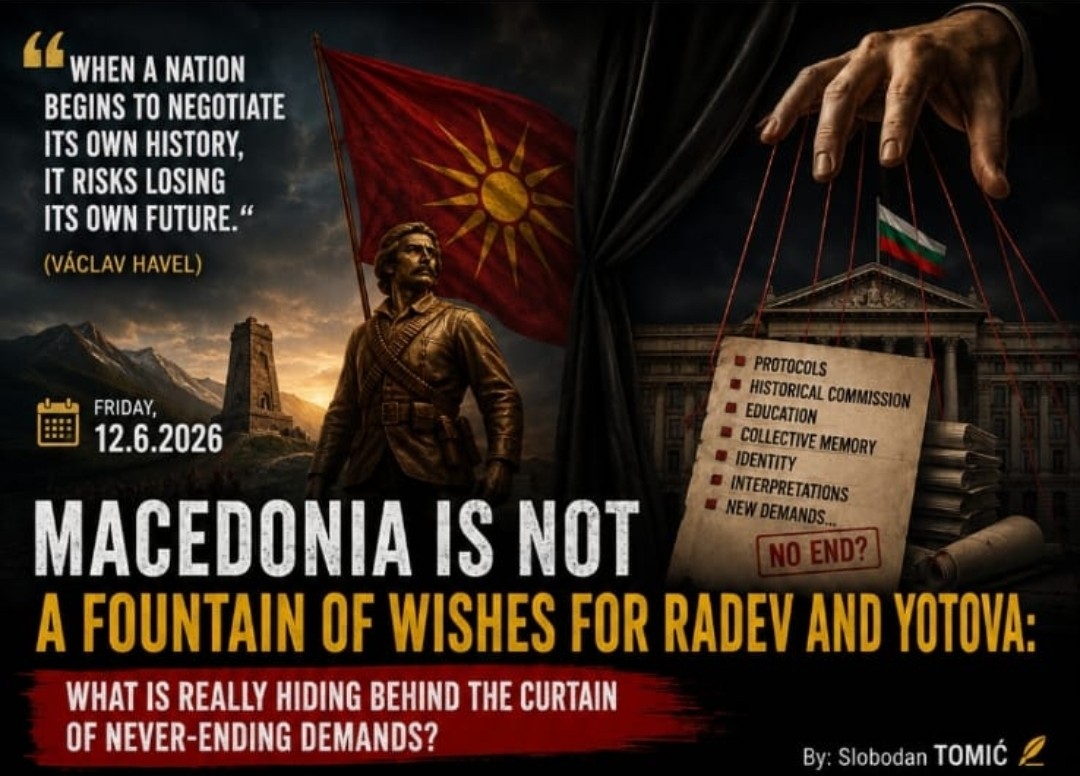
“WHEN A NATION BEGINS TO NEGOTIATE ITS OWN HISTORY, IT RISKS LOSING ITS FUTURE.”
( VÁCLAV HAVEL)
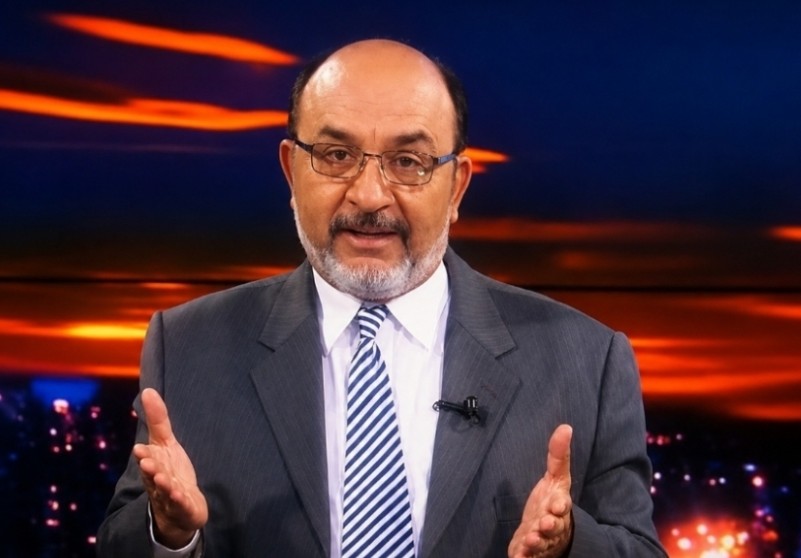
By: Slobodan Tomić
Sometimes a single meeting reveals more than dozens of diplomatic statements.
That is precisely what happened in Sofia, on the sidelines of the Summit of the South-East European Cooperation Process, when President Gordana Siljanovska-Davkova and Foreign Minister Timčo Mucunski met with Bulgarian Vice President Iliana Yotova.
In just a few sentences, many illusions that had been cultivated in the Macedonian public for years began to collapse.
For years, the public was told that the problem had a simple solution.
For years, citizens were assured that everything came down to a single constitutional amendment.
For years, it was claimed that including Bulgarians in the Constitution would be the final step before the genuine start of European Union accession negotiations.
Yet the messages that emerged from Sofia painted a very different picture.
President Gordana Siljanovska-Davkova herself stated after the meeting that the issue was not limited to constitutional amendments, but also involved additional demands connected to bilateral protocols and the work of the Joint Historical Commission.
It was an important statement.
Not because it revealed something entirely new.
But because it publicly confirmed what many had suspected for a long time.
The story does not end with the Constitution.
That is where it actually begins.
Prime Minister Hristijan Mickoski delivered a similar message.
He warned that constitutional amendments represent only the beginning and that they would be followed by the Action Plan, the work of the Historical Commission, and obligations arising from the Second Protocol.
Mickoski used a powerful expression when he said that constitutional amendments would open a “Pandora’s Box.”
And perhaps no phrase better captures the essence of the dilemma facing Macedonia today.
The question is no longer simply who will be included in the Preamble.
The real question is what comes afterward.
And everything heard in Sofia suggests that more demands may follow.
One protocol.
Then another protocol.
One recommendation.
Then another recommendation.
One commission.
Then another commission.
One interpretation.
Then another interpretation.
And so the process continues without a clearly defined endpoint.
This raises a fundamental question:
Where does the list end?
What is the final condition?
What is the ultimate destination?
Because every European integration process must have a clear objective.
A process that constantly generates new requirements risks becoming endless.
Particularly troubling is the fact that many of these issues do not concern economic reforms, institutional modernization, or the rule of law.
Instead, they concern history.
Education.
Collective memory.
National identity.
The way a nation understands itself.
That is why Prime Minister Mickoski’s remarks regarding Goce Delčev and the Ilinden Uprising resonate so strongly among many citizens.
These are not administrative matters.
They touch the very core of national self-understanding.
And this leads to another question that is rarely discussed openly.
Why Macedonia?
According to the 2021 census, approximately 3,500 to 3,700 citizens identified themselves as Bulgarians.
Yet Macedonia remains the only country facing such intense political and diplomatic pressure regarding this issue.
Macedonia is the country being asked to undertake constitutional changes as a condition for progress.
Macedonia is the country being told that its European path depends on fulfilling these demands.
Naturally, many citizens ask:
If this is a matter of principle, why is the principle not applied equally everywhere?
If this is a European value, why is it not implemented uniformly?
If this is about human rights, why is Macedonia uniquely subjected to this form of political conditionality?
These questions remain unanswered.
And because they remain unanswered, many citizens feel that the dispute has long since moved beyond the framework of a minority rights issue.
When one demand is followed by ten more demands, people inevitably begin to wonder what truly lies behind the curtain.
Macedonia is not asking for privileges.
It is not asking for special treatment.
It is not asking to bypass European rules.
Macedonia is asking for predictability.
For certainty.
For guarantees that every fulfilled obligation will not immediately be replaced by another.
Europe is, above all, a community of principles.
And principles must apply equally to everyone.
History teaches us that nations do not disappear because they are small.
They do not disappear because they are poor.
They do not disappear because they face pressure.
They disappear when they begin to doubt their own worth and their own historical truth.
Macedonia has survived divisions.
It has survived denial.
It has survived attempts to erase it from maps and from memory.
For that reason, it must not become a wishing fountain for any politician.
It can speak with everyone.
It can build bridges with everyone.
It can seek compromise with everyone.
But it cannot negotiate its right to exist as what it is.
A nation that writes its own history has a future.
A nation whose history is written by others risks one day losing it altogether.
And that is why the question today is not whether Macedonia wants Europe.
The question is whether Europe will remain faithful to its own principles.
Because a Europe that respects diversity is a source of hope.
But a Europe that allows identity to become an object of political conditionality becomes a warning.
And throughout its history, Macedonia has always known how to recognize the difference between hope and warning.
