

“The greatest danger to any government is not the strength of its opponents, but the moment it forgets that it exists to serve the people.”
( Charles de Gaulle)
By: Slobodan Tomic
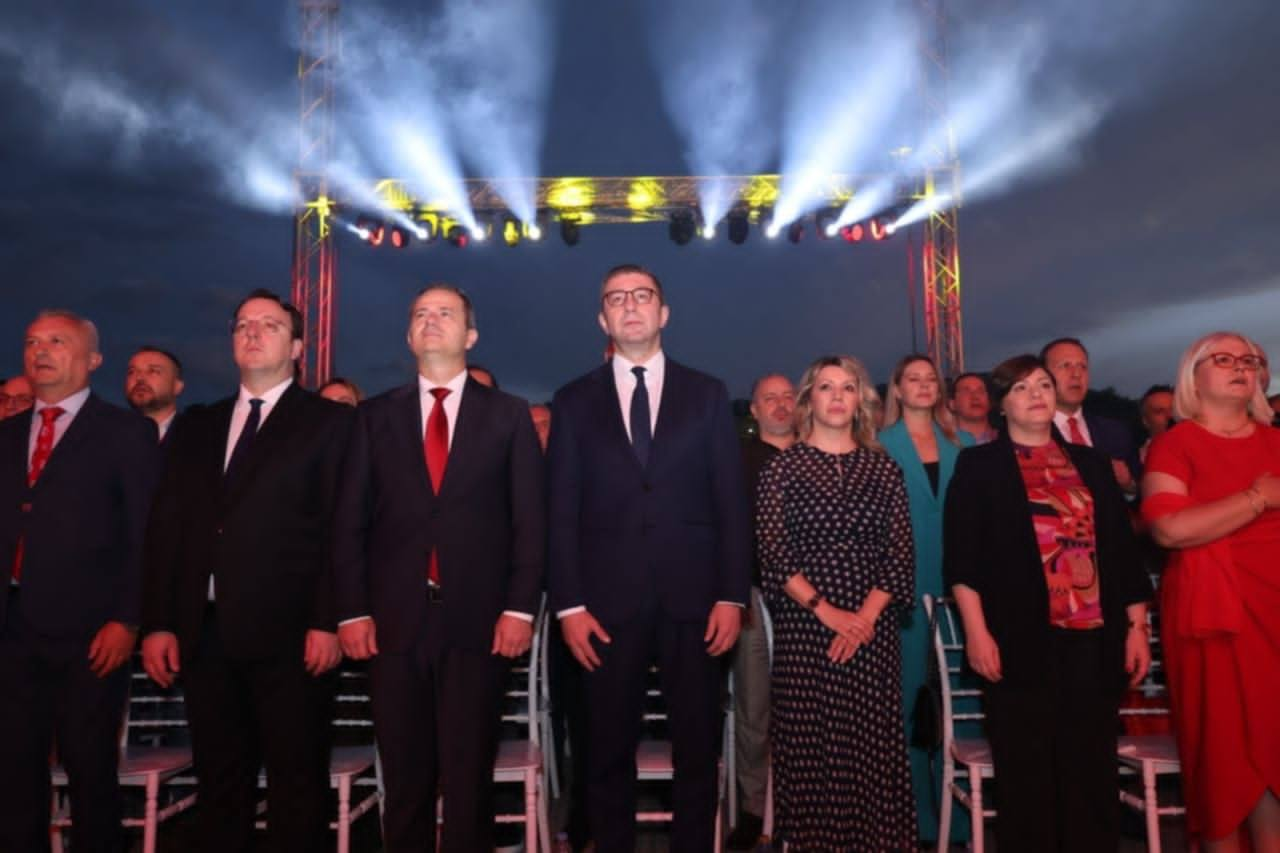
There are political gatherings held merely to commemorate an anniversary, and there are events that transcend celebration and become a political message, a reflection of an era, and a vision for the future.
The commemoration of the 36th anniversary of the founding of VMRO-DPMNE at the stadium in Strumica was precisely such an event.
At the center of attention was not only the history of a political party. At its core was a question that follows every government, regardless of time and circumstance: will it remain close to the people, or will it retreat into the comfort of offices, titles, and privileges?
The strongest message from the speech of VMRO-DPMNE President and Prime Minister Hristijan Mickoski was not directed at political opponents. It was addressed to his own ranks. The warning that for some officials their positions had become more important than the people was a message that goes far beyond day-to-day politics.
In a democracy, it is easy to point out the mistakes of one’s opponents. It is far more difficult to look inward and admit that every government is exposed to the temptation of self-satisfaction, the intoxication of power, and the gradual alienation from the very people whose trust brought it to office.
This is the essence of the message from Strumica.
Power is not a reward. Power is not a privilege. Power is service.
To be a minister, a director, or a public official does not mean being above the people. It means being among the people every day, listening to their concerns, and seeking solutions to their problems. Public office loses its meaning when it loses contact with citizens.
Particularly significant was Mickoski’s reminder of humble beginnings. Recalling a time when everything had to be built with great effort, limited resources, and strong conviction was not merely a personal story. It was a reminder that politics must never forget where it started.
History has been unforgiving toward governments that have distanced themselves from their people.
The greatest political downfalls do not begin with electoral defeat. They begin the moment citizens feel that those they elected no longer listen to them, no longer understand them, and no longer share their concerns.
This is why the announced reconstruction of the Government carries broader significance.
It was not presented as a political spectacle or a settling of scores. It was presented as a message that no one is irreplaceable and that everyone entrusted with public office must give their utmost. In politics, there are no permanent positions—only a permanent obligation toward citizens.
Particularly striking was the message that those who are exhausted should leave honorably.
It is a message about political responsibility. In public life, it is not a weakness to admit that one can no longer meet the challenges of office. The real weakness lies in remaining in office without energy, commitment, or a sense of duty.
In his address, Mickoski also referred to the results achieved during the previous period. He highlighted economic indicators, foreign investments, infrastructure projects, investments in education, and support for agriculture.
Regardless of differing political interpretations, the fundamental message was that politics must ultimately be measured by results rather than by rhetoric and promises.
A particularly important place in the speech was given to the question of North Macedonia’s European future.
The message was clear: the country’s place is within the European Union. Yet it was equally clear that issues related to the Macedonian identity, language, culture, and historical continuity cannot be subjects of bargaining.
The European path was described as a marathon rather than a sprint—a process requiring perseverance, patience, and statesmanship. But it was also presented as a process in which certain values have no price.
This is why the statement that there can be no bargaining over the Macedonian identity became one of the central political messages from Strumica.
In politics, authority is not built solely through electoral victories or high approval ratings. True authority is built when a leader is prepared to demand more both from himself and from his associates; when he demonstrates that office is not an end in itself; when he reminds everyone that a clean reputation is difficult to preserve and easy to lose.
The commemoration of the 36th anniversary of VMRO-DPMNE was therefore not merely the celebration of a party’s birthday.
It was a reminder that every generation faces its own historical test.
The test of this generation is to prove that government can remain close to the people, that reforms can be transformed into tangible results, and that North Macedonia can move toward its European future without relinquishing its dignity, identity, and sense of historical continuity.
In the end, political offices are temporary. Positions come and go. What remains is the question by which every government will ultimately be judged: did it serve the people, or did it gradually distance itself from them?
It is in this question that the essence of the messages from Strumica and their broader political significance can be found: the people must never become secondary to office, because that is the moment when power begins to lose both its purpose and its moral legitimacy.
