

By: Slobodan TOMIC

“History does not warn twice. It only changes direction.”
– attributed to Thucydides
The European Union today is no longer a project of steady evolution, but a system being reassessed under pressure from its own limits, crises, and geopolitical challenges. The war in Ukraine has shattered the illusion of permanent European security and reopened the most difficult debate of recent decades: can the Union remain stable without further enlargement?
In this context, enlargement is no longer a political option, but a strategic necessity.
Every space outside European integration increasingly represents a potential vacuum of influence, instability, and security risk.
The Irish presidency arrives at a moment when Europe is moving slowly, yet under strong external and internal pressure.
France is entering a political cycle that traditionally slows down European decision-making. Other major member states are facing their own economic and security constraints. This creates an unstable rhythm within the Union, and it is precisely this rhythm that shapes the direction of European processes.
Ireland does not have the power to impose decisions, but it can influence the tempo of political developments. In European politics, timing is often as important as decisions themselves.
Ukraine is reshaping the entire architecture of European integration. Its future membership would require a complete redesign of the EU budget, agricultural policy, cohesion funds, and security framework.
Therefore, enlargement is no longer measured only by political will, but by the system’s capacity to transform without losing internal balance.
Europe today is not asking whether it wants enlargement, but how much change it can absorb without losing stability.
The Western Balkans is returning to the European agenda, not because of optimism, but because of geopolitical necessity. Long-term stagnation creates a vacuum, and in international politics, a vacuum is never left empty.
In this framework, Macedonia is not just a candidate country. It is a test of the credibility of the European enlargement policy.
If processes are guided by principles and criteria, enlargement has a future. If they are dominated by blockages and bilateral conditions, the process loses both meaning and predictability.
Three scenarios emerge.
Dynamic scenario: the process accelerates and gains political momentum.
Controlled scenario: technical progress continues without a major political breakthrough.
Inertial scenario: enlargement is delayed and enters prolonged uncertainty.
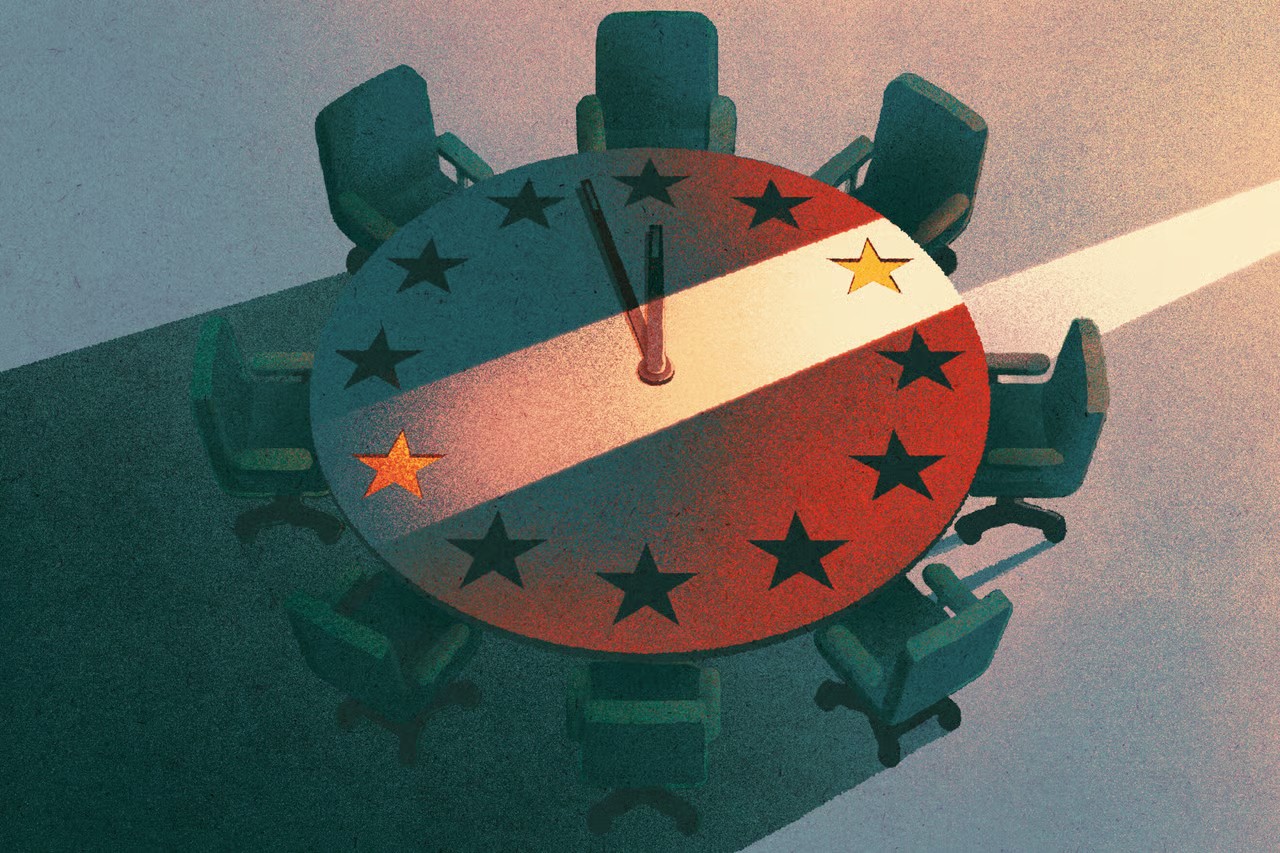
The European Union does not suffer from a lack of strategies, but from a lack of political moments that turn strategies into decisions.
The Irish presidency represents one such moment — limited in time, but significant in potential.
“Wisdom is not in predicting the future, but in recognizing the moment when it begins to change.”
– attributed to Socrates
History does not reward those who wait for perfect conditions.
It rewards those who recognize the moment, and act while it still lasts.
