

By: Slobodan Tomić, MA, Analyst and Publicist

Slobodan Tomić
“When words lose their meaning, people lose their freedom.”
Confucius
PORTRAITS OF POWER – A SERIES
“When words lose their meaning, people lose their freedom.”
Confucius
WITH WHAT RULES DOES EUROPE COME TO MACEDONIA?
On Friday in Skopje, it is not merely the President of the European Commission who arrives.
An enduring question arrives alongside her—one that Macedonia has carried for far too long.
Who writes the rules by which Macedonia ought to reach the European Union, and are those rules truly the same for everyone?
This is not an anti-European question.
On the contrary.
This is one of the most fundamentally European questions Macedonia could possibly ask.
Because the European Union is not merely a common market, a set of institutions, and international treaties.
The European idea rests upon predictability.
Upon rules.
Upon an equal yardstick.
Upon the principle that the conditions set for a candidate country cannot constantly turn into a moving target—and right here, today, Macedonia has every reason to halt and inquire.
According to information published on the basis of a draft document from the European Commission, Brussels is considering specific roadmaps for Montenegro, Ukraine, Moldova, and Albania, outlining concrete priorities and timeframes to accelerate their accession path.
Macedonia is not among that quartet.
And it is precisely here that an ordinary daily political news item ends.
It is here that the true political narrative begins.
ALEXANDRE ADAM: FACTS ARE STRONGER THAN ACCUSATIONS
At the heart of this narrative emerges a single name:
Alexandre Adam.
We ought not to hastily declare him guilty.
There is no evidence that he personally “blocked” Macedonia.
Yet there are documented facts regarding his professional role that simply cannot be bypassed.
Today, Adam serves as Deputy Head of Cabinet to Ursula von der Leyen, and the European Commission explicitly lists enlargement, reforms, and Ukraine among his responsibilities.
Before this appointment, however, Adam served as advisor on European affairs to French President Emmanuel Macron.
And during the critical year of 2022, he was directly involved in French diplomatic efforts to unblock the dispute between Macedonia and Bulgaria. What follows is an unalterable fact.
On September 20, 2022, the Bulgarian Ministry of Foreign Affairs officially announced that Deputy Minister Velislava Petrova awarded Alexandre Adam the honorary “Golden Laurel Branch” of the Bulgarian MFA.
The reason stated by the Bulgarian ministry itself?
For strengthening and developing bilateral relations between Bulgaria and France.
That is a fact.
A documented fact.
Not an accusation.
Not a conspiracy theory.
Not a speculative construct.
And precisely for that reason, the question becomes far more serious when framed correctly.
Not:
“Is Adam to blame for the Macedonian blockade?”
That would be an overreached claim lacking proof.
Rather:
What level of institutional transparency exists when an individual with such a prior role during the most sensitive phase of the Macedonian-Bulgarian dispute now holds direct responsibility for enlargement and reforms within the Cabinet of the European Commission President—at the exact moment Macedonia is omitted from the new quartet designated for tailored roadmaps?
That is a legitimate question.
And Europe should not fear it.
On the contrary.
Europe should possess the best possible answer.
WE HAVE NO ISSUE WITH THE CRITERIA
Here, we must also be honest with ourselves.
The European Union has criteria.
And those criteria are well known.
The Copenhagen criteria demand stable institutions guaranteeing democracy, the rule of law, human rights, and the protection of minorities; a functioning market economy; and the capacity to assume and implement the obligations of membership and the EU acquis.
Thus, it is undisputed that Macedonia must implement reforms.
It must.
The judiciary must be independent.
Institutions must be functional.
Corruption must be curtailed.
Public administration must be professional.
The media must enjoy freedom.
This is not an EU condition merely because Brussels demands it.
It is in the vital interest of Macedonia itself.
Yet then comes the question that exposes this entire affair:
ARE THE SAME CRITERIA APPLIED WITH EQUAL CONSISTENCY AND PREDICTABILITY TOWARD ALL?
That is the crux of the matter.
We do not ask for Ukraine to be halted.
We do not ask for Moldova to be halted.
We do not ask for Albania to be halted.
We do not ask for Montenegro to be halted.
Their progress is their own affair.
The question is:
Where is the benchmark for Macedonia?
MACEDONIA DOES NOT START FROM SCRATCH
Here again, the facts speak for themselves.
Macedonia completed the screening process with the European Commission in December 2023.
The Commission confirmed that the screening encompassed all six clusters, thereby concluding the analytical phase of the process.
In its official report, the Commission noted that the screening for all six clusters was formally concluded on December 7, 2023.
This means Macedonia possesses an established process.
It has an institutional trail.
It has defined sectors.
It has European reports.
It has conditions.
It has reforms it must carry out.
Yet if four other nations are now receiving dedicated roadmaps with new political momentum, the Macedonian question becomes thoroughly logical:
What precisely is lacking for Macedonia to receive a clear, time-bound next phase?
Not in general terms.
Not politically.
Not through a ten-line vague sentence.
Rather:
Which condition?
Which reform?
Which benchmark?
Which deadline?
And what follows once the condition is met?
THE SECOND KAMIKAZE?
This question cannot be detached from the history of the Macedonian European path.
The name dispute with Greece spanned decades and culminated in the Prespa Agreement, signed in 2018 and entering into force in 2019.
In 2011, the International Court of Justice ruled that Greece had violated its obligation under Article 11 of the Interim Accord by objecting to Macedonia’s invitation to join NATO.
Then came Prespa.
An immense political concession.
Then came Bulgaria.
The French proposal.
Constitutional amendments.
The protocols.
Historical disputes.
And once more—Macedonia stands before yet another door.
Therefore, today, Macedonian citizens have every right to ask:
How many more political concessions are required for a European perspective that keeps shifting further down the horizon?
And even more crucially:
Where does European compromise end, and where does the peril of self-cancellation begin?
No democratic Europe ought to fear this question.
AND NOW — THESSALONIKI
At this precise juncture, another scene unfolds in the Balkans.
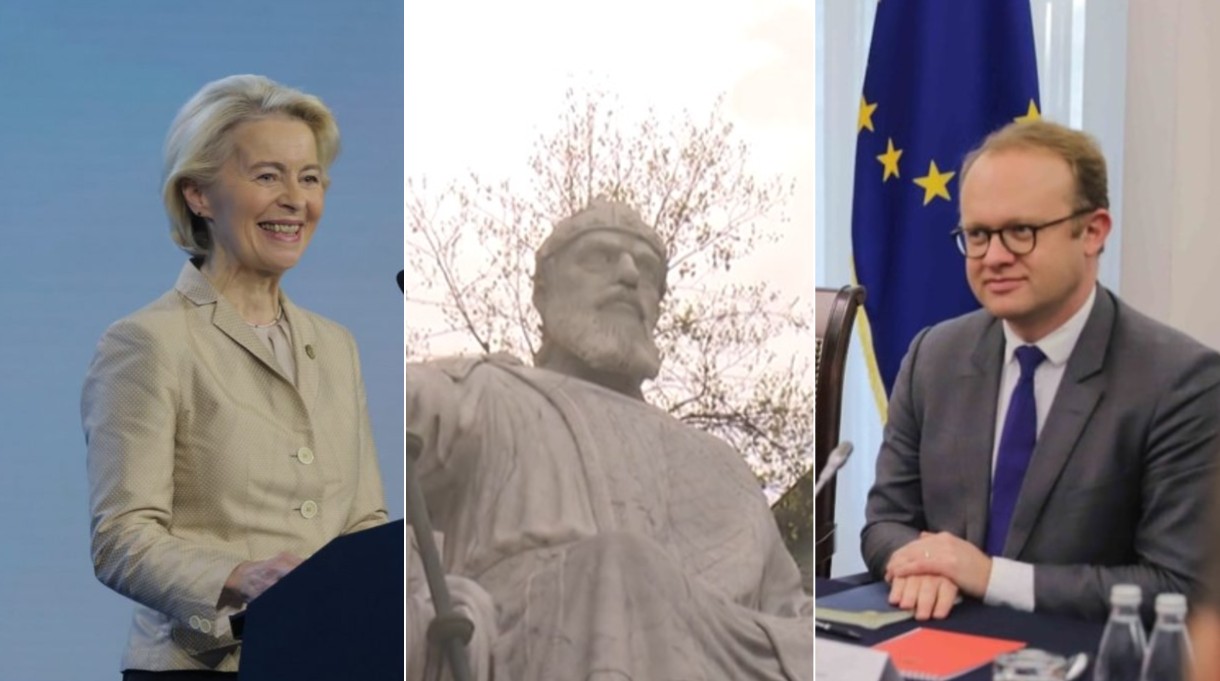
On September 29, it was announced that Bulgaria and Greece reached an agreement regarding the mortal remains of Tsar Samuil, with a ceremony slated for October 3 in Thessaloniki.
In and of itself, that is a bilateral historical act between two sovereign states.
We ought not to convert it into evidence of any coordinated action against Macedonia.
There is no proof for such an assertion.
Yet Macedonia maintains the right to observe the broader context.
Because in the Balkans, history has never been merely history.
It has been:
identity,
politics,
diplomacy,
state interest.
Precisely for that reason, when historical matters are reactivated in the region, Macedonia has every right to remain vigilant—especially when, just days later, the President of the European Commission arrives in Skopje.
EUROPE MUST NOT BECOME A BALKAN BARGAINING TABLE
I am pro-European.
And for that exact reason, I want Europe to be Europe.
Not a Balkan market under European flags.
Not a realm where every new political circumstance can spawn new conditions.
Not a system in which history can be endlessly weaponized as an additional instrument of delay.
Europe must represent something greater than geopolitical mathematics.
It must represent:
rules,
institutions,
predictability,
an equal standard.
If the criteria matter, let them matter for everyone.
If the rule of law is a condition, let it be a condition for everyone.
If reforms are a requirement, let them be measurable.
If the European perspective is real, let there be a clear next stop.
WHAT WILL MACEDONIA SAY TO VON DER LAYEN?
Not:
“Let us in.”
Not:
“Do us a favor.”
Not:
“Turn a blind eye to our shortcomings.”
Rather:
“State the rules to us.”
State clearly:
What exactly must we do?
Which condition must we fulfill?
Which benchmark will you apply?
Which timeframe applies?
And what follows once we fulfill it?
That is partnership.
That is the language of Europe.
UKRAINE IS NOT THE ISSUE
Ukraine is not the problem.
Moldova is not the problem.
Albania is not the problem.
Montenegro is not the problem.
The problem arises only if Europe creates divergent political tracks without explaining with sufficient clarity by what standard it determines who merits which track and at what moment.
Here, Ukraine introduces another crucial dimension.
Today, the European Union views enlargement through a geopolitical lens as well.
Continental security, Russian aggression, strategic autonomy, supply chains, and relations with global powers increasingly shape European policy.
That is a reality.
Yet if geopolitics grows ever more decisive, Macedonia has the right to pose one further question:
WHEN DOES GEOPOLITICS BECOME A CRITERION — AND WHEN DO CRITERIA BECOME GEOPOLITICS?
That is the core question.
MACEDONIA IS NOT ASKING FOR A DISCOUNT
Macedonia does not ask for membership without reforms.
It does not ask to bypass the criteria.
It does not ask for a gift.
It does not ask Europe to forget the rule of law.
On the contrary.
It asks that Macedonia fulfill what constitutes its own obligation.
Yet it simultaneously asks that Europe uphold its own core European principle:
predictability.
Because one cannot endlessly demand new sacrifices from a candidate while constantly pushing the reward beyond the next horizon.
First the name.
Then the dispute with Bulgaria.
Then the Constitution.
Then the protocols.
Then the historical issues.
Then the new European architectures.
And once again, Macedonia before the door.
HOW MANY MORE GATES?
How many more doors must Macedonia unlock before Europe finally opens its own?
This is not an anti-European question.
This is a question regarding the very essence of Europe.
For if Europe is truly a community of rules, those rules must be visible.
If Europe is a community of values, those values must apply in policy as well.
If Europe is a community of law, then the European perspective must be predictable.
ALEXANDRE ADAM IS NOT A VERDICT — HE IS A QUESTION
Therefore, we ought not to say:
“Adam is guilty.”
There is no such proof.
Nor should we say:
“Adam is irrelevant.”
That, too, would mean ignoring the facts.
The man has a documented prior role in French European policy.
He possesses official Bulgarian recognition from 2022.
Today, he holds institutional authority over enlargement and reforms in the Cabinet of the European Commission President.
And at this exact historical moment, Macedonia is absent from the quartet for which tailored roadmaps are being drafted according to published reports.
This does not constitute proof of a conspiracy.
It does, however, form a sufficiently serious context for a democratic inquiry:
Does the Macedonian public have the right to know how these decisions are made, who proposes them, under what criteria, and with what institutional oversight?
The answer must be:
Yes.
FRIDAY MUST NOT BE MERELY A PHOTO OPPORTUNITY
There will be handshakes.
There will be flags.
There will be smiles.
There will be protocol.
Yet Macedonia must not miss the essence.
Ursula von der Leyen should not merely be told:
“Macedonia wants to join the European Union.”
She has known that for a long time.
She ought to be told:
“Macedonia wants to know by what rules it will reach the European Union.”
And one thing more:
“Are those rules the same for everyone?”
If the answer is yes—
show them.
If there are conditions—
name them.
If there are reforms—
measure them.
If there are deadlines—
announce them.
And if Macedonia fails to meet something—
state precisely what it fails to meet.
Without diplomatic fog.
Without moving targets.
Without new surprises halfway through the journey.
EUROPE AND MACEDONIA: TIME FOR AN ANSWER, NOT ANOTHER WAIT
Macedonia must do its own work.
No one can do that in its stead.
Yet Europe, too, must be clear.
Because European integration cannot be a one-way street of unilateral obligations.
The candidate cannot operate under a sole mandate of:
“you must,”
while the European Union operates under a sole posture of:
“we shall see.”
The European path must offer both obligations and predictability.
Criteria and results.
Reforms and perspective.
Conditions and a clear answer regarding what follows when those conditions are fulfilled.
THE FINAL WORD
Macedonia does not ask Europe to change the rules for its sake.
It asks that the rules be clear.
It does not ask to stand above the criteria.
It asks that the criteria be visible.
It does not ask to bypass reforms.
It asks that reforms be measured fairly.
It does not ask for a gift.
It asks for a fair process.
And that is why Friday in Skopje should not be merely a diplomatic photo opportunity.
It ought to be the moment in which a small European state, after more than two decades of waiting, finally poses a monumental European question:
WHO HOLDS THE KEY TO THE EUROPEAN DOOR?
If the key is named reform—Macedonia knows what it must do.
If the key is named the rule of law—let there be clear benchmarks.
If the key is named European law—let there be equal application.
Yet if behind the door there continually appears a new condition, a new political circumstance, and another “wait a little longer,” then Macedonia has every right to ask:
IS THE DOOR TRULY OPEN — OR ARE WE MERELY BEING TOLD THAT IT IS?
Europe should not fear this question.
Because the true Europe is not defended through silence.
It is defended through rules—and a rule, if it is truly a rule,
must apply to everyone.
