

“A statesman is recognised when he refuses to bend his back, but proves his worth when he sets his country upright.”
“Courage without results is merely a gesture; results without dignity amount to a victory stripped of meaning.”
— Original reflections
PORTRAITS OF POWER
By M.Sc. Slobodan Tomić, Political Analyst and Publicist

Slobodan Tomić
There are dates in a nation’s history that must never be reduced to protocol, wreath-laying ceremonies and commemorative speeches. They are historical tests, confronting each generation with the same fundamental questions: What have we done with the freedom bequeathed to us by those who came before, and what kind of country are we preparing for those who will follow?
11 October is one such date.
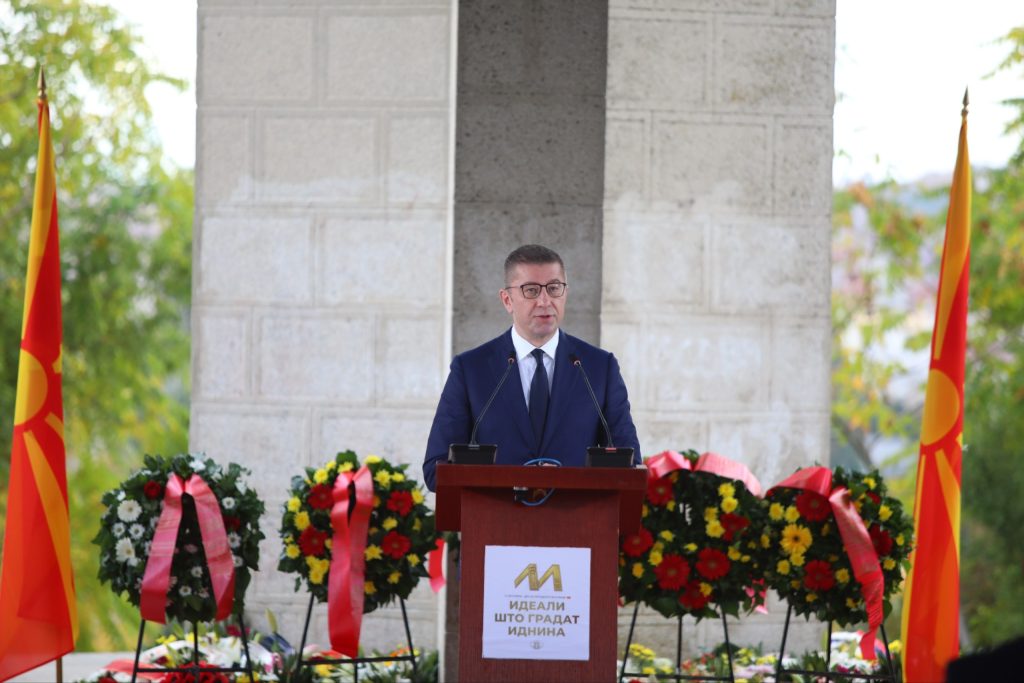
Yet, at the 85th anniversary of the 1941 uprising, commemorated in Kumanovo, political attention was directed not solely towards the past. At the centre of the public message stood Prime Minister Hristijan Mickoski, who transformed historical remembrance into a political declaration about the present and the future: Macedonia wants to move forward, join the European Union and secure a better life for its citizens, but it will not accept its own identity as the price of someone else’s approval.
That was the essence of Mickoski’s message from Kumanovo.
And it deserves an analysis that goes beyond the reflexes of day-to-day political debate.
For the question is not merely what Mickoski said. The deeper questions are what kind of state policy his words announce, what responsibilities they entail, and whether the language of dignity, reform and economic progress will translate into measurable improvements in the lives of Macedonian citizens.
HISTORY IS NOT A DECORATION OF POWER, BUT A MEASURE OF ITS RESPONSIBILITY
11 October commemorates not the comfort of an established order, but the decision to resist when circumstances demand courage. Those who rose in 1941 could not have known in advance how long the struggle would last, how great the sacrifices would be or how heavy the price of freedom would prove. They understood, however, that there are moments when silence becomes complicity in one’s own subjugation.
It was from this historical perspective that Mickoski delivered his message: a state is not a gift, nor does its existence depend on someone from abroad granting its people permission to regard it as their own.
A state is the product of historical struggle, collective will and a responsibility passed from one generation to the next.
Yet this is precisely where the political weight of his words begins.
To invoke historical dignity is to accept that the government of today has a duty to protect not only the country’s name and identity, but also its institutional functionality. Sovereignty remains incomplete if citizens feel powerless before their own institutions. National pride is insufficient if young people see their future elsewhere. And a historic victory loses much of its practical meaning if a free country cannot provide the conditions for a dignified life.
11 October, therefore, is not simply an occasion for political rhetoric. It is a standard by which the performance of any government invoking its ideals must also be judged.
From Kumanovo, Mickoski conveyed the message that Macedonia needs clear objectives, ambition and a vision for generations to come.
That is the right strategic direction.
But its true value will ultimately be determined by whether the country becomes better organised, more efficient, fairer and economically stronger.
History gives legitimacy to remembrance. Results give legitimacy to government.
TO SOFIA AND BRUSSELS: EUROPE, YES. HUMILIATION, NO.
One of Mickoski’s strongest messages was that Macedonia wants to become a member of the European Union, but not with its head bowed and its backbone broken.
That formulation captures a fundamental political dilemma that has confronted the country for years: how to advance towards European integration without allowing the accession process to become an endless exercise in questioning its own identity.
The position articulated by the prime minister is clear: European integration must not require Macedonia to renounce its language, culture, historical memory or national dignity.
This is not a rejection of Europe.
On the contrary, it is a demand that European principles be applied to Macedonia as well.
Europe is more than a geographical expression or a collection of institutions and regulations. It is also a political idea grounded in equality, respect for diversity, the rule of law and the dignity of nations.
If these principles are universal, they cannot be applied selectively according to a country’s size, negotiating leverage or the political interests of its neighbours.
From Brussels, Macedonia is entitled to expect a credible European perspective, a predictable accession process and consistency in the application of European rules. From Sofia, it should expect relations founded on mutual respect rather than the repeated reopening of questions that deepen mistrust between societies.
Yet Macedonia’s own political leadership must also understand that principled firmness and diplomacy are not mutually exclusive.
A country can stand resolutely in defence of its identity while remaining judicious in its choice of diplomatic instruments. It can reject unacceptable conditions while building alliances, presenting arguments, negotiating effectively and strengthening its position through concrete achievements.
Saying “no” is the easy part. The real challenge is to turn a principled “no” into a pathway towards an acceptable “yes”.
This is where Mickoski faces his real test.
His political responsibility does not end with defending national dignity before a domestic audience. It extends to building international support for Macedonia’s position, engaging actively with European institutions and implementing reforms that demonstrate the country’s readiness to contribute to the common European project.
Macedonia must not seek European membership at the cost of humiliation. But neither must its European future become an indefinite waiting room without a clear strategy.
Macedonia has the right to demand respect. It also has the obligation to prepare itself for membership.
“WE CAN DO MORE”: THE WORDS THAT OPEN THE DOOR TO ACCOUNTABILITY
Political speeches are often dominated by praise for achievements. According to the statements reported from Kumanovo, Mickoski also spoke about his own dissatisfaction with the extent of what has been accomplished. He said that he wakes up and goes to sleep asking himself whether the government is succeeding and whether it can do more. He also emphasised his determination to address the problems and hardships confronting citizens.
This is where his message acquires a different dimension.
A politician who acknowledges that more can be done creates the basis for higher expectations.
He can no longer rely solely on the circumstances he inherited, the weaknesses of previous administrations or external constraints. By admitting that better results are possible, he assumes an obligation to explain where progress is needed, how it will be achieved and which measures will deliver it.
Citizens do not live inside statistical tables.
They live with bills, rising prices, loan repayments, medical expenses, their children’s education and the anxiety of wondering whether their monthly income will last until the next payday.
For them, reform is not a document gathering dust in a government office. It is the difference between an institution that solves a problem and one that sends them from one counter to another.
The acknowledgement that not every problem can be resolved immediately must not become an alibi for failure. Equally, every unresolved problem is not automatic proof that nothing has been achieved.
A serious assessment requires comparison: What was the initial situation? What measures have been taken? Which results have been delivered? What remains unresolved?
Mickoski speaks of restoring order to disorder, reforming a system burdened by inherited dysfunction and building a stronger state on firmer foundations.
It is an ambitious political formula. Its credibility, however, will depend on whether citizens can recognise the changes in their everyday lives.
Order is not measured merely by the number of decisions adopted, but by whether the law applies equally to everyone. Reform is not measured simply by the publication of a new strategy, but by better public services, faster procedures and institutions that answer for their performance.
A strong state is not one that merely speaks with authority. It is one in which citizens can exercise their legal rights without having to rely on personal connections, intermediaries or political protection.
If the prime minister genuinely asks himself every day whether more can be done, that question should become a working principle for every minister, director and public-sector manager.
The government does not own the state.
It is its temporary steward, accountable to the citizens it serves.
A €1,000 SALARY: AN AMBITION THAT MUST BE PROVED BY THE NUMBERS
The strongest political promises are not those that sound most impressive from a podium, but those that citizens can verify in their own wallets.
That is why the stated ambition to bring Macedonia’s average net monthly salary close to €1,000 — approximately 60,000 denars — by the end of the government’s term in the spring of 2028 is one of the most consequential economic commitments associated with Mickoski’s appearance.
According to the figures cited in the published material, the average net monthly salary in July stood at 48,499 denars, representing nominal annual growth of 7.1 per cent.
Reaching 60,000 denars would require an increase of approximately 11,500 denars, or about 24 per cent above the stated level.
That objective is not impossible simply because it is ambitious. But neither has it been achieved merely because it has been announced publicly.
An essential distinction must be made between nominal and real wage growth.
If salaries rise while prices increase at a comparable pace, citizens may receive more denars without necessarily being able to purchase more goods and services. Genuine economic success is measured not merely by the amount appearing on a payslip, but by its purchasing power.
Nor does the average salary fully describe the circumstances of every household. Behind the average may lie substantial differences between industries, regions and income groups.
The government must therefore demonstrate not only that the average is rising, but also that people on lower incomes are seeing tangible improvements, that productive employment opportunities are expanding and that young people have compelling reasons to build their futures at home.
Achieving the target will require more than administrative pressure to push salaries upwards. It will demand higher productivity, investment, better education and vocational training, reliable infrastructure, legal certainty, less room for corruption and an economy capable of generating greater added value.
It will also require a carefully balanced policy that aligns wage growth with productivity, inflation and the competitiveness of domestic businesses.
Otherwise, part of the increase could translate into higher operating costs, renewed inflationary pressure or a burden that smaller employers would struggle to absorb.
The €1,000 promise should therefore be neither celebrated prematurely nor dismissed in advance. It should be transformed into a public commitment supported by transparent indicators: growth in real wages, the creation of productive jobs, lower poverty, better working conditions and measurable improvements in living standards.
If Mickoski wants this figure to become a defining symbol of his term in office, it must be supported by policies whose benefits are felt by factory workers, nurses, teachers, farmers and young families deciding whether to remain in Macedonia.
Ambition matters.
But its true value lies in whether it delivers a better everyday life.
THE GREATEST NATIONAL STRUGGLE IS THE STRUGGLE FOR THE YOUNG
Mickoski linked the country’s future to its younger generations.
This is more than a political message. It is a fundamental question concerning Macedonia’s long-term survival and development.
A country that loses its young people loses more than population. It loses knowledge, labour, entrepreneurial energy, future parents, scientists, doctors, engineers, teachers and cultural creators.
It loses a part of its future.
No speech about patriotism can replace the conviction of a young person that they can find a good education, meaningful employment, a decent salary and institutions that judge them by their abilities rather than their connections.
If Macedonia wants its young people to stay, it must become a country where work pays, knowledge is respected, the law applies equally and success does not depend on political affiliation.
Here, all the themes raised in Kumanovo converge: dignity, the European perspective, reform and economic progress.
National identity is not merely what we inherit from our ancestors. It is also the responsibility to build a country in which our children and grandchildren will want to remain.
The struggle to retain young people cannot be won through a single government project or a one-off financial incentive. It requires a long-term strategy: quality education, a functioning healthcare system, secure employment, affordable housing, a clean environment and institutions that encourage rather than punish initiative.
The prime minister can set the objective.
The government must turn it into a programme. Society must help create the conditions.
But the final verdict will belong to the young themselves — through their decision about whether to build their future here.
A POLITICAL OPPONENT IS NO EXCUSE FOR ONE’S OWN PERFORMANCE
Mickoski delivered sharp criticism of his political opponents, using strong language to describe practices and conditions that, in his view, stand in the way of the country’s progress.
There is room in political life for forceful confrontation, particularly when the issues involve accountability, corruption, the abuse of public office or failed policies.
Yet there is a boundary that any serious statesman must recognise: political criticism can be uncompromising while remaining focused on conduct, decisions and evidence, rather than descending into an endless war of personalities and insults.
Mickoski assumed office with his own political programme and a promise of change. For that very reason, his strongest position does not lie in how harshly he describes his opponents, but in how convincingly he demonstrates that his own model of government delivers better results.
If previous administrations left serious problems unresolved, the public has a right to know what those problems were, who was responsible and what is being done to remedy the consequences.
But every allegation must be supported by evidence and handled through the appropriate institutions. Political responsibility is not the same as criminal guilt, and public condemnation cannot substitute for due process.
Nor can the state remain trapped in a perpetual cycle of mutual accusations.
If every government spends its first years explaining how bad its predecessor was and its final years promising that the next period will be better, citizens remain hostages to the political calendar.
Mickoski is entitled to demand accountability from the opposition. But the opposition also has a legitimate role in a democratic system: to scrutinise, question, propose alternatives and warn against mistakes.
A responsible opposition should not wish the country to fail merely to gain political points. A responsible government, in turn, must not portray every criticism as an act of sabotage.
National unity does not mean that everyone must think alike. It means that different political forces can agree on the country’s fundamental interests while resolving disagreements through argument, elections and institutions.
From Kumanovo, Mickoski called for unity around strategic national objectives.
That appeal will be convincing if unity is shown to mean something more than silence in the face of government. It must mean shared responsibility for the country.
A STATE THAT ADVANCES — NOT ONE THAT MERELY FIGHTS TO SURVIVE
Mickoski’s message from Kumanovo draws attention to an important distinction: the difference between a country constantly defending itself against crises and one capable of planning, investing and moving forward.
For years, Macedonia has navigated internal political conflict, economic pressures and unresolved disputes with its neighbours. Yet state policy cannot be exhausted by reacting to the next problem.
The country needs a long-term vision connecting the economy, education, healthcare, infrastructure, the judiciary and foreign policy.
This is where Mickoski must demonstrate the difference between making political promises and exercising statesmanship.
Building a strong state does not simply mean speaking about new foundations. It means establishing institutions that continue to function when the prime minister, ministers and governing parties change.
It means ensuring that reforms do not depend on the will of one individual, but become embedded in the system. It means spending public money responsibly, making contracts transparent, ensuring that the public administration serves citizens and safeguarding the independence of the judiciary.
The true success of a government is not measured solely by what it completes while in office.
It is also measured by what it leaves behind as a lasting institutional legacy.
Mickoski’s greatest victory, therefore, will not be a moment in which his political opponents admit they were wrong. It will be the moment when citizens can say that their country finally works better, regardless of whom they voted for.
That is the higher threshold of political responsibility.
The Kumanovo address carried a clear political message: Macedonia must not abandon its dignity, lower its ambitions or accept a future in which its young people feel compelled to seek their opportunities abroad.
But every powerful message creates an obligation.
If national dignity is a principle, it must be defended through consistent diplomacy. If reform is a promise, it must be visible in the performance of institutions. If a €1,000 average salary is the target, citizens have the right to see a credible plan and measurable results. If young people are the country’s highest national priority, their decision to remain in Macedonia must become one of the principal measures of government performance.
And if the prime minister says that more can be done, that must become the most demanding internal standard of his administration.
Mickoski should not fear high expectations. A politician who accepts responsibility must be prepared to be judged against them.
But the public must not confuse hope with achievement. Support does not mean abandoning scrutiny; criticism does not mean abandoning the national interest.
In a democracy, the strongest political position is not the one that nobody dares to challenge. It is the one capable of withstanding questions, presenting evidence and defending its results.
FINAL WORD: MACEDONIA IS NOT ASKING FOR A GIFT — IT IS DEMANDING RESPECT, JUSTICE AND A FUTURE
Eighty-five years after the historic events of 11 October, Macedonia does not face a choice between dignity and a future. It must secure both.
Dignity without economic prospects risks becoming an empty slogan. Economic progress without national self-respect can produce material comfort without a sense of belonging. European integration without reform is hope without a sufficient foundation, while reform without respect for one’s own people is change stripped of its essential purpose.
Mickoski’s message from Kumanovo must therefore be understood as a political obligation, not merely a ceremonial speech.
The most difficult task now lies ahead: turning political determination into lasting national achievement.
Mickoski must demonstrate that Macedonia can remain principled in its relations with its neighbours, serious in its dealings with European institutions, more efficient in its governance and fairer towards its own citizens.
He must show that economic ambition can translate into real gains in purchasing power and a better quality of life. He must prove that the country can move forward without constantly searching for the causes of its problems exclusively in the past.
That is the difference between a politician who delivers a powerful message and a statesman who leaves behind lasting change.
Macedonia is not asking anyone to give it an identity. It is not asking anyone to give it a language. It is not asking anyone to give it a history.
It is demanding that its rights be respected, that its citizens be able to live with dignity and that its institutions serve the interests of the people.
But Macedonia must also earn its future through hard work, knowledge, responsibility and the courage to confront its own weaknesses.
A country is not defended only when someone abroad challenges it. It is defended when injustice is rooted out, when a job is created, when a young person chooses to stay, when a patient receives proper care, when the law applies equally to all and when public office is treated as a duty rather than a privilege.
On 11 October in Kumanovo, Mickoski spoke of a country that had not been given as a gift and of a future that must not be built with a bowed head.
That message could become a defining political principle — provided it is backed by action, results and accountability.
For Macedonia is not merely a legacy to be preserved. It is a responsibility to be honoured before those who fought for it and those who will inherit it.
The final judgement on any government, including Mickoski’s, will not be delivered by podium speakers, party headquarters or the daily battles of political rhetoric.
It will be delivered by life itself.
By the salary that covers a month lived with dignity. By the young family that decides to stay. By the citizen who receives justice without needing personal connections. By the Macedonian who can defend their identity without having to abandon the European future of their country.
That is where, in the everyday lives of its citizens, the message from Kumanovo will ultimately be measured.
Was it merely a powerful political performance — or the beginning of a stronger, more self-confident and more successful Macedonia?
The answer will not be found in the applause that followed the speech, but in the results that follow it.
