

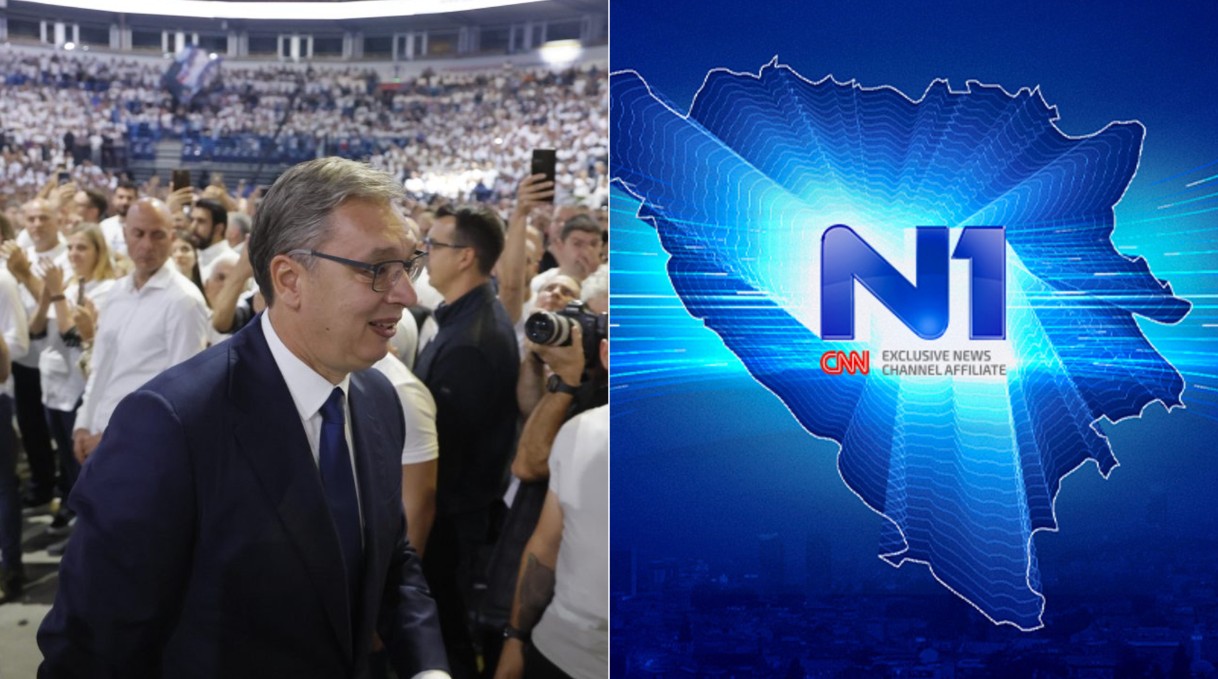
When a media center shuts off the microphone to the leader of the winning electoral list, fundamental questions arise regarding democracy, censorship, media monopolies, and invisible centers of power
By: Slobodan TOMIĆ, M.Sc.

Slobodan TOMIĆ
Analyst and Publicist, Author of the Political TV-Magazine “Voice of the People”
Authorial political and geopolitical analysis ahead of the parliamentary elections in Serbia, October 25, 2026
“The impediment to action advances action. What stands in the way becomes the way.” — Marcus Aurelius
TWENTY-FOUR MINUTES THAT REVEAL FAR MORE THAN A MEDIA DISPUTE
Sometimes the political essence of a historical turning point is not revealed at a grand diplomatic summit, nor in a formal address before tens of thousands of people, but in a seemingly small, symbolically revealing detail. It is exposed in a refusal, behind a closed door, and in a microphone deliberately left switched off for the man whose name stands at the very top of the strongest electoral list in the country.
Precisely such an unprecedented precedent in contemporary Balkan and European media practice occurred in Serbia, on the eve of the fateful parliamentary elections scheduled for October 25, 2026.
The television channel N1 refused to allow Aleksandar Vučić to personally present the electoral list “Aleksandar Vučić, United Serbia” during the designated, standard pre-election broadcast slot of 24 minutes. His political organization was ironically instructed to send another representative instead, while a substitute option was announced for Vučić—a conversation and interview only after the conclusion of the elections.
Here lies the deep systemic and analytical problem that must be openly deconstructed:
- What message is being sent to the citizens when the leader, ideological engine, and ultimate representative of an electoral list is denied the opportunity to directly present the state program during the time slot legally and editorially allocated to that exact list?
- What paradoxical logic offers a platform for political debate only after the ballot boxes have been hermetically sealed and the electoral will already defined?
From an analytical standpoint, the assessment is unequivocal: this decision is no accidental editorial oversight; rather, it raises severe questions about systemic discrimination, the infringement of equal political representation, and a brutal crossing of the line between editorial autonomy and selective political engineering.
The editorial team of N1 justified its action by citing Vučić’s past refusals to appear in their studio and their previously strained relations. However, from an objective, professional, and legal standpoint, pre-election broadcasting space is not private property for settling personal scores—it is a public resource intended to inform the electorate. If a media outlet claims to be professional, its duty is to conduct a rigorous debate with challenging questions, not to utilize its frequency to institutionally block a leader who enjoys the support of the vast majority of citizens.
VUČIĆ IS NOT MERELY A NAME ON A LIST — HE IS THE POLITICAL CHOICE OF MILLIONS
For more than a decade, Aleksandar Vučić has served as the central pillar of the Serbian and Balkan geopolitical architecture. The support he enjoys among the populace is not an abstract concept, nor the product of momentary propaganda. It is the direct result of tangible economic parameters, a historical infrastructure transformation, an active and assertive diplomacy, and a principled defense of state sovereignty under the most complex geopolitical circumstances since World War II.
Opposition structures have every right to critique his policies. However, no media center, no editorial board, and no foreign center of power possesses the right to elevate itself above the sovereign will of the Serbian people.
On October 25, the citizens of Serbia alone will decide—not media commentators, not opposition leaders from their offices, and not foreign embassies.
The undeniable support enjoyed by Vučić stems from the deep conviction of the people that Serbia currently requires:
- Political, economic, and institutional continuity;
- A clear developmental strategy that builds roads, railways, hospitals, and factories;
- Diplomatic resolve that refuses to bow to ultimatums;
- Strong and decisive leadership capable of preserving national dignity.
If his political opponents believe they offer a superior vision, it is their duty to prove it through programs at the ballot box. A political opponent is defeated at the polling stations, not by forcibly turning off the microphone and media-isolating the leader who represents the national majority.
AN INTERVIEW AFTER THE ELECTIONS: WHY THEN, AND NOT BEFORE THE VOTING?
The greatest absurdity in the media outlet’s conduct lies precisely in its offer for Aleksandar Vučić to appear in the studio after the election day has concluded.
The pre-election process and media representation exist so that citizens can evaluate programs, arguments, and leadership visions in a timely manner—before approaching the ballot boxes. Once the election concludes, voters are faced with a fait accompli and the consequences of their choice. Therefore, the offer for an interview after the elections is a transparent attempt to satisfy formal protocol while consciously neutralizing the core substance.
If the editorial team considers Vučić a relevant interlocutor for the day after the elections, every analytical citizen rightly asks: why were his arguments not equally important and necessary when the people had to make a momentous decision regarding the country’s future? Democracy is not media entertainment after the fact; it is an open arena where citizens must hear all political options beforehand.
THE SHADOW OF THE “COLORFUL REVOLUTION”: THE LESSON MACEDONIA MUST NOT FORGET
As an analyst from Macedonia, I have a moral and professional obligation to view these developments through the lens of the bitter experience through which my own country passed. Macedonian society witnessed firsthand how deeply state foundations can be shaken when media space is placed in the service of political engineering, and when protest movements are leveraged to dismantle legitimately elected institutions.
The experience with the so-called “Colorful Revolution” in Macedonia demonstrated what occurs when politics is reduced to a black-and-white matrix, when labels replace dialogue, and when geopolitical agendas that undermine state sovereignty slip through behind the veil of fighting for democracy.
The lesson for Serbia is crystal clear: when political tensions deepen, the most crucial imperative is to preserve the institutional order, constitutional rules, and the legitimacy of the electoral process. Every government must be subject to reasoned criticism, but any change must solely be the product of the people’s will expressed in free elections—never the result of extra-institutional pressures, street blockades, or media dictation.
THE “DEEP STATE” AND POLITICAL CENTERS OF POWER
In modern global geopolitics, internal processes within a sovereign state rarely occur in isolation. Sovereign nations are under constant pressure from international networks, financial centers, non-governmental structures, and media conglomerates pursuing their own geostrategic interests.
In this context, the imposition of media blockades on Serbia’s leadership raises a legitimate analytical question: Do organized media pressures conceal centers of power whose ultimate objective is to weaken Serbia’s independent and sovereign course?
True sovereignty is defended through resilient institutions, transparency, and political resolve. For Aleksandar Vučić, the most powerful response to these insidious pressures is not retreat, but the continuous demonstration of superior results—proving that his statesmanlike vision provides long-term stability, economic rise, and steadfast protection of Serbia’s national interests.
THE DANGER OF HISTORICAL ANALOGIES AND RECKLESS RHETORIC
In Balkan political clashes, recourse is frequently taken to exaggerated historical parallels and the reckless labeling of opponents with terms drawn from the darkest epochs of the 20th century.
Such reckless rhetoric trivializes historical tragedies and destroys the space for genuine political discourse. Not every media dispute is systemic totalitarianism, nor is every political crisis fascism. The N1 case must be analyzed soberly and idiomatically: not through empty slogans, but by demanding equal treatment for all participants in the electoral race, media accountability, and respect for the public’s right to be fully informed.
CROATIA, REGIONAL PRESSURES, AND SERBIA’S RIGHT TO CONDUCT ITS OWN POLICY
Today, Serbia operates in a highly complex regional environment. Relations with neighboring states, particularly with Croatia, are frequently weighed down by historical burdens as well as contemporary, conflicting diplomatic and security interests.
Serbia possesses an absolute, sovereign right to conduct its own foreign and domestic policy, regardless of whether that policy pleases political elites in Zagreb, Brussels, or Washington. Serbian sovereignty is authentic and requires no permission from foreign centers; it is affirmed through the state’s capacity to independently define its priorities and uncompromisingly protect its citizens.
WHAT VUČIĆ HAS BUILT AND WHY HIS VICTORY IS VITAL FOR THE REGION
Any rigorous and objective analysis must be grounded in concrete, measurable, and undeniable factors.
Over the past thirteen years, under the leadership of Aleksandar Vučić, Serbia has undergone a historical economic and infrastructural renaissance:
- Hundreds of kilometers of modern highways, expressways, and high-speed railways have been constructed;
- Billions of euros in direct foreign investment have been attracted;
- A record-low unemployment rate has been achieved, accompanied by a steady rise in wages and pensions;
- Dozens of hospitals, clinical centers, schools, and industrial zones have been built and modernized.
Unlike past eras when public capital drained through dubious private channels, today every citizen can witness tangible results on the ground.
On the geopolitical stage, Vučić has forged a level of diplomatic prestige unseen in the region for decades. He is a leader with whom global powers—from Washington and Brussels to Beijing, Moscow, and the BRICS nations—engage with profound respect. Particularly significant is his statesmanlike wisdom in establishing constructive dialogue even with regional figures with whom he previously had sharp disagreements (such as Edi Rama), transforming historical rivalries into projects of regional cooperation and economic growth.
Therefore, the contest on October 25 transcends Serbia’s borders. A strong and stable Serbia guarantees a secure and stable future for the entire Balkans. The victory of the option led by Vučić is the guarantor of peace, economic equilibrium, and prosperity for all regional nations.
In this context, the tragic event in Novi Sad represents a profound human sorrow that must receive a complete, independent, and institutional legal resolution. However, attempts by specific structures to exploit this human tragedy as fuel for violent break-ins, arson, and state destabilization constitute anti-democratic acts that must be condemned in the strongest terms.
PENSIONERS, CITIZENS, AND MACEDONIANS IN SERBIA
The true mark of a state-building policy lies in its care for its most vulnerable citizens.
Through continuous pension increases, financial support for young families, and systemic social measures, Serbia demonstrates that its economic successes translate directly into tangible benefits for its people.
As a Macedonian analyst, I place particular emphasis on the position of the Macedonian national minority in Serbia:
- Macedonians are exceptionally loyal, hardworking, and honorable citizens of Serbia who must be fully and equally integrated into all institutional and political processes;
- The voice of the Macedonian community in key areas like Pančevo and Jabuka, led by responsible and established representatives such as Maja Georgijevska (President of the Party of Macedonians), must be heard and appropriately represented within the National Council and state bodies;
- Authentic representation is crucial: Macedonians in Serbia must not be left on the margins or represented by commercial profiteers serving self-interests; rather, they must have direct opportunities to preserve their language, culture, traditions, and political identity within the constitutional framework of Serbia.
BLOCKADES AND RESPONSIBILITY TO THE CITIZENS
The right to protest is protected in every democracy, but that right ends where anarchy begins. Blocking highways, disrupting the daily lives of ordinary citizens, and attempting to forcibly seize institutions by political nonentities lacking a program and accountability do not constitute democracy—they represent a deliberate bid for chaos.
Young people and students must maintain their critical thinking, but they must not allow themselves to be used as tools by structures seeking to destabilize their own country for foreign geopolitical goals. Power in a sovereign state is earned exclusively through trust, arguments, and votes at the ballot box—never through street blockades and the violent overthrow of order.
WHY WE MUST STAND WITH ALEKSANDAR VUČIĆ
Support for Aleksandar Vučić is not empty propaganda; it is a firm conclusion derived from facts, the geometry of power, and undeniable results on the ground.
I stand openly and unreservedly behind Vučić because:
- Serbia genuinely requires an experienced statesman who knows how to preserve developmental continuity and who refuses to yield to external pressure from foreign centers of power;
- His achievements are concrete and visible: new highways, factories, low unemployment, energy security, and international prestige;
- His policy serves as the anchor of regional stability, which is of vital importance to Serbia, Macedonia, and the entire Balkans.
This endorsement reflects an understanding that genuine progress, reforms, and the protection of national interests are achieved through strong state leadership and electoral legitimacy—never through artificially engineered chaos.
FINALE: LET THE CITIZENS DECIDE — NOT THE MEDIA GATEKEEPERS
The 24 minutes denied to Aleksandar Vučić have evolved into a powerful symbol of the fight for true democracy and equality in the public sphere.
If opposition contenders believe they offer a better future for Serbia, let them present their concepts before the people. However, attempts to eliminate the leader of the winning electoral list through media blockades undermine the very foundation of the democratic process.
On October 25, the citizens of Serbia will not merely elect parliamentarians—they will decide the direction of state policy, the preservation of national sovereignty, and who will guide the nation through these geopolitical tempests.
Marcus Aurelius reminds us that “the impediment to action advances action. What stands in the way becomes the way.” For Aleksandar Vučić, this media blockade serves merely as another catalyst to demonstrate the superiority of his program, strength, and statesmanlike vision. And for all actors on the political stage, one eternal truth remains: Do not fear confronting arguments. The people are more important than any editorial board, and history remembers only those who built for their homeland.
On October 25, the final word and decision belong exclusively to Serbia and its sovereign people.
Slobodan TOMIĆ, M.Sc.
Analyst and Publicist
Author of the Political TV-Magazine “Voice of the People”
