

PORTRAITS OF POWER
EUROPE DEMANDS REFORMS, MACEDONIA DEMANDS FAIRNESS – COMPROMISE MUST NEVER BECOME A SYNONYM FOR ONE-SIDED CONCESSIONS!
By: M.Sc. Slobodan TOMIĆ

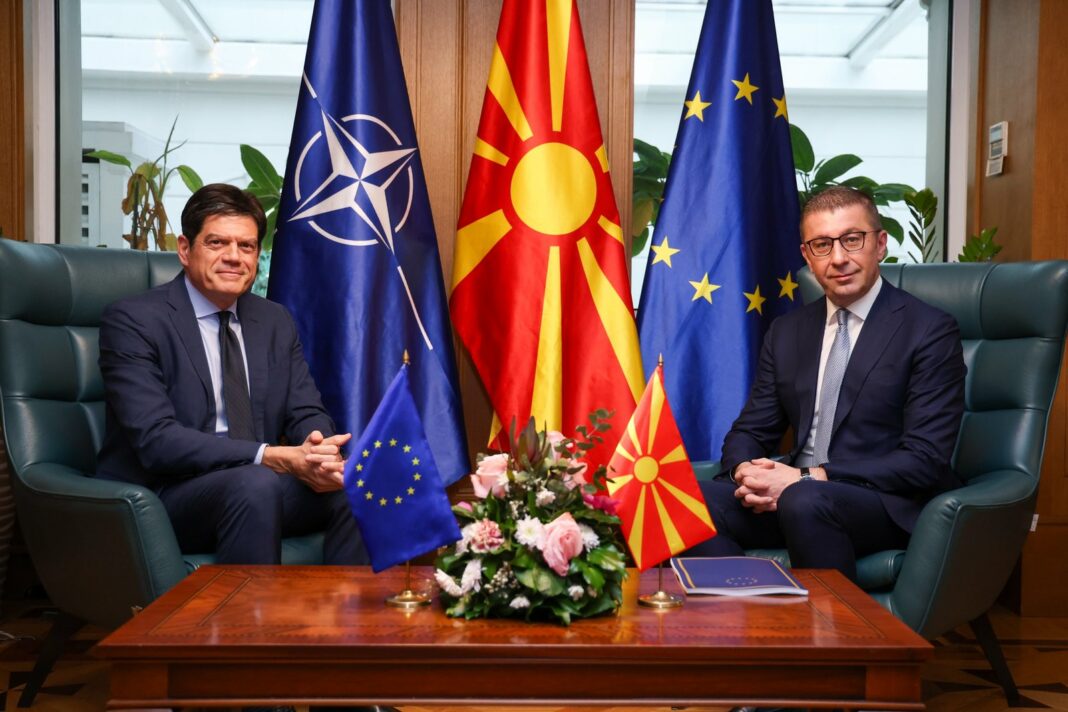
Yesterday’s joint press conference held by Prime Minister Hristijan Mickoski and the European Union Ambassador, Michalis Rokas, following the presentation of the European Commission’s Report on the country’s progress, raised far more questions than can be found in Brussels’ diplomatically worded assessments.
This was not merely another meeting between Macedonia’s political leadership and a representative of European diplomacy. It was a moment in which two fundamental political realities once again collided: Macedonia’s legitimate demand for its achievements to be recognised and Europe’s policy of conditionality, which has kept our accession process in uncertainty for years.
Therefore, the central question is not simply how much progress Macedonia has made, but whether the European Union has the political will to apply its own principles consistently, predictably and equally to all countries.
Prime Minister Hristijan Mickoski conveyed a clear message: Macedonia remains committed to its European path. It will continue implementing reforms, strengthening its institutions, improving its economy, fighting corruption and aligning its legislation with European standards.
However, the essence of his address lay in his demand that achievements be assessed according to principles rather than political calculations.
This is a position that deserves serious consideration.
Macedonia is not asking to be exempted from its European obligations. It is not seeking privileges, nor is it asking European institutions to overlook domestic shortcomings. It is asking for something that should form the foundation of every credible European process: fulfilled obligations must be acknowledged, results must be recognised, and criteria must not change according to political circumstances.
That is the essence of Mickoski’s message.
“Macedonia is not asking Europe to lower its standards. It is asking Europe not to change its principles.”
ROKAS ACKNOWLEDGES PROGRESS, BUT DOES NOT DISGUISE SHORTCOMINGS AS ACHIEVEMENTS
Ambassador Michalis Rokas noted that, compared with the previous report, improvements had been recorded in several areas, particularly education, science, research, digital transformation and alignment with the European Union’s Common Foreign and Security Policy.
He welcomed the steps taken in the area of the rule of law and the adoption of certain legislative measures, while emphasising that further tangible results were still needed.
Here, we must remain precise and objective.
The report is neither entirely positive nor entirely negative. It acknowledges progress in certain areas, but also identifies serious shortcomings that cannot be ignored.
Of particular concern is the finding that no progress has been made in preventing and combating corruption, which remains widespread. The report also highlights problems relating to the rule of law, judicial independence and delays in proceedings involving high-level corruption.
These observations must not be subjected to political relativisation.
Not every criticism from Brussels can be dismissed as unfair, just as not every positive assessment can be turned into a political victory.
The state must implement reforms first and foremost for the benefit of its own citizens. An independent judiciary, a professional public administration, effective institutions and an uncompromising fight against corruption are not gifts from Europe. They are essential prerequisites for the normal functioning of any state.
Yet this is precisely where another fundamental question arises.
If the European Commission recognises improvements in reform areas, acknowledges progress in aligning legislation with European standards and upgrades its assessment of the country’s readiness for membership, why does the political process remain trapped in deadlock?
Reforms and political conditionality are two separate issues. They must not become so entangled that a country’s progress is rendered almost invisible behind bilateral political disputes.
Rokas has acknowledged progress. But acknowledging progress is not the same as unlocking the European path.
And that distinction is at the heart of the problem.
MARTA KOS – IMPROVED READINESS, BUT THE SAME POLITICAL CONDITION
Just one day before yesterday’s press conference, European Commissioner for Enlargement Marta Kos, while presenting the 2026 Enlargement Package, announced that Macedonia had improved its level of preparedness for membership and was among the candidate countries with a high degree of alignment with European legislation.
At the same time, she reiterated that constitutional amendments agreed upon in 2022 remain necessary to unblock accession negotiations and open the first cluster.
There is no need to manufacture a contradiction between Marta Kos and Michalis Rokas. They are addressing different dimensions of the same process.
Rokas highlights reform achievements, while Kos emphasises the political condition for the continuation of negotiations.
Yet it is precisely this distinction that reveals the essence of Macedonia’s European dilemma.
The European Union can acknowledge that Macedonia is making progress in aligning its legislation with European standards, fulfilling its reform obligations and improving its readiness for membership, while simultaneously keeping the accession process blocked over constitutional amendments.
That is the political reality.
However, the country has every right to ask a legitimate question: what concrete guarantees exist that fulfilling this condition will lead to genuine and uninterrupted progress in the negotiations?
Is this truly the final political obstacle, or will further demands, interpretations and additional conditions emerge once again?
This is not a question of mistrust towards Europe. It is a question of political predictability.
Trust cannot be a one-way obligation. If Macedonia is expected to take difficult political decisions, the European side must also demonstrate that its assurances carry institutional and political weight.
Europe’s perspective cannot continually be presented as being within reach, only for its realisation to recede whenever Macedonia approaches the next political obstacle.
“The European perspective must be a process governed by clear rules, not a horizon that is constantly pushed further away.”
ŠEKERINSKA AND THE PHILOSOPHY OF COMPROMISE – WHO IS EXPECTED TO GIVE WAY?
Particular attention should also be paid to Radmila Šekerinska’s interview, in which she argued that Macedonia must propose solutions and achieve domestic political consensus, since neither Brussels, Washington nor Berlin will resolve our problems on our behalf.
Šekerinska, who serves as NATO’s Deputy Secretary General, is entitled to call for political responsibility, dialogue and statesmanship.
However, precisely because of her senior international position, her public message carries particular significance and deserves serious political scrutiny.
I agree that Macedonia needs domestic political consensus on its most important national issues. I also agree that no foreign capital can replace the responsibility of domestic political actors.
But the real question goes much deeper: what kind of consensus is being sought, around which conditions, and with what guarantees for the state?
Whenever compromise is invoked, we must also ask who is expected to compromise, on what issues and where the limits of concessions lie.
Compromise cannot become a permanent obligation imposed on only one side while the other retains all its positions and demands.
Macedonia cannot forever be the side expected to prove its willingness to make further concessions, while the question of reciprocity remains on the margins of the diplomatic agenda.
It is particularly important to remember that Macedonia and Bulgaria are allied countries within NATO. However, membership of the Alliance does not mean that NATO should conduct negotiations concerning membership of the European Union. These are two distinct institutional frameworks.
Nevertheless, an alliance also entails responsibility for fostering good-neighbourly relations, respecting agreements and refraining from policies that undermine mutual trust.
In this context, a legitimate question arises: why is the public call for compromise directed so strongly towards Macedonia, while an equally clear appeal for reciprocity, goodwill and responsibility from the Bulgarian side is missing?
The European Commission itself states that existing bilateral agreements with neighbouring countries should be implemented in good faith by all parties.
That is an important formulation.
“Responsibility cannot be one-sided, just as good-neighbourly relations cannot be a unilateral obligation.”
The European principle of good-neighbourly relations cannot be transformed into a mechanism whereby one country is constantly expected to demonstrate its readiness to make concessions, while the other is not held to an equally clear standard of reciprocity.
Nor can every concession automatically be portrayed as an act of statesmanship, while every demand to protect national dignity is dismissed as political stubbornness.
Compromise is a civilised and political instrument for overcoming differences. But when compromise becomes a permanent demand for only one side to abandon its positions, we are no longer talking about an equal agreement.
We are talking about an asymmetric political relationship.
This political debate must also address the position of the opposition leadership, particularly Vенко Filipche, which supports the need for constitutional amendments and calls for political progress in the process.
However, whenever such a step is proposed, the public has the right to receive clear answers: what guarantees exist, what exactly follows afterwards, and how will the same uncertainty be prevented from recurring?
Calling for speed is not enough. Decisions of national importance are not a race in which the winner is the one who makes concessions first.
They are obligations to present and future generations.
Therefore, domestic political consensus must not be built on the pressure that Macedonia must accept everything in order not to remain outside Europe.
It must be built on a clear understanding of the national interest, democratic legitimacy, concrete guarantees and equal respect for the obligations undertaken.
THE EUROPEAN UNION FACES ITS OWN TEST – DOUBLE STANDARDS UNDERMINE TRUST
Macedonia’s story also has a broader European dimension.
The European Union is not merely an economic alliance or an administrative structure. It is a political community whose strength rests on values, rules, legal certainty and respect for the national and democratic sovereignty of its member states.
That is precisely why Brussels must be held to the standard of consistency.
If European institutions demand the rule of law, predictability, respect for agreements and institutional accountability from candidate countries, those same principles must also be reflected in their own conduct.
European criteria cannot be applied rigorously when assessing reforms in Macedonia, while political considerations are allowed to take precedence over principles when determining the fate of the accession process.
Enlargement cannot be presented as a strategic interest of the European Union while, in practice, its progress is allowed to depend on prolonged bilateral disputes without a sufficiently clear mechanism for resolving them.
This is not merely a Macedonian problem.
It is a test of the credibility of the European Union’s enlargement policy.
If the European perspective of Western Balkan countries is reduced to political negotiations in which rules remain open to further interpretations, the European Union risks losing the trust of precisely those societies that have regarded membership as their strategic objective for the longest time.
If Europe wants to be a geopolitical actor, it must demonstrate the political will to deliver on its own strategic commitments.
Encouraging statements are not enough. Concrete results are needed.
Speaking of a European family is not enough. Europe must demonstrate that the rules of that family apply equally to everyone.
MACEDONIA MUST REFORM, BUT IT MUST NEVER ABANDON ITS NATIONAL INTEREST
One essential lesson must be drawn from yesterday’s press conference.
Macedonia must not use political blockades as an excuse for its own institutional weaknesses.
The fight against corruption, judicial independence, a professional public administration and the rule of law are not European favours that we must earn in order to receive praise from Brussels.
They are fundamental obligations of every functional state towards its own citizens.
The Government must deliver the reforms it has promised. Institutions must demonstrate results. Accountability must apply to everyone, without political, economic or party privileges.
At the same time, however, the European perspective must not become an endless process of political conditionality in which achievements are acknowledged in declarations while progress is continually postponed.
Prime Minister Mickoski was right to raise the issue of assessing results according to principles.
This must not remain merely a political message delivered at a single press conference. It must become a consistent national position.
Macedonia must remain steadfast in its reforms, active in diplomacy and principled in its politics.
It must fulfil its obligations, but it also has the right to demand clear guarantees that fulfilling those obligations will be followed by tangible progress in the European process.
Its national interest must never become an object of daily political bargaining, nor must national dignity be treated as an obstacle to European integration.
If the European Union wishes to preserve its appeal and credibility in the region, it must demonstrate that its rules are founded on predictability, fairness and equal respect for obligations.
That is precisely why yesterday’s press conference should be viewed neither as a diplomatic victory nor as a defeat.
It represents a moment in which reform progress has been acknowledged, but the political deadlock remains firmly in place.
Rokas recognises the reform dimension. Kos reiterates the political condition.
Šekerinska calls for domestic consensus. The opposition demands movement in the process.
But above all these messages stands one question that cannot be avoided:
“Who will take responsibility for ensuring that Europe’s promises finally become a predictable and fair political process?”
Macedonia has an obligation to change. But Europe has an obligation to demonstrate that its values are more than declarative statements in reports and diplomatic speeches.
Macedonia has the right to a European future. But it also has a responsibility to build that future on its own institutional strength, democratic maturity and national dignity.
We are not asking Europe to make concessions on our behalf.
We are asking that we not be expected to make all the concessions ourselves.
Ultimately, membership of the European Union must not become an objective that justifies any price.
It must be a strategic choice that delivers a better quality of life, stronger institutions, legal certainty and greater prosperity for the citizens of Macedonia.
A state does not exist to satisfy the political expectations of others.
It exists to protect its citizens, their rights, their freedom and their future.
The European path is our strategic choice.
But the national interest is our enduring responsibility.
A WORD OF WISDOM
“Salus populi suprema lex esto.”
“The welfare of the people shall be the supreme law.”
Marcus Tullius Cicero, Roman statesman, orator and philosopher.
This thought is not a call for isolation. It is a reminder that every political decision, every agreement and every compromise must ultimately be judged by the consequences it has for the state and its citizens.
THE FINAL WORD
“MACEDONIA IS NOT ASKING EUROPE TO RELEASE IT FROM ITS OBLIGATIONS. IT IS ASKING EUROPE NOT TO RELEASE ITSELF FROM THE OBLIGATION TO BE FAIR!”
MACEDONIA MUST MOVE TOWARDS EUROPE, BUT IT MUST NEVER ABANDON ITSELF TO PROVE THAT IT BELONGS THERE.
M.Sc. Slobodan TOMIĆ
Analyst and publicist, author of the political television programme “The Voice of the People”.
