

By Slobodan TOMIC

Europe is once again speaking of enlargement, unity, economic strength, democracy and a shared future.
But can Europe genuinely aspire to be great and united while allowing one country to endure decades of new conditions, political pressure and demands that reach into the very essence of its national identity?
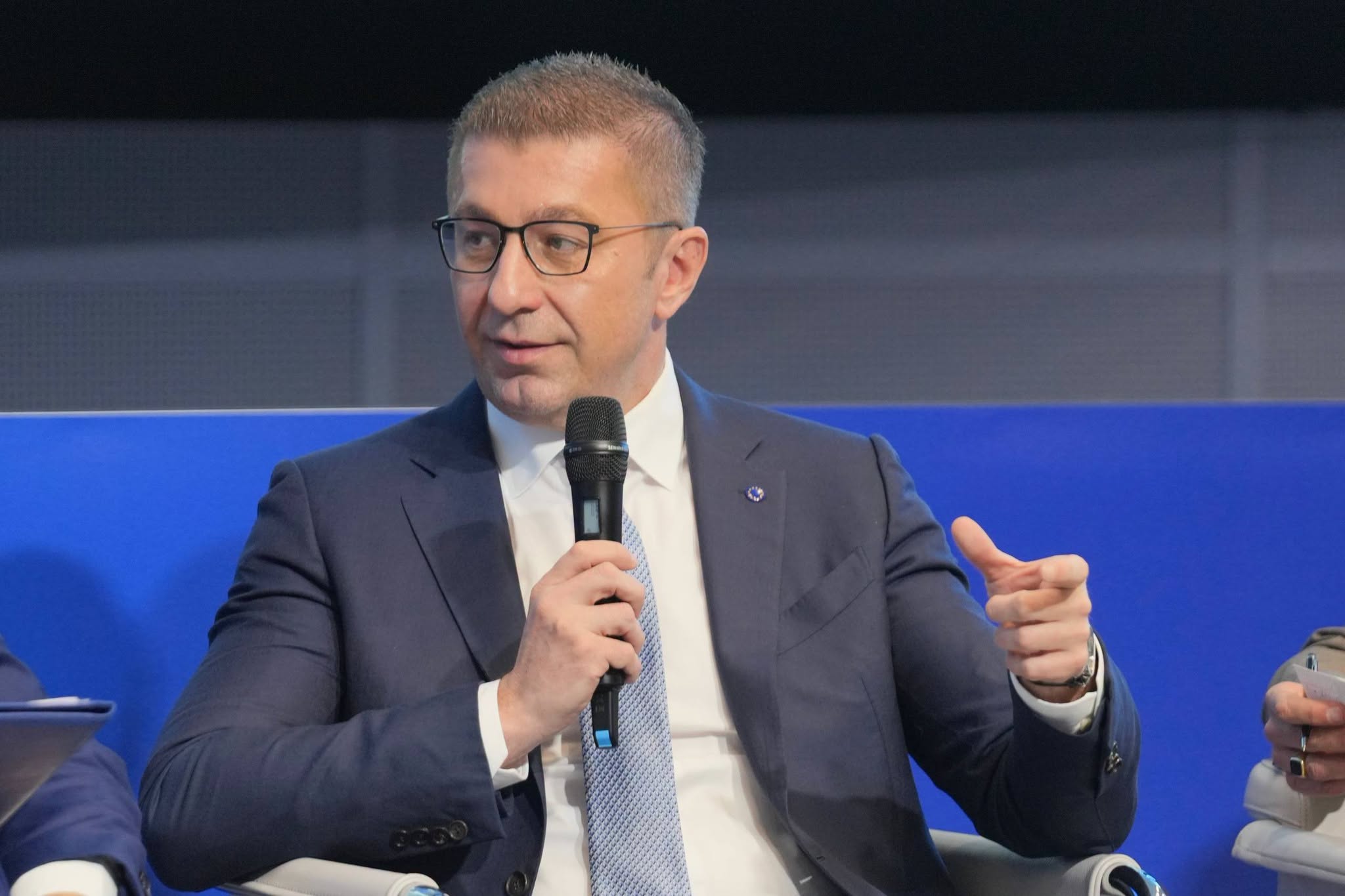
This is precisely why Prime Minister Hristijan Mickoski’s message at the Enlargement Forum in Brussels carries particular political significance.
Mickoski made it clear that the enlargement process should be about modernising states, reforming institutions, strengthening accountability, transparency and openness towards citizens.
However, if a country is expected to amend its Constitution simply because certain actors seek changes that touch upon the very foundations of its national identity, then such demands have little to do with the true purpose of European enlargement.
And this is precisely where Mickoski struck at the most sensitive nerve of European policy towards Macedonia.
The road to Europe must never become a road to self-denial! Membership of the European Union must never become a price that a nation is expected to pay with its national dignity!
Macedonia is not asking for privileges. It is not asking to be exempted from reform. Nor is it seeking to circumvent the Copenhagen criteria.
It is asking for those criteria to be applied equally to all.
Let us be precise: the 2022 negotiating framework includes an obligation to amend the Constitution to include citizens who identify as Bulgarians. Yet the fundamental question remains: will fulfilling this requirement ensure uninterrupted progress towards EU membership, or will Macedonia once again face additional political conditions?
Who can guarantee that tomorrow will not bring new demands concerning the Macedonian language, history or national self-identification?
Do European institutions not understand that the repeated reopening of such questions undermines Macedonian citizens’ confidence in the European Union itself?
More importantly, is it consistent with European values to place a country in a position where it must amend its Constitution under sustained political pressure, without any clear guarantee that doing so will remove all obstacles on its European path?
A Constitution is not an instrument for satisfying someone else’s historical or political ambitions. It is the supreme legal act of a sovereign state. Constitutional amendments must arise from democratic will and the conviction that they serve the country’s interests, not from fear that the country will once again be blocked.
Ursula von der Leyen speaks of enlargement as a historic achievement, of a stronger Europe and of the dangers posed by Russian aggression. Marta Kos warns that today’s enlargement is unfolding in a far more complex geopolitical environment.
But allow us to ask: why is Macedonia’s European future so consistently measured against geopolitical interests rather than the principles of fairness, equality and respect for national distinctiveness?
Why is enlargement so often presented through the prism of Russia?
Are economic development, open markets, investment, democratic standards and a better quality of life for European citizens not equally important objectives?
Russia must never become the measure of Macedonia’s European worth. Our European commitment is not the product of someone else’s geopolitical interests. It stems from our own conviction that the country’s future lies in a democratic, economically prosperous and united Europe.
I support a European Macedonia, but I oppose the disregard for European principles. We cannot invoke Europe while forgetting its fundamental values whenever Macedonia is concerned.
WHERE DOES THE BALKANS FIT INTO THIS GRAND EUROPEAN VISION?
Will the Balkans continue to be Europe’s blind spot — geographically at its heart, yet politically relegated to its periphery?
Europe cannot speak of unity while allowing the Western Balkans to remain trapped in perpetual uncertainty. Macedonia, Albania, Serbia, Montenegro, Bosnia and Herzegovina, and Kosovo are not a geopolitical periphery. They are part of Europe’s future.
The European perspective must be equal, regardless of the religious, ethnic or cultural composition of a country’s population.
There can be no genuine European future where double standards prevail, where principles apply to some while political interests dictate the rules for others.
Particularly troubling is the fact that bilateral historical and identity-related disputes with Bulgaria have become such a serious obstacle to Macedonia’s European integration.
The European Union cannot speak of good neighbourly relations while failing to demonstrate sufficient political will to prevent bilateral disagreements from assuming the role of European accession criteria.
Macedonia cannot be expected to make one concession after another without any assurance that the latest demand will indeed be the last.
Europe is not great if it asks a small nation to renounce itself in order to earn a place in its family.
Europe demonstrates greatness when it possesses the dignity, wisdom and democratic maturity to respect diversity.
In this context, Mickoski’s position deserves support. Not because every decision made by a government must be beyond criticism, but because the principle he is defending concerns an issue of lasting national significance.
Naturally, Macedonia must continue with reforms, the fight against corruption, judicial independence, stronger institutions and improvements in living standards. These are our obligations to our citizens and to Europe.
But reform does not mean self-denial. European integration does not mean erasing national distinctiveness. Modernisation does not mean changing one’s identity.
The political interests of individuals must never take precedence over national interests.
Macedonia must not once again be placed in a position where it is forced to choose between its European future and its own dignity.
And this is where the distinction lies between a politics of principle and a politics of concessions at any cost.
Zoran Zaev and his political approach left serious consequences for Macedonia’s state policy. Today, when Venko Filipche and the opposition demand that constitutional amendments be accelerated, they have an obligation to answer one fundamental question: what guarantees does Macedonia have that further demands will not follow?
Mickoski has a historic opportunity in Brussels to demonstrate that Macedonia can be a constructive, responsible and serious partner, while remaining a country that knows how to defend its own red lines.
My message to European leaders is clear:
“We are not asking Europe to make an exception for Macedonia. We are asking Europe to stop making exceptions to its own principles at Macedonia’s expense!”
My message to Hristijan Mickoski is equally clear: continue the dialogue, pursue reforms, build European alliances and defend national interests on the basis of principle.
Do not allow Macedonia to be placed once again before a false choice between Europe and its own identity.
For Macedonia was not created to remain a perpetual candidate, an endless subject of negotiations or a permanent victim of other people’s historical and political complexes.
If the motto of the Forum is “Wider Europe – Stronger Europe”, then let Europe truly become wider and stronger.
Let it not be a Europe of double standards. Let it not be a Europe of endless conditionality. Let it not be a Europe in which small nations are expected to abandon their distinctiveness in order to be accepted.
“IF EUROPE WANTS TO BE GREAT, LET IT BE GREAT IN HEART AND SOUL AS WELL! LET THERE BE ROOM FOR ALL NATIONS, BUT ALSO RESPECT FOR EVERY SINGLE ONE OF THEM!”
Macedonia wants to be part of Europe. But it wants to join as Macedonia — with its own name, its Macedonian language, its identity, its history and its dignity.
That is not an obstacle to European unity.
THAT IS THE TRUE DEMOCRATIC TEST OF EUROPE’S GREATNESS!
