

By Slobodan TOMIĆ

“Who controls culture controls the future; who controls perception controls the state.”
Samuel Huntington
THE INVISIBLE EMPIRE OF THE 21ST CENTURY
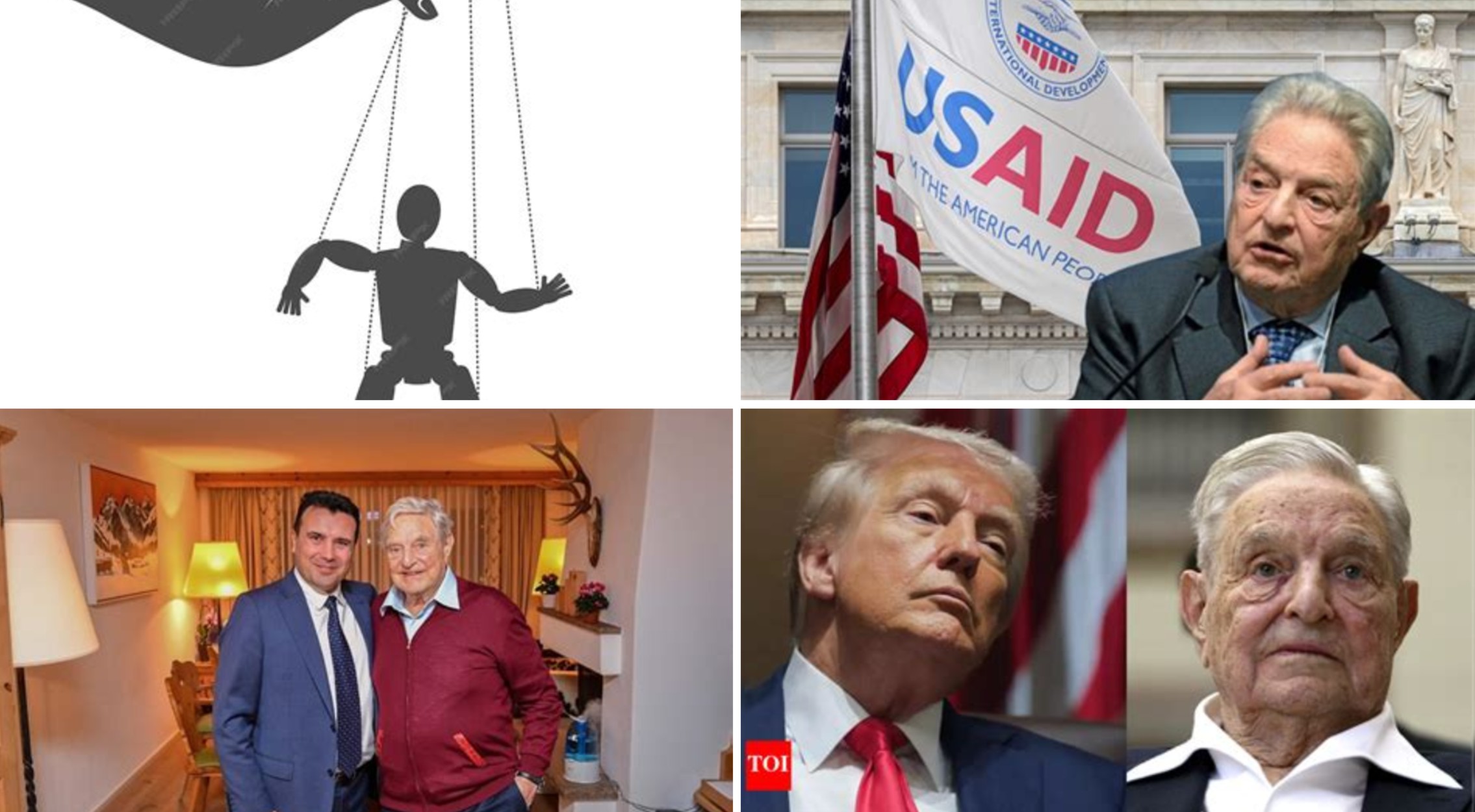
In the modern world, there exists a form of power that does not march with armies, does not plant flags, and does not conquer territories.It conquers something far deeper.It conquers , consciousness.This is the power of transnational networks of foundations, NGOs, media influence structures, and ideological centers operating beyond the traditional democratic mandate.Critics describe this system as:an empire without borders,an empire without accountability,an empire without a people.Within this context, the name of George Soros has become a symbol of a global confrontation between:national sovereigntyandtransnational ideological power.
WHY SOROS BECAME THE MOST CONTROVERSIAL FIGURE IN GLOBAL POLITICS
Over the past three decades, Soros has been one of the most polarizing figures in the world.To some, he is a philanthropist and supporter of liberal values.To others, he represents political influence exercised through financial and ideological networks.Particularly in Central and Eastern Europe, criticism often centers on claims that such foundations do not function solely as humanitarian institutions, but also as instruments of social and political engineering.This perception has created deep ideological polarization in many countries, including Macedonia.
MACEDONIA AS A FRONTLINE OF IDEOLOGICAL CONFLICT
During years of political crisis, Macedonia became a space where the clash between globalism and sovereignty was felt intensely.A segment of the public came to believe that NGO networks exercised significant influence over:political processes,public discourse,and identity-related policies.Gradually, a perception emerged that an elite was forming which did not derive legitimacy from citizens, but from external centers of influence.
THE LANGUAGE OF PUBLIC ANGER
When trust between citizens and political elites collapses, a new political vocabulary emerges.In Macedonian public discourse, particularly on the streets and across social media — certain political actors began to be described using harsh terms reflecting:disappointment,anger,and a sense of national insecurity.This language is not a legal classification.It is a sociological signal.A signal that a significant portion of society feels the state is no longer functioning as a sovereign expression of the people’s will.
THE PERCEPTION OF PROXY POLITICS
In political analysis, the term “proxy” is used for actors perceived as intermediaries for broader geopolitical interests.In Macedonia, parts of the public adopted this concept to explain why certain political decisions appeared not to originate from domestic strategic priorities, but from external agendas.Regardless of differing interpretations, this perception became deeply embedded in the political psychology of society.
WHY DONALD TRUMP SEES SOROS AS A SYMBOL OF THE GLOBAL SYSTEM
The conflict between Donald Trump and George Soros is not personal.It is ideological.Trump represents a model centered on:national sovereignty,economic protectionism,and state-centered political authority.Soros, according to his critics, symbolizes:open borders,global institutional frameworks,and transnational governance.Thus, their confrontation reflects a deeper clash between two visions of world order.
THE MYTH AND REALITY OF THE “FIFTH COLUMN”
The term “fifth column” is used in political rhetoric to describe groups perceived as advancing external interests.In Macedonia, it became part of political language rather than a legal definition.Yet its popularity reveals something profound:a deep crisis of trust between citizens and political elites.
THE ROOT OF THE CRISIS: THE LOSS OF TRUST
Macedonia’s greatest challenge is not external influence alone.The deeper problem arises when domestic elites:lose connection with the people,lose sensitivity to national issues,and lose historical responsibility.At that point, citizens begin to feel that the state is being managed — but not truly represented.
THE REAL BATTLE — FOR CONSCIOUSNESS
In the 21st century, geopolitical conflicts are rarely fought with weapons.They are fought through:education,media,cultural policy,and control over narratives.For this reason, the global debate surrounding Soros and his critics is not merely financial.It is civilizational.
CONCLUSION: THE STRUGGLE FOR SOVEREIGN STATES
History shows that nations survive empires when they preserve their consciousness.Macedonia has survived:empires,occupations,identity pressures.And it has always renewed itself.Therefore, today’s struggle is not about individual personalities.It is about a fundamental question:Will states remain masters of their own destiny,or become components of global ideological architectures?The answer to that question will shape Macedonia’s future.
