

By Slobodan Tomić

“A statesman is one who thinks of the next generation, not the next election.”
Winston Churchill
ORBÁN, THE ARCHITECT OF BALANCE IN A SHAKEN EUROPE
At a time when Europe hesitates—when Brussels often appears as a center without a clear दिशा—Viktor Orbán governs like a chess player thinking several moves ahead.
His policy is neither blind alignment with the West nor uncritical proximity to the East. It is a calibrated balance—rooted in sovereignty, pragmatism, and national interest.
That is why Budapest today is not merely a capital. It is a signal.
TRUMP’S MESSAGE: EUROPE WILL NO LONGER BE GUARDED
Donald Trump is sending a message Europe may not want to hear—but must understand: the era of unconditional American backing is ending.
Signals related to energy, Iran, and global stability are not merely economic—they are strategic warnings.
The United States is stepping back.
Europe must learn to stand on its own.
In that emerging reality, space opens for new centers of influence—and Budapest is becoming one of them.
MICKOSKI: A POLITICIAN WHO BUILDS POSITION, NOT APPLAUSE
Hristijan Mickoski has done something long considered unthinkable in Macedonian politics: he refused to play by the old script.
He did not rush to Brussels for validation.
He did not chase quick diplomatic points.
He did not adjust his rhetoric for approval.
Instead—he began to build.
He builds position.
He builds relationships.
He builds strategy.
That is the difference between a politician who reacts and a statesman who plans.
TEN MEETINGS: CONTINUITY OF TRUST, NOT PROTOCOL
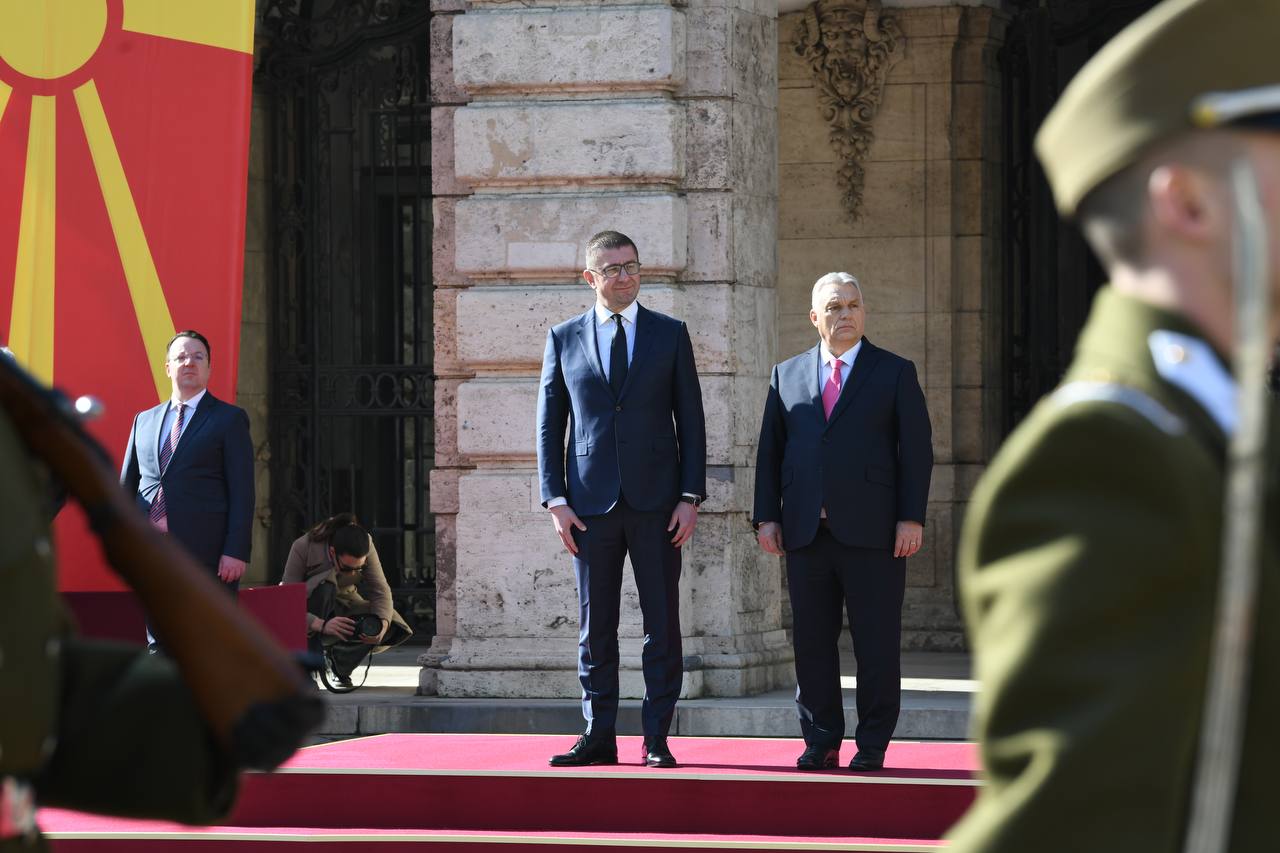
Ten meetings between Mickoski and Orbán are not protocol.
They are evidence.
Evidence of a shared vision.
Evidence of a long-term axis in the making.
Evidence that Macedonia is stepping out of improvisational politics.
This is not symbolism.
This is positioning.
COMPASS VS. ANCHOR: TWO POLICIES, TWO DESTINIES
One policy moves a country forward.
The other keeps it in place.
Today, Mickoski holds the compass—direction, orientation, strategy.
The anchor of the past, tied to the policies of Zoran Zaev and SDSM, held Macedonia in a cycle of concessions without results.
One side sought approval.
The other seeks position.
That is the essential difference.
SDSM AND THE POLITICS OF HUMILIATION
The most dangerous element is not merely a flawed strategy—it is the attitude toward partners and reality itself.
The same political establishment, now led by Venko Filipče, which today lectures on diplomacy, once dismissed dissenting voices as “marginal.”
Even when former U.S. Secretary of State Mike Pompeo signaled the need for a new approach and new partnerships, those signals were ridiculed.
They underestimated the shifts.
They ignored the signals.
They mocked what is now becoming policy.
This is not just a political miscalculation.
It is a loss of compass.
FEAR OF A NEW WORLD: WHY SDSM CANNOT ADAPT
SDSM does not fear Mickoski.
It fears change.
Its model was simple:
Brussels as the only center.
Acceptance as the only strategy.
But today’s Europe is layered.
The world is multipolar.
A policy that does not evolve—disappears.
MACEDONIA BETWEEN TWO ERAS
Macedonia now stands between two epochs:
— the old one, where decisions came from outside
— the new one, where states build their own weight
Budapest symbolizes that transition.
From a country that waits—
to a country that acts.
SUMMARY: POLICY WITH DIRECTION, A STATE WITH DIGNITY
This is not about being “pro” or “anti” Brussels.
It is about a fundamental question:
Will Macedonia be a passive executor—
or an active partner?
Mickoski is choosing the latter.
Orbán is opening the door.
The real judgment, however, will come from results—economic performance, stability, and the dignity felt by citizens.
FINAL MESSAGE: THE COMPASS IS SET
History does not remember those who waited for permission.
It remembers those who set direction.
The question is no longer where Europe is heading.
The question is whether Macedonia finally knows where it is going.
For now, the answer can be traced to a single point on the map:
Budapest.
