

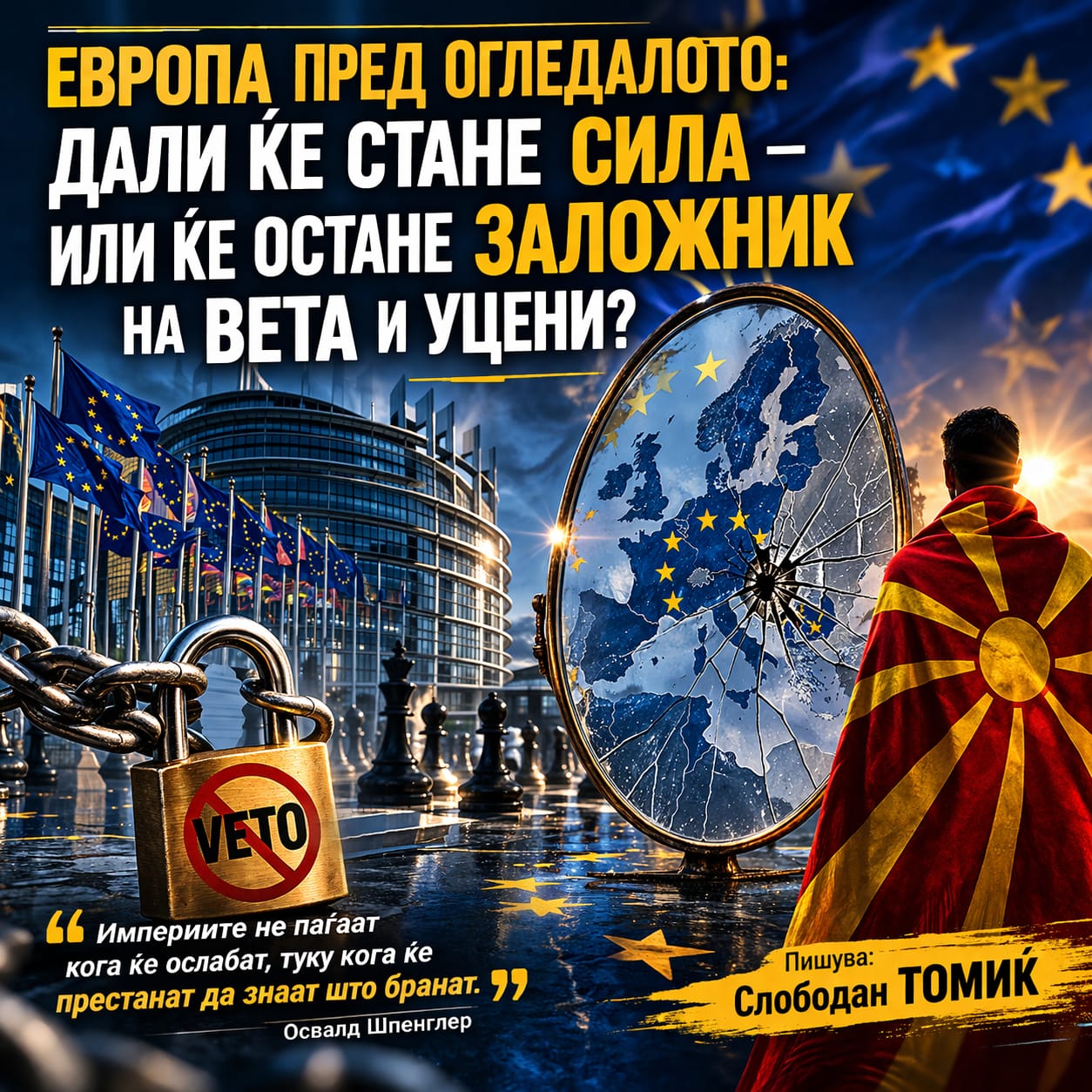
By Slobodan TOMIĆ

“Empires do not fall when they weaken, but when they forget what they stand for.” – Oswald Spengler
EUROPE HAS ADMITTED ITS OWN WEAKNESS
The statement by Belgian Foreign Minister Maxime Prévot is not just a diplomatic phrase — it is an admission. An admission that the European Union is trapped in its own unanimity mechanism, where a single state can hold the entire Union hostage.
What Prévot said openly, Brussels has whispered for years:
The EU cannot be a geopolitical power if every decision depends on the right of veto.
But this raises the key question — will EU reform mean the end of blockades… or merely their redefinition?
MACEDONIA — A VICTIM OF EUROPEAN INDECISION
Macedonia is not the problem. Macedonia is proof that the problem exists.
Decades of reforms.
Decades of compromises.
Decades of promises.
And once again — blockade.
Prévot carefully admits: guarantees are needed that there will be no new conditions, no new demands, no new blackmail.
But immediately, the truth follows:
The EU cannot guarantee on behalf of all its member states.
This is where the entire narrative collapses.
What kind of Union cannot guarantee its own process?
What kind of Europe demands sacrifices but offers no certainty?
THE VETO — A WEAPON AGAINST JUSTICE
The veto mechanism is no longer a tool of protection — it has become a weapon of coercion.
What we see today is the abuse of bilateral issues to block the European path of entire nations.
Macedonia is the clearest example.
Instead of criteria — political conditions.
Instead of values — historical dictates.
Instead of Europe — national agendas.
And that is precisely why Prévot speaks of qualified majority — not out of idealism, but out of necessity.
GUARANTEES WITHOUT GUARANTEE — A EUROPEAN PARADOX
Macedonia is being offered a promise without legal weight.
“No new demands” — but without a mechanism.
“No blockades” — but without a binding framework.
That is not policy.
That is diplomatic consolation.
And Macedonia has already paid too high a price for such consolations.
IDENTITY AS A TARGET — NOT ACCIDENTAL, BUT SYSTEMIC
While Europe speaks of reform, another battle is being fought in parallel — silent, yet fundamental.
A battle for history.
A battle for language.
A battle for identity.
Contradictory narratives — from both Eastern and Western centers — are not accidental.
They are part of a broader geopolitical game.
When others debate where a script, culture, or faith originates, it is not an academic discussion.
It is an attempt to redefine identity.
And identity is not negotiable.
It is not subject to revision.
And it is not up for bargaining.
DOUBLE STANDARDS AND “FREEDOM” BY DESIGN
While the EU declares its commitment to media freedom, we are witnessing troubling trends across Europe.
Politicians announcing the shutdown or “cleansing” of media.
Narratives dividing outlets into “acceptable” and “unacceptable.”
This is not a European value.
This is a warning signal.
When freedom becomes selective, democracy becomes a façade.
THE NEW EUROPE — SOVEREIGN NATIONS OR CENTRALIZED POWER
The question now is historic:
Will the EU become
a union of sovereign nations based on mutual respect
or
a centralized structure that absorbs the small?
Reforming decision-making is not a technical issue — it is about Europe’s future.
MACEDONIA MUST NOT WAIT ANY LONGER
Macedonia must not remain a permanent candidate in Europe’s waiting room.
It must not accept:
– endless conditions
– historical revisions
– political humiliation
The path to Europe must be principled — or it will not be European at all.
CONCLUSION: TIME FOR A CLEAR LINE
Europe today stands at a crossroads:
Either it reforms and becomes a true geopolitical power,
or it remains hostage to its own contradictions.
Macedonia, however, must draw a clear line:
Yes to Europe —
but not at the cost of identity.
Not at the cost of dignity.
And not at the cost of truth.
“EUROPE IN THE MIRROR: WILL IT BECOME A POWER — OR REMAIN A HOSTAGE TO VETOES AND BLACKMAIL?”
The answer is not in Brussels.
The answer begins with how firmly we know what we stand for.
