

By Slobodan Tomić

Slobodan Tomić
“In politics, the greatest danger is not the enemy—but the underestimation of risk.”
— Henry Kissinger
THE NIGHT HISTORY RETURNED — NOT AS FARCE, BUT AS WARNING
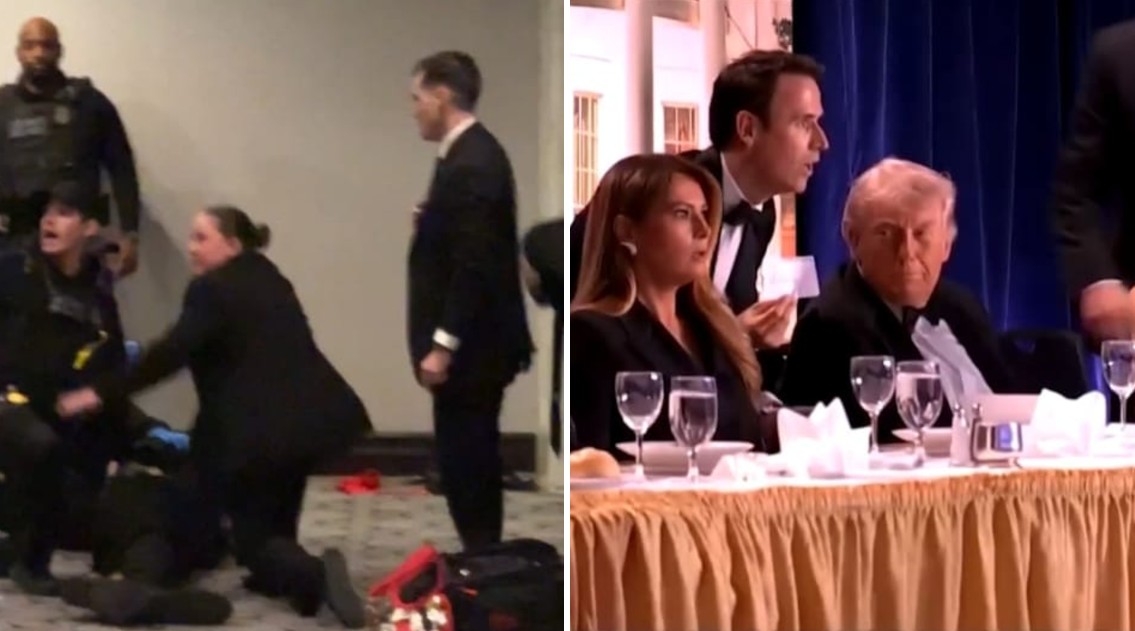
On April 25, 2026, in the very heart of American power—Washington—the world once again witnessed something that must never become “normal”: an assassination attempt against state authority, in the middle of ceremony, in the middle of elite confidence, in the middle of self-assurance.
The Washington Hilton is not just a building.
It is a symbol.
A symbol of a historical wound—the place where a bullet once struck President Ronald Reagan.
Four and a half decades later, the same space.
The same risk.
The same illusion that “this cannot happen again.”
But it did.
THE BULLET IS NOT RANDOM — IT IS A SYMPTOM
The attack on Donald Trump is not an isolated incident.
It is a symptom of a deeper disease: the radicalization of political consciousness and the erosion of trust in institutions.
A third attempt in two years.
That is no longer statistics.
That is a trend.
And in politics, trends are never accidental—they are the result.
SECURITY AS ILLUSION: WHEN THE SYSTEM IS BREACHED FROM WITHIN
The greatest paradox is simple:
the most protected man in the world was, once again, in danger.
The attacker did not fit a classic profile.
Not a known radical.
Not part of a network.
And precisely because of that—he was dangerous.
The fact that he carried a weapon, breached a security perimeter, and approached the center of power is not a lapse.
It is a systemic failure.
“JUST ONE CHECK” — THE COLLAPSE OF PROTOCOLS
In an era of technological control, a single security check is not an error—it is naivety.
And naivety in security always comes at a cost.
THE “LONE WOLF” — THE MOST DANGEROUS MODEL
The lone attacker is the most difficult opponent:
no network, no trace, no pattern.
This is the new architecture of violence.
POLITICS AS A DANGEROUS PROFESSION
“This comes with the territory.”
That is not a statement.
It is an admission that democracy is no longer a safe arena.
HISTORY DOES NOT WARN — IT ALREADY SHOUTS
1981 — Reagan.
2026 — again.
The problem is not that history repeats itself.
The problem is that systems do not learn.
THE GEOPOLITICAL SHADOW
In a world of hybrid conflicts, the line between internal and external violence is disappearing.
THE PSYCHOLOGY OF FEAR
Elites under tables.
Diplomats in panic.
This is not a scene.
It is a signal.
DIPLOMACY IN THE SHADOW OF FEAR
When even kings begin calculating whether to travel, trust is already broken.
HOW CHAOS EXPOSED THE TRUTH ABOUT THE SYSTEM
In every crisis, the truth is not hidden in the bullet—but in the reaction.
The fact that the vice president was evacuated before the president is not just protocol.
It is a signal that in moments of chaos, even the strongest system improvises.
The moment the president stumbled during evacuation is not weakness.
It is a symbol of collapsing control.
The most frightening thing was not that shots were fired.
The most frightening thing was that the system did not know whom to save first.
The attacker’s profile further destroys the illusion of predictability:
educated, integrated, without classical signs of radicalization.
That means one thing:
the threat no longer comes from the margins—it comes from within.
Claims that the motive may have been religious or ideological open the most dangerous dimension:
When hatred acquires an idea, it becomes a mission.
And when violence becomes a mission, security becomes impossible.
THE STATE ON TRIAL
Every such event raises one question:
will the system reform—or defend itself?
History is not optimistic.
THE FINAL TRUTH
The bullet is not the greatest danger.
It is the consequence.
The real danger is:
polarization
hatred
the normalization of violence
FINALE: NOT A QUESTION OF IF — BUT HOW MANY MORE
This is not a story about one night.
Nor about one man.
This is a story about a line that has already been crossed.
It is not a question of whether there will be another bullet.
It is already in the air.
The question is:
how many systems will fall before they admit they are vulnerable?
Democracy does not die in a single moment.
It erodes—quietly, gradually, almost invisibly.
Every new attempt, every new incident, every new “almost”
is not relief—
it is a warning.
Because “almost” is the most dangerous lie of modern politics.
It creates the illusion that the system works,
while in reality, it is collapsing.
And the truth is brutal:
The most frightening thing was not that shots were fired.
The most frightening thing was that, for a moment, everyone accepted that it was possible.
And when the impossible becomes possible,
the end no longer comes as shock.
It comes as habit.
And right there, in that habit,
democracy does not fall with the sound of a bullet—
it disappears into silence.
