

“The greatest victory is not to defeat your opponent, but to remain who you are.”
Confucius
By Slobodan Tomić
Slobodan Tomić
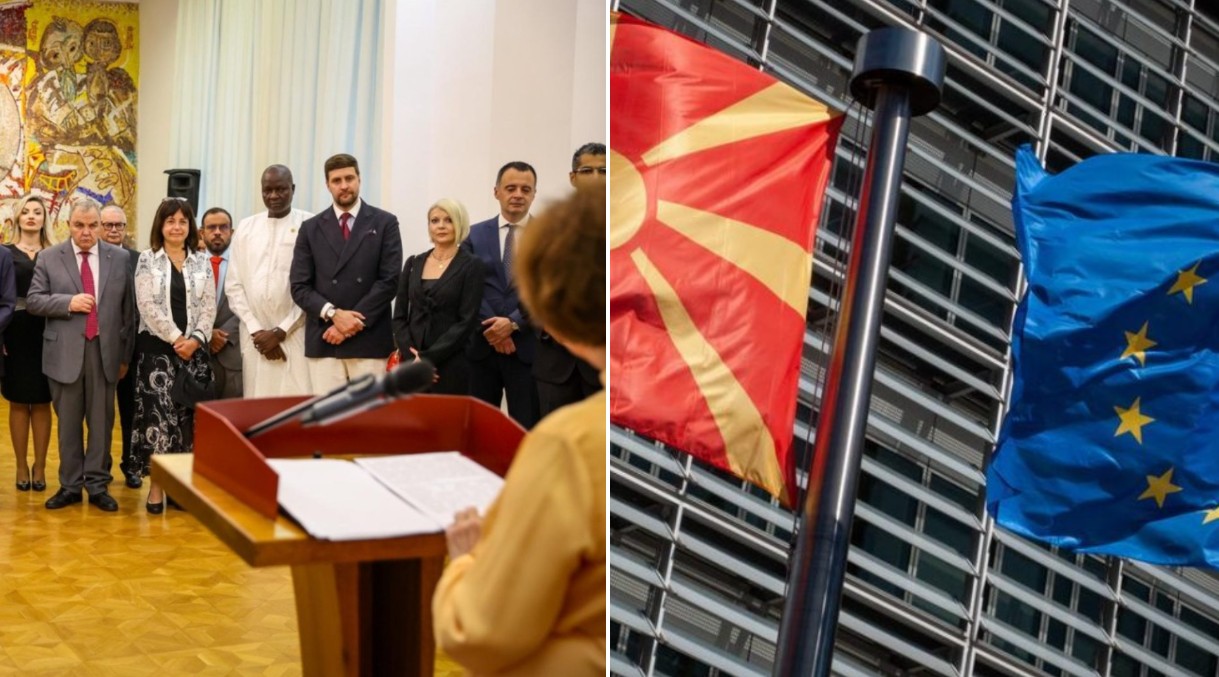
There are moments in history when a single sentence carries more weight than dozens of diplomatic documents, more than countless conferences, more than thousands of pages of political declarations. There are moments when a clear thought becomes the voice of an entire people, and a message becomes a testimony to the era in which we live. Such was the address delivered by President Gordana Siljanovska-Davkova in the Parliament of the Republic of Macedonia, when, before representatives of numerous states and parliaments, she sent a message that was not intended only for those present in the chamber, but for all of Europe, for every center of political power, and for all those who for years have believed that identity can be negotiated and dignity traded as political currency.
Her message was simple yet powerful: there is no place for the denial of identities, no place for the instrumentalization of history, and no place for obstructing the future of a state through conditions that reach into its very soul. Within a single sentence lay the entire contemporary Macedonian drama. Within a single sentence was contained the struggle of generations of Macedonians who, for centuries, have fought not for what belongs to others, but for the right to be themselves.
Macedonia is one of the few European states that, throughout its modern history, has been forced to defend both its existence and its right to self-identification at the same time. While other nations discussed economic strategies, industrial policies, and technological development, Macedonia was often compelled to explain that it exists, that it has its own language, culture, history, and people. It is an absurdity that few outside the Balkans can fully comprehend. That is why Siljanovska-Davkova’s words were not merely a political statement. They reflected a historical truth that has stood before Europe’s eyes for decades.
What makes this message particularly significant is that it was delivered not in the language of confrontation, but in the language of principles. Here lies the difference between statesmanship and daily politics. Daily politics speaks about the next election. Statesmanship speaks about the next generation. Daily politics seeks immediate applause. Statesmanship seeks lasting respect. When the President spoke against the denial of identities, she was not speaking only about Macedonia. She was speaking about a principle that should apply to every people in the world. That is why her message possesses universal value.
In essence, contemporary Europe faces a test of its own. Its foundations are built upon the principles of human dignity, equality, and respect for diversity. But if these principles are truly universal, then they must also apply to the Macedonian people. If Europe genuinely believes in cultural diversity, there can be no room for questioning a language, an identity, or a historical continuity. If it believes in human rights, then those rights must not end where the Macedonian question begins.
For this reason, Siljanovska-Davkova’s address carries far greater significance than it may appear at first glance. It was directed not toward the past, but toward the future. It was not a call for conflict, but for principle. It was not a demand for privilege, but for equality. Macedonia does not seek special treatment. Macedonia seeks the same standards that apply to every other European nation. Nothing more and nothing less.
Over the past decades, Macedonians have learned a difficult lesson: compromises may resolve political disputes, but they cannot create identity. Identity is not created through agreements. It is shaped over centuries through language, culture, tradition, and the collective memory of a people. Therefore, every attempt to politically define identity is destined to fail. History demonstrates that peoples may be pressured, but they cannot be permanently reshaped according to the wishes of others.
In this context, today’s message from Parliament gains even greater weight. It arrives at a time when Europe faces serious geopolitical challenges, when it speaks of stability, security, and enlargement. Yet stability cannot be built through humiliation. Security cannot be built through denial. Enlargement cannot be built through historical conditionality. The true European idea can be strong only if it rests upon mutual respect.
Through her address, Gordana Siljanovska-Davkova demonstrated that Macedonia has a president capable of transforming legal argumentation into a statesmanlike vision. Her words were not a random diplomatic formulation. They were a carefully crafted message containing the essence of the Macedonian position: the future must not be held hostage by disputes over identity. Nations cannot move forward if they are constantly forced to prove their own existence.
Perhaps that is precisely why this message resonated so strongly. Behind it stands the experience of a people who for too long have been subjected to the interpretations of others. A people who have learned that dignity has no price. A people who know that history may be challenged, but it cannot be erased. A people who understand that language is not an administrative category, but the living soul of a nation.
Today, Macedonia does not stand before a choice between Europe and identity. The real choice is between a Europe of principles and a Europe of double standards. If Europe remains faithful to its own values, then the Macedonian story will not be a problem but proof that dignity and integration can coexist. If, however, identity issues remain instruments of political pressure, Europe will undermine its own moral foundations.
That is why the President’s speech was not merely a diplomatic address. It was a reminder that dignity is the foundation of every free nation. And a people who are denied do not seek foreign mercy. They seek the right to be who they are. Within that truth lies Macedonia’s greatest strength. Not in numbers, not in territory, not in geopolitical power, but in the perseverance with which, through generations, it has preserved its name, its language, and its dignity. And a people who have safeguarded these treasures through every historical storm have every right to believe that the future belongs to them, and not to those who have tried to convince them that they are something other than what they truly are.
