

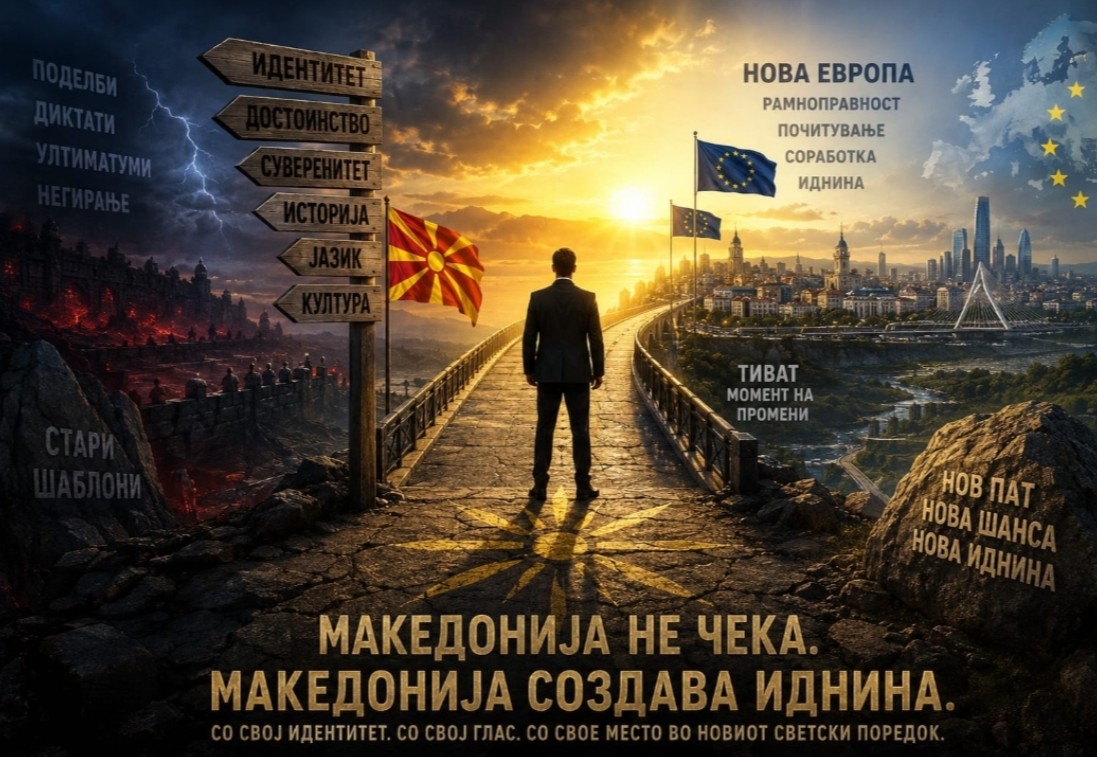
“When the winds of change blow, some build walls, while others build windmills.”
( Chinese Proverb)
By Slobodan Tomić
Slobodan Tomić
Today in Tivat, we are not witnessing just another regional summit. Today, a much broader geopolitical debate is unfolding about the future of Europe, the place of the Western Balkans, and the new architecture of the European continent.
At first glance, the agenda appears familiar: enlargement, integration, reforms, and European perspectives. Yet behind the diplomatic language lies something much deeper. One can feel that Europe is no longer discussing the Western Balkans in the same way it did five or ten years ago. It is not the Balkans that are changing today. It is Europe itself.
That is precisely why this summit comes at such a sensitive moment.
Serbian President Aleksandar Vučić decided to travel to Tivat despite warnings from Serbian security services regarding potential risks to his safety. His message was clear: a promise given to European leaders must be honored, and he has important things to say to his counterparts. He openly stated that he would speak about what he sees as double standards toward Serbia and would not remain silent in front of Europe’s most influential decision-makers.
This is more than a personal decision. It is a symbol. A symbol that no one wants to be absent from the table where the new rules of the game are being written.
And those rules are indeed changing.
German Chancellor Friedrich Merz and French President Emmanuel Macron arrived with an initiative that could represent the most significant transformation of the European Union’s enlargement policy since the Union’s creation.
The new model envisions gradual integration. Candidate countries would receive tangible benefits even before full membership: access to the European market, participation in European programs, observer status within institutions, and gradual inclusion in common policies.
On paper, this appears to be acceleration.
But this is where the great dilemma begins.
Is this truly a pathway toward full membership?
Or is Europe creating a new political circle of countries that will remain close to the Union, yet never fully inside it?
That is why Tivat is far more than a diplomatic gathering.
Tivat is a test of Europe’s sincerity.
If this new model serves as a bridge toward full membership, it could become a historic step forward.
But if it evolves into a permanent substitute for membership, it risks creating a Europe of first-, second-, and third-class states.
And that would contradict the very principles upon which generations of European visionaries built the European project.
The deeper question is even more important.
Why is Europe suddenly discussing flexibility?
Why is Berlin suddenly talking about new formulas?
Why is Paris speaking about gradual integration?
The answer may not lie solely in the Western Balkans.
The answer may lie in Europe itself.
The European Union today faces challenges unlike any it has encountered in decades. The war in Ukraine continues to reshape the continent’s security architecture. Economic competition from China is intensifying. The United States is increasingly focused on the Indo-Pacific. Migration pressures persist. Energy security remains a strategic concern. Internal political divisions are growing.
Europe is beginning to understand that geopolitical time moves faster than bureaucratic time.
And this realization changes everything.
In this broader story, Macedonia does not arrive empty-handed.
Quite the opposite.
While many continue speaking about European prospects, Macedonia has recently achieved significant international recognition through its election to the United Nations Economic and Social Council with the support of 174 member states.
This is not merely a diplomatic statistic.
It is a message.
A message that a country can earn trust when it acts seriously, strategically, and with clear objectives.
At the same time, Macedonia has secured representation in several important international bodies, gradually strengthening its credibility on the global stage.
This is precisely why Prime Minister Hristijan Mickoski arrives in Tivat with a clear position: Macedonia seeks integration, but not at the expense of its identity and dignity.
This issue gains even greater importance when examining developments within the European Parliament.
The draft report concerning Macedonia emphasizes that linguistic, cultural, and national identity constitute fundamental values that must not be challenged by third parties.
This wording should not be underestimated.
For years, Macedonia has faced demands that extended into questions of identity, language, and historical heritage.
Today, for the first time in a long while, European institutions are once again speaking the language of core European principles: respect for diversity and respect for the dignity of nations.
Even more noteworthy is the fact that, simultaneously, the European Commission continues infringement proceedings against Bulgaria over shortcomings in the implementation of European legal aid regulations.
This highlights an important truth.
There are no perfect states within the European Union.
There are rules that apply to everyone.
And that is why the notion that Macedonia alone must endlessly prove itself is fundamentally flawed.
But perhaps the most astonishing development came far away from Tivat.
It came from New York.
While Europe discusses its future, Germany suffered a diplomatic setback that echoed across the world.
Berlin failed to secure a seat on the United Nations Security Council.
Instead, Portugal and Austria won the support of the international community.
This is not merely a diplomatic defeat.
It is a geopolitical signal.
For decades Germany symbolized European strength.
Europe’s largest economy.
Europe’s financial engine.
A global diplomatic heavyweight.
Yet the General Assembly voted differently.
Why?
Because the world is changing.
The era in which economic power alone guaranteed political influence is ending.
The Global South is becoming increasingly influential.
Africa is finding its voice.
Latin America is demanding greater respect.
Asian powers are expanding their reach.
Middle powers are asserting their independence.
The balance of influence is shifting.
German officials themselves suggested that Berlin’s unwavering support for Israel may have cost it crucial votes. They also pointed to Russian efforts to undermine Germany’s candidacy because of Berlin’s support for Ukraine.
Whether one agrees with those explanations or not, the conclusion remains the same.
Germany encountered limits to its influence.
And that matters.
Because at the very moment Friedrich Merz is presenting a new vision for Europe in Tivat, Germany is discovering that even Europe’s strongest states no longer possess unlimited diplomatic authority.
Portugal’s success is particularly revealing.
The country has carefully cultivated a reputation as a bridge-builder between Europe and other regions of the world.
Its diplomatic network stretches across Africa, South America, and Asia.
Two Portuguese statesmen now occupy some of the most influential positions in international politics.
Meanwhile Austria successfully leveraged its image of neutrality and independence to gain support among countries skeptical of great-power politics.
The message could not be clearer.
The world increasingly rewards dialogue over dominance.
Consensus over pressure.
Partnership over hierarchy.
This should be a lesson not only for Germany, but also for the European Union itself.
If Europe wants to remain a global actor, it cannot rely solely on economic strength.
It must rebuild political trust.
It must demonstrate consistency.
It must show that its values are universal rather than selective.
And nowhere is that test more visible than in the Western Balkans.
For years, countries across the region have heard promises.
For years, they have been told that reforms would be rewarded.
For years, they have been encouraged to believe in a European future.
Yet delays accumulated.
Conditions multiplied.
Frustrations deepened.
Public trust declined.
Today Europe faces a strategic choice.
Either it restores credibility to the enlargement process.
Or it risks creating a vacuum that others will seek to fill.
This is why Tivat matters.
Not because another declaration will be issued.
Not because another photograph of leaders will be taken.
But because Europe has reached a moment when geopolitical necessity and political reality are finally colliding.
The Western Balkans are no longer merely candidates waiting outside the door.
They are part of the continent’s strategic future.
And Macedonia occupies a unique position within this debate.
For more than two decades, Macedonia has demonstrated patience.
It has made compromises.
It has pursued reforms.
It has repeatedly reaffirmed its European orientation.
The question now is not whether Macedonia belongs in Europe.
Geographically, historically, culturally, and politically, it already does.
The question is whether Europe is prepared to act according to its own principles.
At the same time, voices continue to emerge claiming that the Macedonian people are incapable of understanding complex political realities or that ordinary citizens are somehow obstacles to progress.
Such views fundamentally misunderstand the strength of democratic societies.
No nation advances because a self-appointed elite looks down upon its people.
Nations advance when institutions respect citizens, when leaders listen to society, and when public trust is treated as a strategic asset rather than an inconvenience.
History repeatedly demonstrates that dismissing the wisdom, dignity, and resilience of ordinary people is not a sign of sophistication.
It is a sign of detachment.
The future of Macedonia will not be built through contempt for its citizens.
It will be built through confidence in them.
That is the deeper lesson hidden beneath the headlines from Tivat.
Europe is changing.
The global order is changing.
The balance of power is changing.
Old certainties are disappearing.
New realities are emerging.
And in such moments, nations that know who they are possess a tremendous advantage.
Because identity becomes an anchor when the world enters turbulence.
Macedonia must therefore approach this new era with confidence rather than insecurity.
With strategic patience rather than passivity.
With dignity rather than desperation.
With a clear understanding that European integration is important, but national self-respect is indispensable.
The true lesson of Tivat is not that Europe is opening a door for us.
The true lesson is that Europe itself is searching for a new path.
And nations that possess self-respect, and states that know who they are, are always best positioned to find their place when the world is changing.
That is why, after Tivat, nothing will be the same.
Not because a final decision has been made.
Not because all questions have been answered.
But because for the first time in many years it is becoming unmistakably clear that a new Europe is already being born before our eyes.
The question is no longer whether Macedonia belongs to that future.
The real question is whether Europe will have the wisdom, the courage, and the strategic vision to recognize Macedonia’s value while shaping its own future in a rapidly changing world.
