

“The greatness of a nation is measured not by its wealth, but by how it treats its most vulnerable citizens.”
Nelson Mandela
By: Slobodan TOMIC
Sometimes a nation does not decline because of war.
Sometimes it does not decline because of natural disasters.
Sometimes it does not decline because of foreign enemies.
Sometimes a nation slowly weakens when its most important national priorities are buried beneath years of political promises, delays, and excuses.
The story of the Clinical Center is exactly such a story.
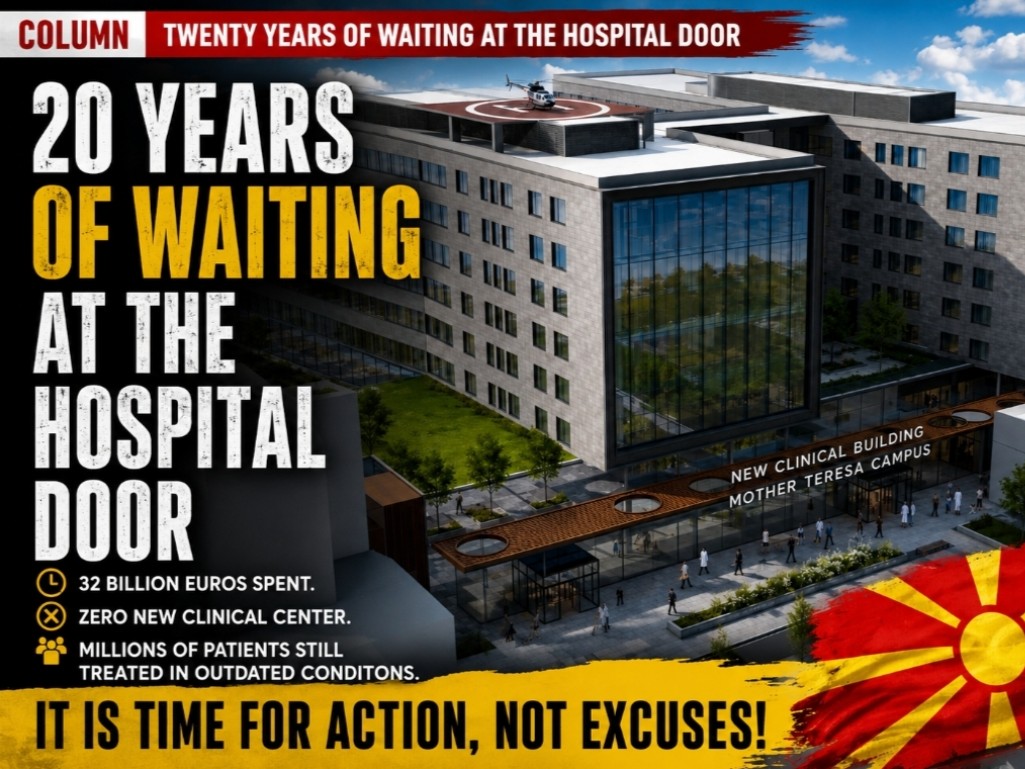
For more than two decades, Macedonia has been listening to promises about a new Clinical Center.
For more than two decades, governments have come and gone.
Ministers have come and gone.
Strategies have changed.
Committees have changed.
Locations have changed.
Excuses have changed.
Only one thing remained unchanged.
The patient.
The citizen who waits.
The citizen who spends an entire lifetime paying taxes and health contributions.
The citizen who believes that when the most difficult day arrives, the state will stand beside him.
Yet this is precisely where the greatest disappointment begins.
Because while Macedonia spoke endlessly about modernization, too many patients continued to face an outdated system struggling under the weight of decades of neglect.
While politicians spoke of European standards, ordinary citizens continued to search for basic dignity in healthcare.
During the years of SDSM rule, the public heard countless announcements.
Countless promises.
Countless reform plans.
Countless press conferences.
Yet one question still echoes throughout the country:
Where is the Clinical Center?
Where is the flagship healthcare project that was supposed to transform Macedonian medicine?
Where is the modern medical complex that generations were promised?
The years passed.
The answers never came.
Citizens have every right to ask why previously signed projects were abandoned.
They have every right to ask why concepts were changed.
They have every right to ask why Macedonia repeatedly returned to the starting line whenever it was supposed to move forward.
History may debate the political arguments.
But facts remain stubborn.
After years in power, no new Clinical Center was built.
After years in power, the Clinical Hospital in Štip remained unfinished.
After years in power, citizens were left with expectations rather than results.
The tragedy of the modular hospital fire in Tetovo must never be forgotten.
Not because of politics.
But because of the lesson it carries.
A lesson about responsibility.
A lesson about preparedness.
A lesson about the consequences of delayed investment and neglected priorities.
Because when healthcare systems fail, it is not politicians who pay the highest price.
It is patients.
It is families.
It is ordinary people.
Today, Prime Minister Hristijan Mickoski faces a historic challenge and a historic opportunity.
The plan to build a new Clinical Center near Boris Trajkovski Sports Center, integrated with the 8 September Hospital, the PET Center, and the Bukurešt Polyclinic, represents far more than another construction project.
It represents an opportunity to correct one of the longest-standing failures in modern Macedonian healthcare.
But words alone will not be enough.
The people of Macedonia have heard enough promises.
They want to see excavators.
They want to see foundations.
They want to see construction sites.
They want to see completed hospitals.
They want proof that healthcare is finally becoming a national priority rather than a political slogan.
The same applies to the long-delayed Clinical Hospital in Štip.
The same applies to healthcare investments across the country.
Because Macedonia does not end in Skopje.
Macedonia lives in Štip.
In Tetovo.
In Kičevo.
In every town where citizens deserve the same quality of healthcare and the same dignity when facing illness.
This is why the responsibility before Mickoski’s government is enormous.
Not to repeat old promises.
Not to repeat old mistakes.
But to deliver results.
To build what others failed to build.
To complete what others left unfinished.
To restore trust where trust has been lost.
Because people do not live from press conferences.
They do not live from political statements.
They do not live from endless debates.
They live from functioning institutions.
From modern hospitals.
From doctors who have the tools and conditions to save lives.
From a state that understands that human life is its highest responsibility.
And that is why the defining question facing Macedonia today is simple:
Will this generation finally build the Clinical Center that previous generations were promised?
Or will another decade disappear into political arguments and missed opportunities?
The answer will not come from speeches.
The answer will not come from party headquarters.
The answer will not come from television studios.
The answer will come from the first foundation laid into the ground.
The answer will come from the first completed hospital ward.
The answer will come from the day Macedonia finally receives a Clinical Center worthy of its people.
And when that day arrives, history will ask a simple but devastating question to every government that ruled before:
If it could be done today, why wasn’t it done yesterday?
