

By Slobodan Tomić
“Who controls the past controls the future. Who controls the present controls the past.”
(George Orwell)
NOT JUST TWO PRESIDENTS MEETING, TWO VISIONS OF THE BALKANS
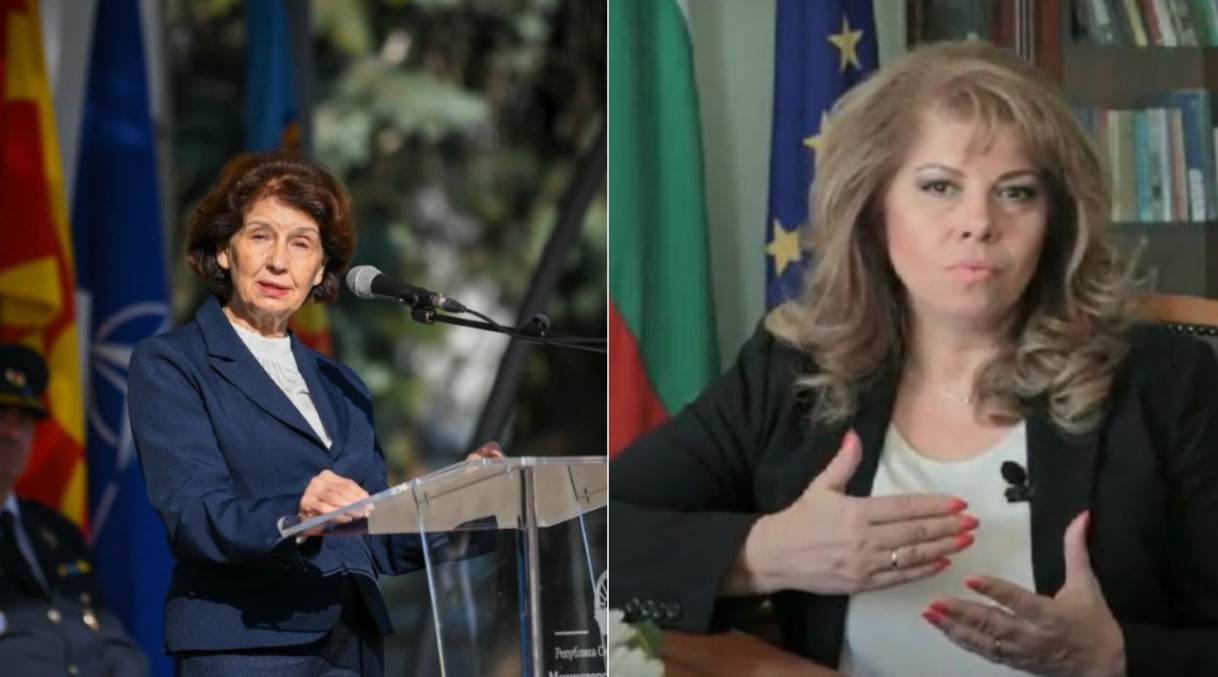
Today in Sofia, it is not only Gordana Siljanovska-Davkova and Iliana Iotova who are meeting.
At the same table sit two fundamentally different understandings of Europe.
One believes that Europe is a community of values, dignity, and equality.
The other believes that Europe is a mechanism through which national agendas can be transformed into European conditions.
That is why this meeting is far more than a diplomatic event.
It is a historic test.
A test for Macedonia.
A test for Bulgaria.
But above all, a test for the European Union itself.
WHY NOW?
Following the summit in Tivat, after Prime Minister Hristijan Mickoski’s meetings with leading European leaders, and after announcements of a new Franco-German approach toward the Western Balkans, a new political dynamic can suddenly be felt.
It is no coincidence that President Siljanovska-Davkova is speaking in a calm, dignified, yet firm tone.
It is no coincidence that Mickoski speaks about strategy rather than spectacle.
It is no coincidence that the word “guarantees” is being heard more frequently.
Because Macedonia has learned a painful lesson.
Concessions without guarantees create new concessions.
Compromises without limits create new conditions.
THE BIG QUESTION SOFIA DOES NOT ANSWER
Let us be honest.
Today, Macedonian citizens are not asking whether Bulgarians in Macedonia should enjoy full rights.
Those rights already exist.
No one disputes them.
The question is entirely different.
Why has the inclusion of Bulgarians in the Constitution been turned into the key for opening the European door?
According to the 2021 Census, 3,504 citizens identified themselves as Bulgarians.
That is an official state statistic.
And for that reason, the public asks a logical question:
If this is truly a European principle, why is the same principle not applied everywhere?
If it is a European value, then it should apply equally to all.
If it applies only to Macedonia, then we are not speaking about a principle.
We are speaking about a political condition.
MACEDONIA DOES NOT DISPUTE THE EXISTENCE OF
BULGARIANS — MACEDONIA DISPUTES THE DOUBLE STANDARD
This is the crucial distinction many deliberately ignore.
Macedonia is not seeking to deprive anyone of rights.
Macedonia is not asking for anyone to be removed from any constitution.
Macedonia asks for one thing.
Equality.
If human rights are universal, then they must be universal for everyone.
If European standards apply to Macedonia, then they must apply to every member state as well.
Otherwise, Europe risks losing its own moral authority.
SILJANOVSKA SENT A MESSAGE THAT WILL BE REMEMBERED
“I will never negotiate in secret, not even dead.”
In just a few words, more was said than in dozens of diplomatic communiqués.
It is a message that identity is not a currency.
It is a message that history is not merchandise.
It is a message that dignity cannot be purchased with European promises.
That is precisely why this statement resonated so strongly among Macedonian citizens.
STRASBOURG, THE UNCOMFORTABLE MIRROR
There is another issue in this debate that many would prefer to avoid.
The judgments of the European Court of Human Rights.
For years, discussions have been held regarding their implementation.
Therefore, Macedonia has every right to ask a simple question:
Do European values apply only when conditions are imposed?
Or do they also apply when obligations must be fulfilled?
This is not an anti-European question.
It is a fundamentally European question.
MICKOSKI AND THE NEW MOMENTUM
Following Tivat, Prime Minister Hristijan Mickoski delivered a message that deserves attention.
No miracles.
No false hopes.
No spectacles.
There is work.
There is strategy.
There is patience.
But there are also red lines.
And the first red line is clear.
The Macedonian identity is not subject to negotiation.
The Macedonian language is not subject to negotiation.
Macedonian history is not subject to negotiation.
HISTORY DOES NOT REMEMBER THOSE WHO YIELDED WITHOUT END
History remembers statesmen who knew when to extend a hand.
But it remembers even more those who knew where the line stood and refused to cross it.
The meeting between Siljanovska-Davkova and Iotova may not produce a sensational agreement.
It may not bring a historic breakthrough.
But it can bring something even more important.
It can demonstrate that Macedonia is ready for dialogue.
But not for humiliation.
Ready for cooperation.
But not for erasure.
Ready for Europe.
But not for the deletion of its own identity.
And that is the essence of this historic moment.
Not what will be said at the press conferences.
But whether Europe will finally understand that the Macedonian people are asking for nothing more than what belongs to every European nation:
The right to dignity.
The right to identity.
The right to history.
The right to remain what they are.
