

“Injustice anywhere is a threat to justice everywhere.”
Martin Luther King Jr.
Written by: Slobodan Tomic

There are days when parliaments vote on laws, resolutions, and reports.
But there are also days when a single vote carries far more significance than a few pages of text.
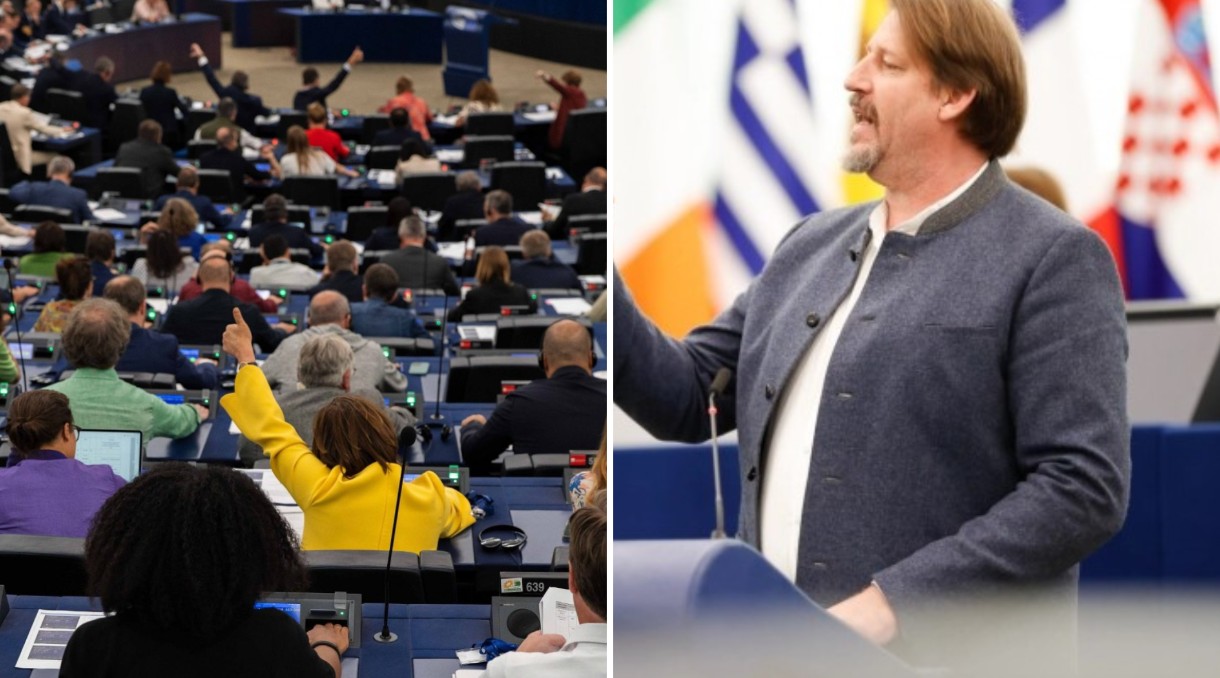
Today in Strasbourg, the vote is not only about Rapporteur Thomas Waitz’s report on Macedonia.
Today, Europe is voting on its own credibility.
It is voting on whether the European Union will remain a community of principles or become a space where bilateral disputes, historical interpretations, and political pressures can be transformed into European criteria.
It is voting on whether the founding idea of the European Union will remain alive: the rule of law, equality among states, and respect for the dignity of nations.
Thomas Waitz said something that carries far greater weight than it may appear at first glance.
He acknowledged that Macedonia has implemented reforms and demonstrated progress.
He also acknowledged that the European Union itself has made promises that it failed to fulfil.
More importantly, he clearly stated that identity-related issues are not part of European legislation and that Europe must not allow Macedonia to lose its motivation on its European path.
This is not an ordinary diplomatic formulation.
It is the essential question of Macedonia’s entire European journey.
If identity, language, and history are not part of European law, then by what principle do they become conditions imposed only on Macedonia?
This question is no longer solely a Macedonian one.
It is a European question.
That is why today’s vote is a test for Europe itself.
A test of whether its promises carry real weight.
A test of whether its rules apply equally to all.
A test of whether enlargement will remain a process based on principles or become a process of constantly changing the rules in the middle of the game.
Macedonia is not asking for privileges.
It is not asking for shortcuts.
It is not asking for concessions.
It is not asking anyone to lower the standards.
It is asking for only one thing:
That the rules applied to others also apply to Macedonia.
The same principles.
The same standards.
The same justice.
Nothing more and nothing less.
Otherwise, every new concession will generate new demands, every new compromise will open new conditions, and every step forward will create another threshold that must once again be crossed.
Then the problem will no longer be only Macedonia’s.
The problem will lie within the credibility of the European Union itself.
Because trust is not built merely through declarations.
It is built through consistency.
It is built when the rules are equal for everyone.
It is built when principles are stronger than day-to-day politics.
It is built when law stands above pressure.
For more than three decades, Macedonia has walked the European path.
It has endured disappointments.
It has endured blockades.
It has endured delays.
It has accepted painful compromises.
It has made difficult political and societal concessions in the name of its European future.
But no nation can live indefinitely with the feeling that different rules apply to it than to others.
That is precisely why today carries historical significance.
Today in Strasbourg, the vote is not merely on a report concerning Macedonia.
Today, Europe is voting on itself.
It is voting on whether it will remain faithful to its own principles.
It is voting on whether the dignity of nations is truly a value it is prepared to defend.
It is voting on whether identity and language will remain the right of every nation rather than becoming subjects of political conditionality.
And perhaps this is the greatest significance of today.
Because Macedonia is not asking Europe to be less European.
On the contrary.
Macedonia is asking Europe finally to be exactly what it promises to be—a community of law, principles, equality, and respect for the dignity of every nation.
For, as Martin Luther King Jr. warned, “Injustice anywhere is a threat to justice everywhere.” And when one nation for too long feels that the rules are being changed only for it, then that nation is not the one being tested.
Europe itself is on trial.
