

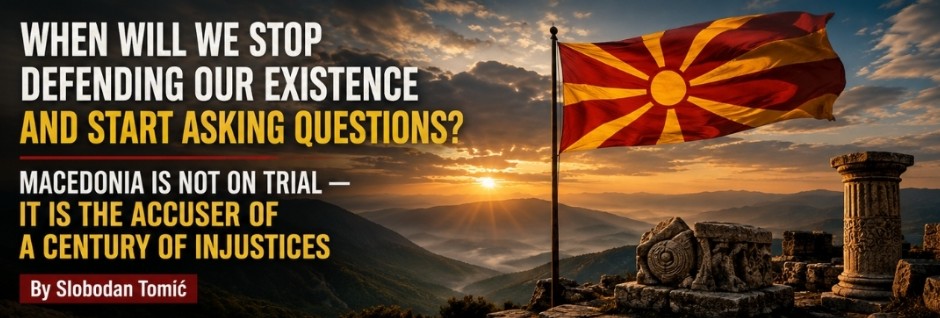
“A nation that is constantly forced to prove that it exists is not a weak nation; it is a nation against whose memory a long war has been waged.”
(Milan Kundera)
By Slobodan Tomić
There is a weariness among the Macedonian people.
A weariness of endlessly proving our own existence.
A weariness of constantly having to explain that we are Macedonians, that we speak the Macedonian language, and that we possess our own history and national consciousness.
Not because we lack arguments, but because it is painful to prove something that you live, feel, and carry within yourself.
Perhaps the time has come to stop standing in a defensive trench and begin asking questions.
Not to justify ourselves, but to demand answers.
Not to respond to every provocation with new evidence of our existence, but to shift the burden of the question to where it truly belongs.
WE ARE NOT THE ACCUSED, BUT WITNESSES TO A CENTURY-LONG ATTEMPT TO RESHAPE MACEDONIAN HISTORICAL CONSCIOUSNESS
Macedonia has no obligation to prove its existence.
Its obligation is to preserve its memory.
For a people do not disappear when they lose a battle; they disappear when they agree to forget who they are.
For more than a century, debates have been waged over Macedonian identity, language, and history. Yet the essential question is different: Why is Macedonia constantly called upon to explain itself?
Why are Macedonians required to prove what every other nation regards as a natural and inviolable right?
IF MACEDONIA HAS A PROBLEM WITH THE EUROPEAN UNION, THEN WHAT KIND OF PROBLEM IS IT?
When it is claimed that Macedonia’s problem is not with its neighbours but with the European Union, a much deeper question emerges.
Does this mean that the European project permits questions of identity to become conditions for integration?
Can a political community founded upon the ideas of reconciliation and respect for diversity become a place where a people must debate its own right to historical memory and self-determination?
If the answer is yes, then this is not merely a Macedonian question. It becomes a question about the very principles upon which Europe claims to stand.
WHY MUST MACEDONIA ALWAYS PROVE, WHILE OTHERS MERELY ASSERT?
When someone claims that Macedonians speak another people’s language or that their identity is the product of someone else’s history, the worst thing that can be done is to accept the role of the perpetually accused.
For every new attempt at proving ourselves creates the impression that the question remains open.
Yet one question imposes itself naturally: if Macedonian identity and the Macedonian language are supposedly “artificial constructs,” then how is it possible that for more than a century there has existed Macedonian literature, Macedonian culture, a Macedonian revolutionary movement, Macedonian national institutions, and a clearly expressed collective consciousness?
How can a supposedly “non-existent” people create such a powerful historical and cultural legacy?
EUROPE MUST NOT BECOME AN ARBITER OF IDENTITIES
The European Union is a political and values-based community of states.
It cannot and must not become a court that determines which people are a people, which language is a language, and whose history belongs to whom.
For the moment identity becomes an object of political conditionality, a dangerous precedent is created.
Today it may be Macedonia; tomorrow it may be any other European nation.
WHAT IS BEING DEMANDED IS NOT A CHANGE OF POLICY, BUT A CHANGE OF HISTORICAL CONSCIOUSNESS
At the heart of this dispute lie neither economic reforms, nor the rule of law, nor democratic standards.
At its core are questions of language, identity, historical memory, and national continuity.
This is precisely why many Macedonians feel that what is being demanded is not merely the fulfilment of conditions for membership, but the acceptance of interpretations that intrude upon their understanding of their own historical existence.
HISTORY CANNOT BE REARRANGED THROUGH AGREEMENTS AND COMMISSIONS
History is a complex and multilayered process.
It can neither be created nor erased through administrative formulations.
Agreements may regulate relations between states, but they cannot replace the historical memory of peoples.
The modern Macedonian state has its legal and political foundations, but Macedonian national consciousness, cultural memory, and historical sentiment are far broader and deeper categories than any contemporary institution.
A PEOPLE ARE NOT CREATED BY THE STATE
No people begin to exist on the day a modern state is established.
States are created, transformed, and sometimes disappear. Peoples endure through their culture, language, memory, and sense of belonging.
Therefore, every attempt to redefine historical consciousness through political agreements or administrative mechanisms encounters the natural resistance of collective memory.
History cannot be transferred from one people to another by a signature, nor can national consciousness be erased by a political decision.
MACEDONIA MUST NOT BECOME A PEOPLE THAT IS CONSTANTLY ON THE DEFENSIVE
The greatest danger is not that others challenge our right to self-determination. The greatest danger is when we ourselves become accustomed to constantly justifying our existence.
The time has come for Macedonia to stop being the accused who must endlessly defend itself and to become a state that asks questions.
To ask on the basis of what principles a people should negotiate its language and identity.
To ask whether the European future means respect for diversity or its reshaping.
To ask whether the dignity of nations is subject to conditions or whether it is a fundamental value beyond negotiation.
For peoples do not endure because someone granted them the right to exist.
They endure because they themselves never abandoned who they are.
And throughout all its trials and tribulations, Macedonia has demonstrated precisely this: that it may be pressured, challenged, and conditioned, but it cannot be erased.
