

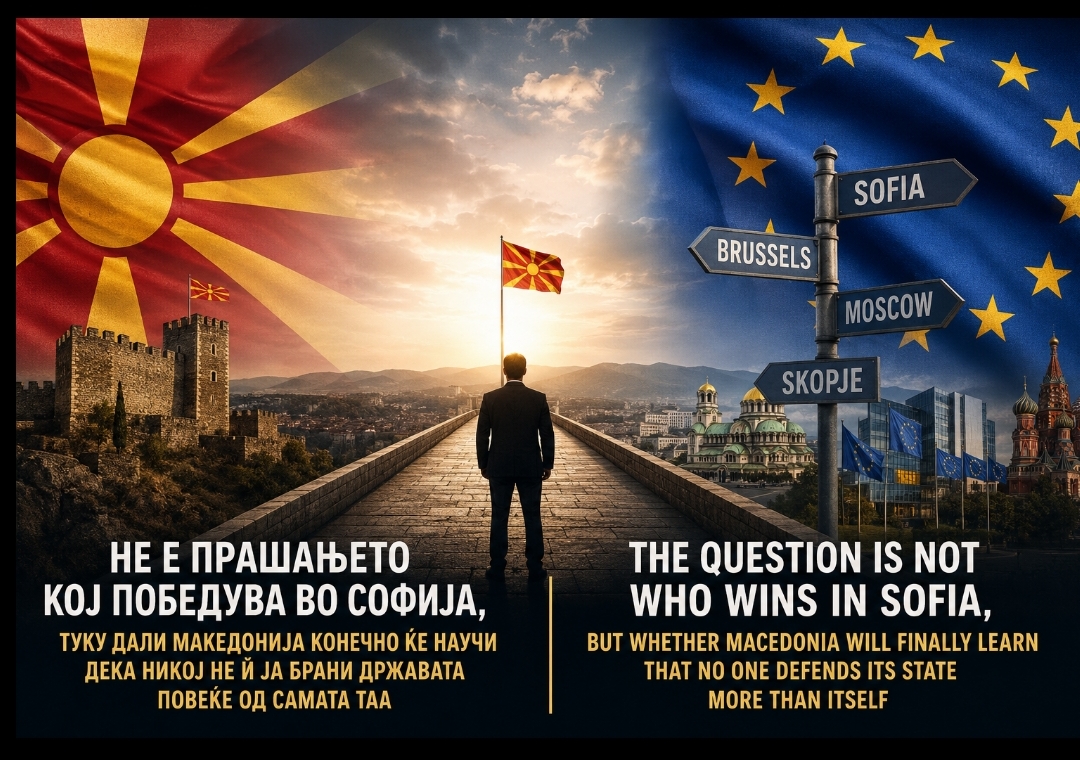
“A nation that expects its future to depend on the elections of others gradually loses the ability to create that future for itself.”
(Arnold Toynbee)
By: Slobodan TOMIC

Slobodan TOMIC
When Europe Searches for a New Orbán and Macedonia Searches for Saviors Again
Europe is currently preoccupied with a single question: after Viktor Orbán’s departure from the center of the European political stage, will another politician emerge as Moscow’s voice within the European Union?
Part of Europe’s attention has turned toward Bulgaria and toward Rumen Radev.
Yet both Brussels and Skopje risk making the same mistake.
State strategies do not change with the replacement of a single individual.
National policies are not transformed simply because one politician wins or loses an election.
That lesson has been repeatedly demonstrated throughout modern European history.
Whether one agrees with Orbán’s policies or not, one fact remains undeniable: he consistently defended the right of sovereign nations to protect their national interests and often urged the European Union not to ignore the realities of the Balkans.
At the same time, new political generations across Europe are advancing a different vision of the Union’s future and of the balance between national sovereignty and common European policies.
Yet neither Orbán nor any other European leader holds the key to Macedonia’s future.
That key has always been in Skopje.
Rumen Radev – Between Geopolitics and Bulgarian State Policy
In many European media outlets, Rumen Radev is frequently portrayed as a politician whose approach toward Russia differs from that of several European leaders.
His remarks regarding sanctions, the war in Ukraine, and European security have often generated debate far beyond Bulgaria’s borders.
For Macedonia, however, the essential question is not Moscow.
The essential question is Sofia.
When it comes to Macedonian-Bulgarian relations, many observers have noted a remarkable continuity in Bulgaria’s official positions regardless of which political force is in power.
The tone may vary.
The political style may differ.
But strategic positions rarely change.
That is precisely the lesson Macedonia must understand.
From Patriarch Kirill to the Bulgarian Veto
When Russian Patriarch Kirill publicly criticized Bulgaria’s political leadership over historical interpretations concerning Bulgaria’s liberation, an important message was sent.
States defend their own interests.
Not those of others.
Regardless of whether pressure comes from East or West.
The same principle applies throughout the Balkans.
No politician in Sofia will defend Macedonia’s position more strongly than Macedonia itself is willing to defend it.
Nor can anyone in Skopje expect that elections in neighboring countries will automatically resolve Macedonia’s own strategic dilemmas.
Political Divisions and Competing Visions of European Integration
Recent Macedonian political history has been marked by numerous controversies regarding negotiations with Sofia.
Particularly concerning the processes that led to the French Proposal and the signing of bilateral protocols.
For some, these steps represented necessary compromises to unblock the European path.
For others, they raised serious questions regarding national consensus and long-term consequences for the country’s strategic positions.
That is why these issues continue to generate intense political debate today.
At the same time, current contacts between representatives of Skopje and Sofia are taking place in a different political environment, one in which an increasingly important question is being raised: how can the European perspective be preserved without deepening domestic divisions?
These are two different political philosophies.
One believes compromise creates trust.
The other argues that trust can only be sustainable when built upon mutual respect, clear rules, and a predictable process.
Constitutional Amendments and the Question of Consensus
One of the most sensitive issues remains the constitutional amendments and their connection to the European integration process.
Supporters argue that the amendments are necessary to continue negotiations with the European Union.
Critics warn that such fundamental issues cannot be resolved without broad political and social consensus.
Regardless of political positions, it remains a fact that this issue reaches deeply into the country’s constitutional and societal framework.
For that reason, its resolution requires patience, political maturity, and meaningful national dialogue.
European integration is not merely a technical process.
It is a process that must enjoy broad public support if it is to succeed in a lasting and meaningful way.
A Diplomatic Note or a Warning Sign of Further Radicalization?
Recent developments involving the alleged leak of diplomatic communications related to the travel of the Macedonian Prime Minister’s family have raised new questions in the public sphere.
If sensitive security-related information indeed entered the public domain, then this matter extends far beyond ordinary day-to-day politics.
Not because it concerns a particular politician.
But because it raises questions about trust between institutions and about the principles upon which modern diplomacy functions.
Diplomatic channels exist to facilitate communication, cooperation, and security.
When confidential information becomes part of political or media confrontation, legitimate concerns inevitably arise regarding the future consequences for relations between states.
Especially when those states are neighbors and allies within NATO.
The significance of the issue becomes even greater because it unfolds at a time when official messages continue to emphasize good-neighborly relations, European cooperation, and regional stability.
This raises an unavoidable question:
How can trust be built if confidential communications become instruments of political conflict?
And how can trust be restored if each new crisis leaves deeper scars than the previous one?
Final Blow
Macedonia’s greatest illusion has often been the belief that its problems will be solved by the victory or defeat of a politician in a neighboring country.
History teaches a different lesson.
States move forward when they possess a clear vision of their own future.
Not when they wait for others to define that future on their behalf.
Sofia has long-term strategic positions.
Brussels has long-term strategic objectives.
Every serious state pursues clearly defined national interests over years and decades.
The real question is not what others will do.
The real question is what we will do.
Because the greatest danger to Macedonia does not begin when neighboring states have plans regarding us.
The greatest danger begins when we ourselves stop having a plan for our own future.
“States do not collapse because they are small. They collapse when they forget who they are and what they aspire to become.”
(Charles de Gaulle)
