

“A nation is not lost when it is attacked from the outside, but when it is persuaded that it must constantly justify its own existence.”
Roger Scruton
By: Slobodan TOMIC

There are moments when seemingly unrelated events reveal the same underlying truth. Such a moment is unfolding for Macedonia today.
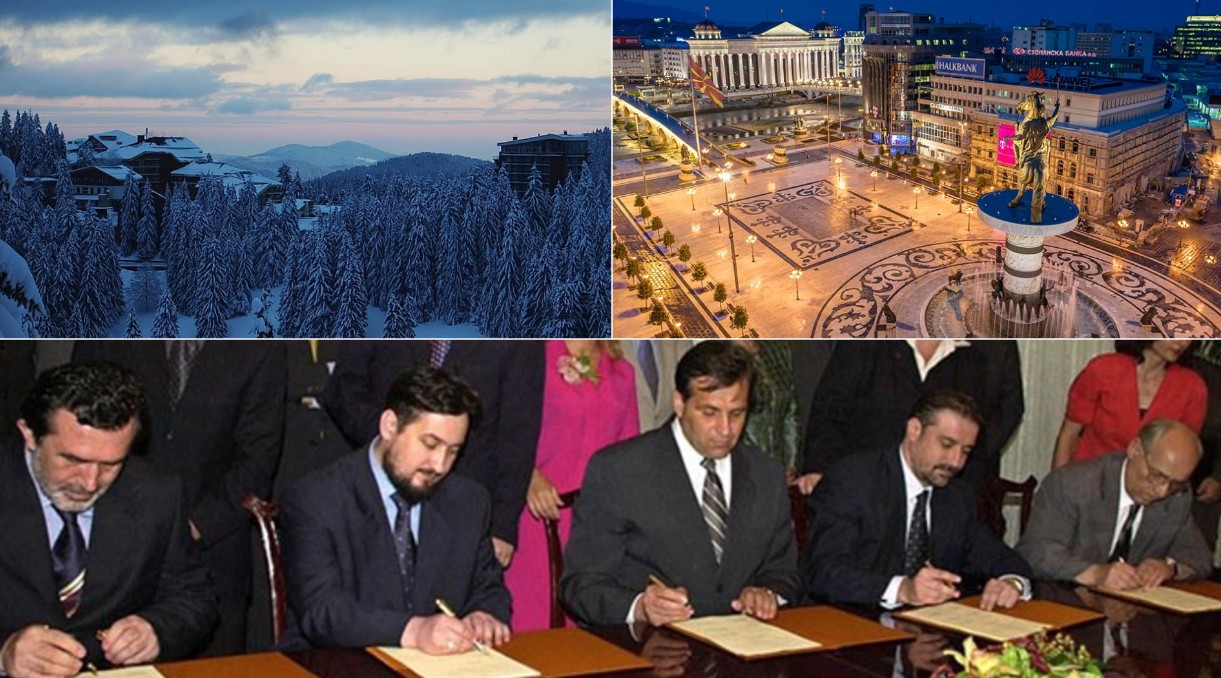
On one side, U.S. President Donald Trump extended the long-standing American national emergency concerning the Western Balkans. In that document, the Ohrid Framework Agreement once again remains recognized as one of the pillars of regional stability.
On the other side, the public witnessed a diplomatic scandal without precedent: the publication of a confidential diplomatic note containing sensitive information regarding the private trip of the wife and minor son of Prime Minister Hristijan Mickoski to Pamporovo.
At first glance, these appear to be two separate stories. Yet together they raise the same fundamental question: how much more must Macedonia prove that it respects the principles that others continuously demand from it?
TRUMP DID NOT OPEN A NEW ISSUE – HE REMINDED THE WORLD OF AN OLD REALITY
To be precise, Donald Trump did not send a new political message to Macedonia. He did not launch a new initiative, nor did he introduce a new policy.
He merely extended a legal framework that has existed for more than two decades and has been renewed by successive American administrations.
Yet the fact that the Ohrid Framework Agreement still appears in official U.S. documents carries important symbolism.
It means that Washington continues to regard it as one of the foundations of peace and stability in the region.
And this raises an important question.
If Macedonia has spent more than twenty years implementing the agreement, expanding rights for ethnic communities and investing in interethnic coexistence, why does it remain a target of constant demands, conditions, and doubts?
MACEDONIA AS A UNIQUE POLITICAL EXPERIMENT IN EUROPE
Following the Ohrid Framework Agreement, Macedonia undertook profound institutional reforms.
The use of community languages was expanded. Mechanisms for equitable representation were introduced. Additional guarantees for ethnic equality became part of the political system.
The question is not whether these changes were right or wrong.
The question is whether there is another example in Europe where the majority, state-forming nation accepted such extensive institutional concessions in the name of peace and stability.
Germany is home to millions of citizens of Turkish origin, yet Turkish is not a federal official language.
France continues to insist on a unified civic model.
The United States has no system of ethnic quotas comparable to those found in Macedonia.
The British model is entirely different.
For that reason, Macedonia remains a unique example—perhaps even a singular one.
WHEN CONCESSIONS BRING NO RECOGNITION
Logic would suggest that a country investing so much in coexistence would be encouraged and rewarded.
Yet Macedonia has often experienced the opposite.
The more conditions it fulfills, the more conditions appear.
The more compromises it makes, the more demands emerge.
This creates the impression that the problem was never the fulfillment of obligations.
The problem is that the standards themselves keep changing.
PIRIN AND THE QUESTION FEW ARE WILLING TO ASK
If human rights are truly universal, then they must apply to everyone.
Not only to Macedonia.
Not only when politically convenient.
But to everyone equally.
That is why it is legitimate to ask questions about the implementation of judgments of the European Court of Human Rights concerning the freedom of association of citizens who identify as Macedonians in the Pirin region.
If European standards are universal, they cannot be selective.
PAMPOROVO – WHEN DIPLOMACY BECOMES A SECURITY ISSUE
Against this backdrop came the diplomatic note scandal.
The central issue is not where the Prime Minister’s family traveled.
That is their private matter.
The real issue is that sensitive information entered the public domain—information that any serious state would treat as a security concern.
Travel routes.
Security arrangements.
Vehicles.
Communication equipment.
Operational details.
In any serious democracy, such a breach would trigger an immediate investigation.
Not because of the identity of the individual involved.
But because of the principle at stake.
WHY THE REACTION MATTERS
Foreign Minister Timcho Mucunski demanded an investigation, an explanation, and accountability.
That is the normal response of a state determined to protect its institutions and security standards.
What makes the incident even more troubling is that the document reportedly appeared through circles known for anti-Macedonian rhetoric.
Therefore, the essential question is not simply who published the document.
The question is how it reached them in the first place.
DOUBLE STANDARDS AS THE REAL PROBLEM
Macedonia has spent years listening to lectures about European values.
About good-neighborly relations.
About the rule of law.
About trust.
Yet when principles affecting Macedonia itself are challenged, the reactions are often far more muted.
This is where the crisis of trust begins.
Not in Skopje.
But in the very credibility of the principles being invoked.
MICKOSKI AND THE POLITICS OF CLEAR RED LINES
In this environment, the government of Hristijan Mickoski has sought to pursue a different approach.
An approach in which Macedonia will not automatically accept new demands without clear guarantees.
An approach in which national positions are not altered under pressure.
An approach in which state dignity is not treated as a negotiable commodity.
People may agree or disagree with that strategy, but it resonates with many citizens who have grown weary of endless concessions.
MACEDONIA IS NOT THE PROBLEM – MACEDONIA IS THE TEST
Today, the real question is not whether Macedonia can withstand another blockade, another condition, or another diplomatic dispute.
It has survived far greater challenges.
The real question is whether Europe will remain faithful to the values it claims to uphold.
Because a country that has invested for more than two decades in peace, coexistence, and stability should not be endlessly placed in the position of the accused.
Because a country that respects agreements should not constantly face new political conditions.
Because a country asking for equal treatment is not asking for privileges.
It is asking for fairness.
FINAL WORD
Macedonia does not seek anything that every European nation seeks for itself.
Respect.
Dignity.
Sovereignty.
Equal standards.
Today, as the Ohrid Framework Agreement continues to be recognized as an important pillar of stability, as Macedonia remains an example of extensive community rights, and as it once again faces diplomatic tensions and political pressure, one simple question remains.
How much more must Macedonia prove that it respects values which others often only preach?
Because a nation that is constantly required to justify its dignity does not suffer from a crisis of identity.
It suffers from a crisis of justice.
And when justice becomes selective, the problem is no longer Macedonia.
The problem lies with those who demand more from Macedonia than they are willing to demand from themselves.
