

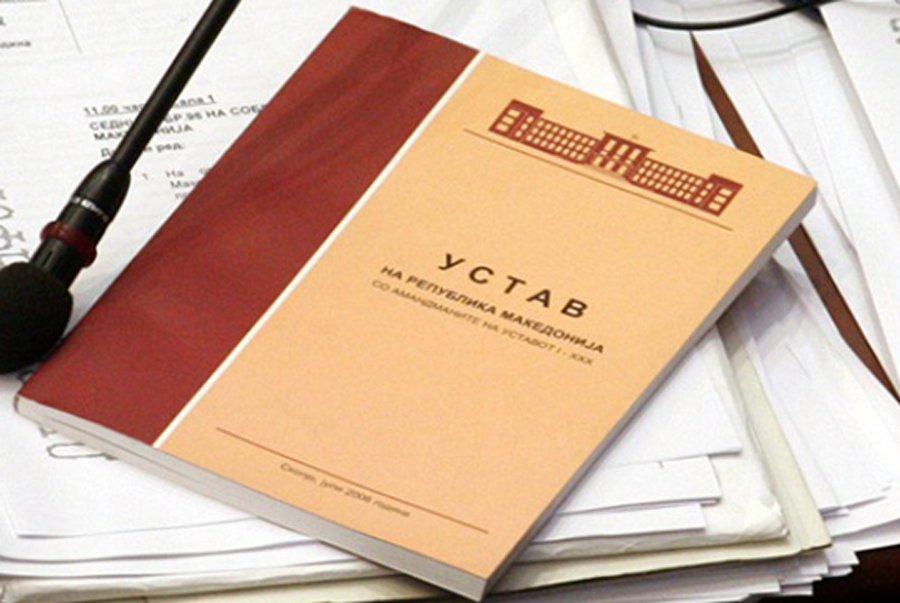
“A state is not sustained by force, but by justice. Where law falls silent, the state begins to weaken.”
(Inspired by Aristotle’s reflections on justice and the state)
Written by: Slobodan TOMIC

WHEN LAW BECOMES MORE IMPORTANT THAN POLITICS
There are moments when an institution does not decide merely on a specific case, but on the public’s trust in the entire constitutional order. Such is the case concerning the Second Protocol of the Joint Intergovernmental Commission between Macedonia and Bulgaria.
This is not a debate about being “for” or “against” European integration.
Nor is it a political confrontation between government and opposition.
The essence lies much deeper: whether every act that produces legal effects for the state has been adopted in full compliance with the Constitution, laws, and prescribed procedures.
In every democratic state, this question is the true measure of the rule of law.
THE INITIATIVE OF LILJANA POPOVSKA: REQUEST FOR CONSTITUTIONAL REVIEW
In this context, former Member of Parliament Liljana Popovska submitted an initiative to the Constitutional Court requesting an assessment of the constitutionality and legality of the Second Protocol.
The initiative raises several legal arguments. Among them are doubts about whether the document should have been ratified by Parliament, whether it was published in accordance with domestic legislation, and whether the procedure of its adoption fully complied with constitutional rules.
A subsequent formal request was also submitted, urging the Court to prioritize the case due to its significance.
These are the claims contained in the initiative.
Their legal validity can only be determined by the Constitutional Court, as prescribed by the Constitution.
WHY THIS CASE MATTERS
This case is important because it raises a fundamental question: can an act that produces significant consequences for the state become part of the internal legal order without full respect for constitutional procedures, if such doubts are reasonably raised?
In a democratic system, it is precisely for such dilemmas that a Constitutional Court exists. Its role is not political, but to protect the Constitution and to review the legality and constitutionality of contested acts.
THE MESSAGE OF THE CONSTITUTIONAL COURT
The President of the Constitutional Court, Darko Kostadinovski, publicly stated:
“We do not calculate, and we will not calculate.”
With this message, the Court emphasized that proceedings will be based on facts, relevant documentation, and legal arguments—not political expectations.
Such an approach is the essence of the rule of law: decisions must derive from the Constitution and laws, not from daily political pressure.
THE FINAL WORD BELONGS TO THE CONSTITUTION
In a constitutional state, no one stands above the Constitution. Not the Government, not Parliament, nor any other institution.
Therefore, the decision of the Constitutional Court will carry significance that goes beyond the specific case itself. It will demonstrate how institutions resolve serious legal dilemmas and whether constitutional review is applied consistently in matters of major national importance.
Regardless of the outcome, trust in institutions is built when they act independently, impartially, and strictly in accordance with the Constitution and laws.
That is the strength of a constitutional state.
