

Written by: Slobodan Tomić

“Democracy is not measured by how easily power is won, but by how honestly the will of the citizens is respected.”
Karl Popper

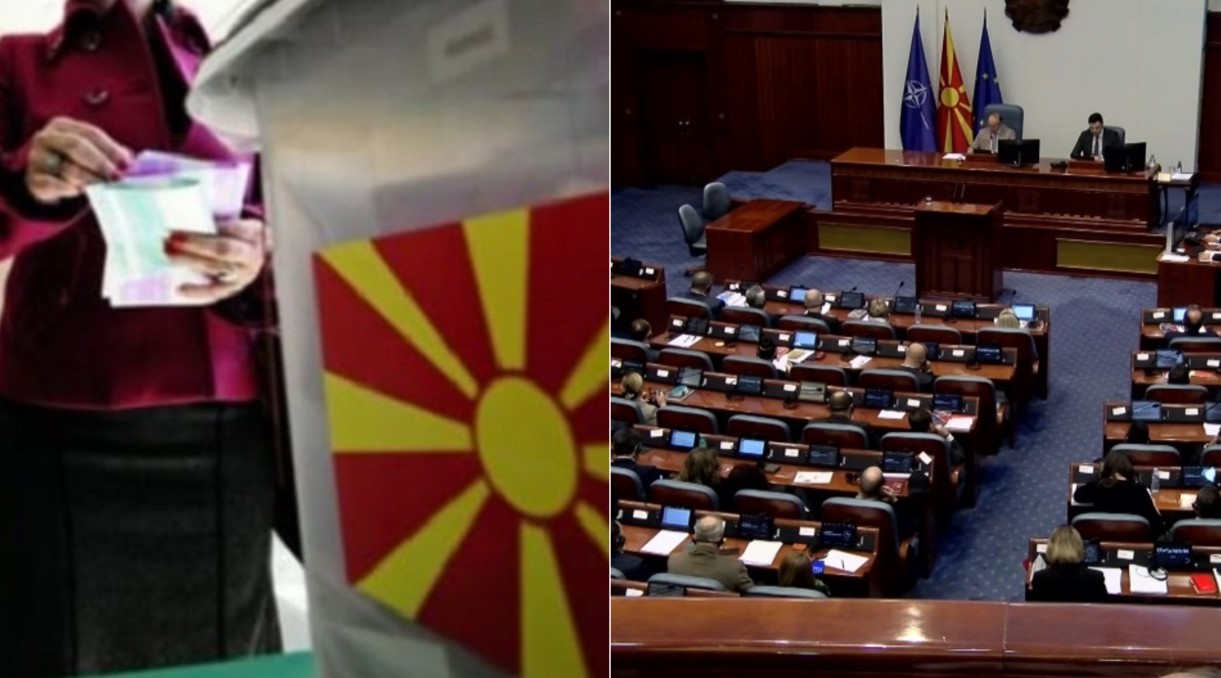
The political battle over the new Electoral Code has long ceased to be a simple debate between the government and the opposition. Today, it represents one of the most important political tests for the maturity of Macedonian democracy, the capacity of its institutions, and the sincerity of all political actors in their declared commitment to European integration.
The Electoral Code is neither a condition imposed by the Government nor a political whim of any single party. It is part of the reform commitments that the Republic of Macedonia has undertaken before the European Commission. Harmonizing electoral legislation with European democratic standards is one of the key indicators of successful implementation of the Reform Agenda, from which hundreds of millions of euros in European financial support depend directly—funding infrastructure, education, healthcare, digitalization, and economic development.
That is precisely why today’s blockade is not merely a party conflict.
It represents a risk to the country’s European perspective.
Particular attention should be given to the fact that Prime Minister Hristijan Mickoski publicly stated that the Government is prepared to accept almost all demands raised by opposition parties. Among them is the introduction of a single electoral district, a long-standing demand of the Left Party, as well as increased funding for election campaigns of smaller parties.
In European political practice, such compromises are usually the foundation of an agreement.
But if, even after the acceptance of these demands, new conditions and blockades continue, then an unavoidable question arises:
Is a better Electoral Code truly being sought, or is the goal for it not to be adopted at all?
FILIBUSTERING – WHEN PROCEDURE BECOMES A POLITICAL WEAPON
In every democratic parliament, mechanisms exist for submitting amendments and extending debate. This is an essential part of parliamentary democracy.
But the difference between democratic debate and institutional blockade is clear: one improves a law, the other prevents it from existing.
When thousands of amendments are announced with the sole purpose of delaying or obstructing the adoption of a law, we are no longer talking about a democratic process, but about filibustering as a tool of political paralysis.
In European democracies, such practices are recognized as legal but highly problematic when abused to block reform processes—and the Electoral Code is not just any law.
It is directly linked to the country’s European integration.
Therefore, every delay affects not only the Government or the opposition.
It affects the citizens.
And it weakens trust in institutions.
In this context, political responsibility is not measured by the number of amendments submitted, but by the ability to reach a functional compromise.
THE DIASPORA, EUROPEAN PRACTICE AND THE QUESTION OF POLITICAL EQUALITY
One of the most controversial issues in the debate over the Electoral Code is diaspora voting.
However, this issue is neither new nor unique to Macedonia.
In modern democracies, voting rights for citizens living abroad are widely accepted practice.
In Estonia, electronic voting has been functioning for more than two decades and represents one of the most advanced digital electoral systems in the world.
In more than 21 European Union member states, citizens are allowed to vote by mail, especially when they live or reside outside their home country.
In France, diaspora voting models exist through various channels, including electronic and consular mechanisms.
The European Commission, in its analyses, states that postal voting is a legitimate democratic model that facilitates access to voting rights, but it must be accompanied by strong security and verification mechanisms.
In this regard was the statement of MP Antonio Miloshoski, who pointed out that possible postal voting would not be conducted through the national postal operator, but through an international postal system, in order to ensure security, traceability, and timely delivery of electoral materials.
Particularly significant is also the position from my exclusive interview with former German MEP Doris Pack, who stated that there is no democratic basis for restricting the voting rights of the diaspora simply due to their residence abroad.
According to her, citizens must not lose their right to vote because of geographic distance.
NEGOTIATIONS OVER THE ELECTORAL CODE ON THE BRINK OF FAILURE
Political talks are facing a serious risk of deadlock due to lack of coordination among parliamentary groups.
Different positions exist:
The Government insists on including the diaspora and is ready for compromises;
the opposition expresses reservations about remote voting models;
the Left Party demands a single electoral district as a key reform.
Prime Minister Hristijan Mickoski stated that the Government is prepared to accept almost all demands, including increased funding for political parties and the introduction of a single electoral district, solely to ensure the adoption of the new Electoral Code.
In this atmosphere, negotiations stand between two logics:
one of reform and expansion of democratic rights,
and another of caution and fear of electoral abuse.
FINAL: CHOICE BETWEEN REFORM AND POLITICAL BLOCKADE
The Electoral Code today is not merely a legal issue.
It is a test of whether Macedonia can function as a stable European democracy or remain trapped in cycles of political blockade.
On one hand, there is readiness for compromise, including a single electoral district, improved funding for smaller parties, and modern voting models for the diaspora.
On the other hand, there are blockades, conditions, and announcements of mass amendments.
In essence, the question is political and strategic:
does the state have the capacity to make decisions, or will it remain a hostage to endless obstruction?
The European Union, through the Reform Agenda, sends a clear message: reforms must be delivered, not merely announced.
CONCLUSION
This debate is not only about the diaspora, nor only about the electoral model.
It is a test of the political maturity of the state.
European practices—from Estonia to postal voting systems across the EU—demonstrate one common principle:
the right to vote is not lost by crossing a border.
Therefore, the real question is not which model will be chosen, but whether Macedonia will build a system that is secure, inclusive, and fully aligned with European standards.
