

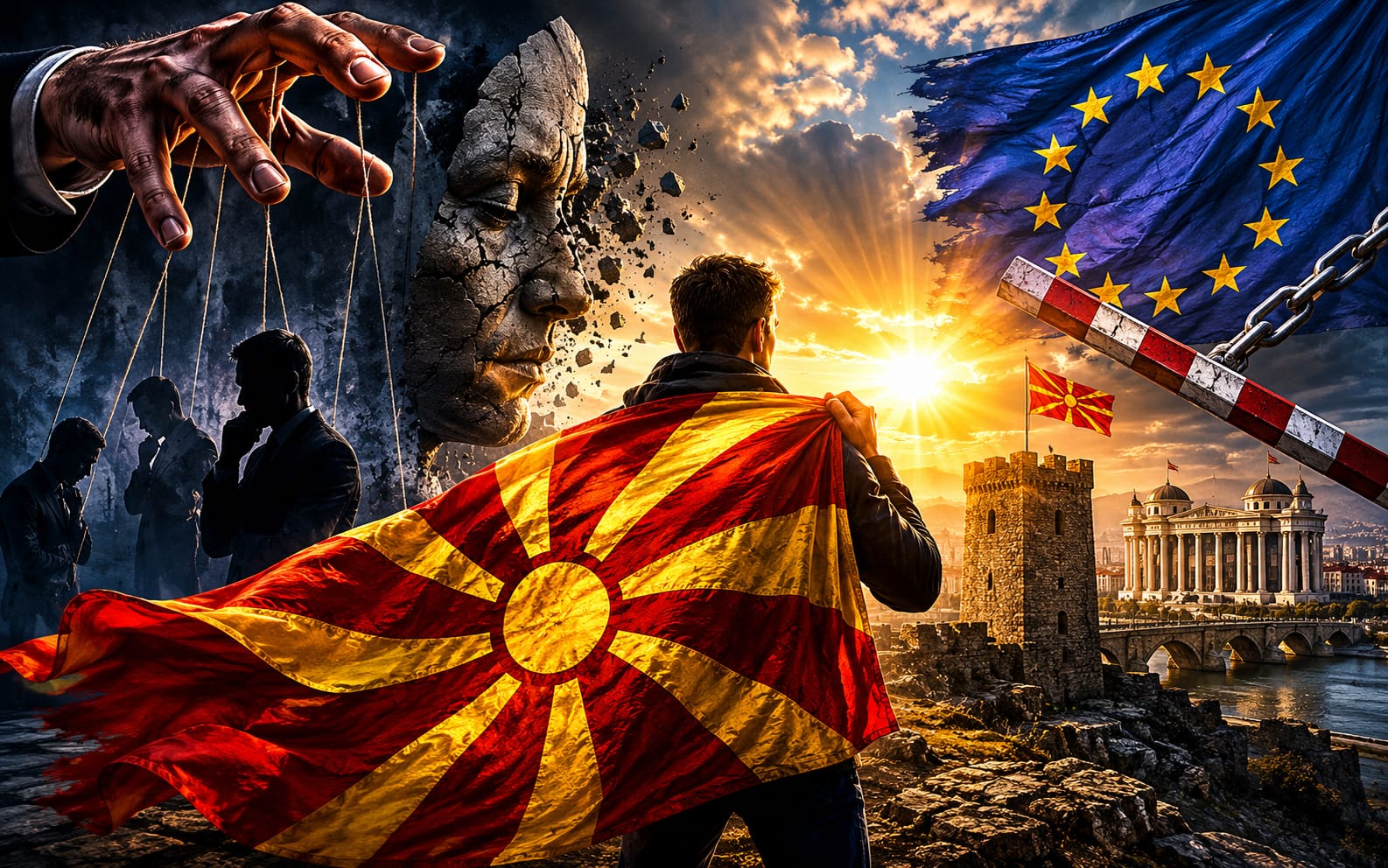
Human rights cannot be a “European value” in one case and a “technical issue” in another.
“When principles are applied selectively, they cease to be principles and become instruments of power.”
(Václav Havel)
By Slobodan Tomić

Sometimes a single sentence says more than a dozen carefully crafted diplomatic communiqués.
That was the case when EU Ambassador Michalis Rokas remarked that “a great deal of work is being done under the radar” to help unblock Macedonia’s path toward the European Union.
“Under the radar.”
The phrase is more than diplomatic language. It suggests that an unseen process is unfolding behind closed doors—a process intended to produce a political breakthrough.
Yet one obvious question immediately follows.
A breakthrough toward what?
A solution grounded in European principles? Or another political compromise in which Macedonia is once again expected to bear the greatest burden?
Rokas’ statement came at a moment when another message from Sofia exposed the deeper contradiction at the heart of the dispute.
Bulgarian Vice President Iliana Iotova argued that implementing the judgments of the European Court of Human Rights concerning the freedom of association of ethnic Macedonians in Bulgaria should not be viewed politically, but merely as an institutional and technical process.
That distinction is far from technical.
It exposes two different standards.
When Bulgaria demands changes from Macedonia, the discussion revolves around European values, human rights and conditions that must be fulfilled before accession negotiations can move forward.
But when the European Court of Human Rights rules against Bulgaria in cases concerning citizens who identify themselves as Macedonians, the issue suddenly becomes little more than a procedural technicality.
This is where the real European question begins.
Are European values truly universal, or do they depend on whether a country is already an EU member or merely a candidate?
If those values are universal, they must apply equally to everyone.
If they do not, then the problem is no longer exclusively Macedonian.
It becomes a question of the European Union’s own credibility.
UNDER THE RADAR SHOULD NOT MEAN NEW CONCESSIONS—IT SHOULD MEAN NEW PRINCIPLES
Diplomacy has always had its quiet language.
History’s most important agreements were rarely born before television cameras. They emerged behind closed doors, through negotiations, difficult compromises and carefully managed political dialogue.
There is therefore nothing unusual about the fact that, as Ambassador Rokas noted, significant work is taking place “under the radar.”
The real question is different.
What exactly is being negotiated?
Macedonia has already paid a considerable political price on its European journey. From changing its constitutional name to implementing extensive reforms and accepting the current negotiating framework, the country has taken steps that few candidate states have ever been asked to take.
For that reason, whenever another solution is said to be taking shape “under the radar,” Macedonian citizens have every reason to expect that it will not become yet another list of unilateral concessions, but rather the beginning of a more balanced relationship between obligations and rights.
The European Union repeatedly defines itself as a community founded on the rule of law, respect for human rights and equality before common rules.
Now is the moment for those principles to be demonstrated in practice,not through declarations or diplomatic rhetoric, but through consistent action.
THERE CANNOT BE TWO DIFFERENT EUROPEAN JUSTICES
The statements coming from Sofia raise an uncomfortable question for Europe’s institutions.
If the rights of Bulgarians in Macedonia are considered a European value, then by the same logic the rights of Macedonians in Bulgaria must also be treated as a European value.
Not because Macedonia demands it.
But because European principles require it.
The European Court of Human Rights does not issue political declarations.
It delivers legally binding judgments.
Those judgments are meant to be respected equally, regardless of the member state involved.
One set of court rulings cannot become a political condition for an EU candidate while another is dismissed as a mere technical matter because it concerns an existing member state.
Such an approach does not build confidence.
It undermines it.
And without trust, there can be neither a strong European Union nor a credible enlargement policy.
INTERNAL GUARANTEES: A MACEDONIAN RESPONSE USING EUROPEAN LEGAL PRINCIPLES
In recent days, increasing attention has been given to the idea of so-called internal guarantees,a constitutional and institutional framework through which Macedonia would safeguard its constitutional order, national identity and Macedonian language throughout the accession process.
This proposal should not be interpreted as opposition to the European Union.
Quite the opposite.
It represents an attempt to rely on European legal principles in order to protect constitutional rights and national identity within the European framework itself.
There is nothing anti-European about such an approach.
Indeed, it reflects the very logic upon which the European legal order claims to be built.
Candidate countries are expected to strengthen the rule of law and constitutional certainty.
It is therefore entirely legitimate for Macedonia to seek legal mechanisms that provide predictability, reciprocity and protection against politically shifting conditions during negotiations.
The debate is not about rejecting Europe.
It is about ensuring that European standards are applied consistently.
IF A SOLUTION IS BEING BUILT UNDER THE RADAR, IT MUST ALSO WITHSTAND PUBLIC SCRUTINY
Ambassador Rokas’ remarks have created cautious optimism that diplomatic space still exists to move the accession process forward.
That optimism, however, can only survive if any agreement reached behind closed doors is capable of standing openly before public opinion.
Trust is not created through secrecy alone.
It is created through transparency, consistency and respect for principles.
Macedonian citizens are not asking for impossible promises.
They are asking for clear rules.
They expect European standards that apply equally to everyone.
And they expect an accession process in which the dignity of their country is not treated as the price of progress.
THE TEST IS NO LONGER MACEDONIA’S,IT IS EUROPE’S
Over the past two decades, Macedonia has undergone reforms, accepted difficult political compromises and made painful strategic decisions in the belief that every step would bring it closer to European Union membership.
Today, the central question is no longer whether Macedonia wants to join the European Union.
That has long been established.
The real question is whether the European Union is prepared to remain faithful to the principles it has consistently promoted: the rule of law, equality before the law, respect for human rights and non-discrimination.
The assertion that “a great deal of work is being done under the radar” has created hope that there may still be diplomatic room to overcome the current deadlock.
But any agreement negotiated behind closed doors will ultimately be judged not by the secrecy surrounding it, but by whether it can withstand public scrutiny while remaining consistent with the principles Europe claims to defend.
Macedonia is not asking for special treatment.
It is not asking for privileges.
Nor is it asking for the rules to be rewritten in its favour.
It is asking for something far simpler.
That the same rules applied to every European country should also apply to Macedonia.
If European principles are genuinely universal, they must bind both member states and candidate countries alike.
Otherwise, the growing perception will be that enlargement is shaped less by shared values than by political leverage and the power of the veto.
That would weaken not only the credibility of enlargement policy but also the European Union’s authority as a community founded on law rather than political convenience.
If Europe is indeed searching for a solution “under the radar,” that solution should reinforce legal certainty, equal treatment and mutual trust,not create another exception to principles that are supposed to be universal.
Only then will Europe demonstrate that its values are more than diplomatic language.
They will become living principles capable of guiding the Union through one of the most challenging moments in its enlargement policy.
In the end, the decisive examination is no longer Macedonia’s.
It is Europe’s.
“Equality before the law is not a privilege granted to some. It is the foundation without which no political community can claim to be truly just.”
Montesquieu
