

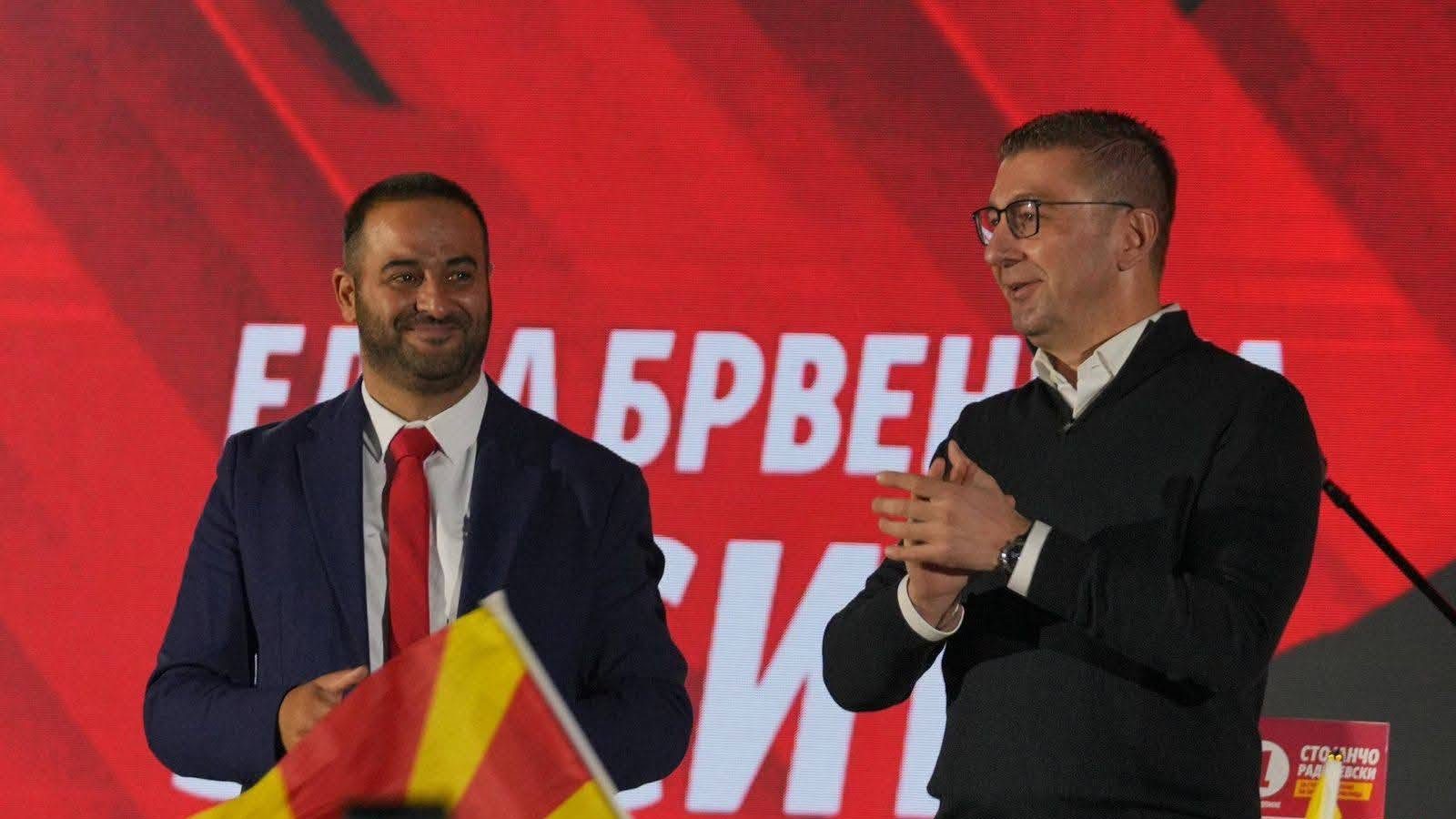
MEGA-AUTHORIAL POLITICAL PORTRAIT
By: Slobodan TOMIĆ, M.Sc.

“A man is not measured by the position he occupies, but by the footprint he leaves behind. And politics acquires its true meaning only when personal ambition turns into responsibility toward the people.”
(Slobodan Tomić, M.Sc.)
THERE ARE MOMENTS WHEN A MUNICIPALITY CHOOSES MORE THAN A MAYOR
Brvenica!
A name that gathers within itself the homes, families, memories, hopes, labor, and destinies of its people. A name that is not merely a dot on a geographical map, but a living part of the Macedonian land, of its historical memory, and of its future.
Behind every street stands a human story. Behind every school — a child’s dream. Behind every field — the toil of the man who tills the earth. Behind every family — the quiet, yet persistent hope that tomorrow will be better than today.
That is precisely why local politics is never merely a matter of streets, sewage systems, budgets, and construction works. It is the politics of everyday life. Politics felt inside the home, in family conversations, in the opportunity for young people to find work, in the security of parents, and in the dignity of the elderly.
Local elections, therefore, are far more than an electoral race. They are a test of trust, of political maturity, and of the ability to recognize what the people truly need.
In politics, there are moments when a name becomes a symbol of expectations. But there are also moments when that name must prove that behind it lie vision, readiness, and the capacity to assume responsibility.
Brvenica stands before such a moment.
Following the passing of Jovica Ilievski, local political life faces a new chapter. The candidacy of Stojančo Radichevski from VMRO-DPMNE opens the question of continuing development, the direction in which the municipality will move, and how political offerings can be transformed into concrete change.
From my authorial perspective, the essential question is not merely who will assume office, but what vision will guide Brvenica in the years to come.
It is not enough to inherit an institution. One must understand its weight.
It is not enough to offer hope. One must show the path to its fulfillment.
It is not enough to speak of development. One must create the conditions for it to become visible in people’s lives.
That is why Brvenica must not stop. It must continue to develop, to open its possibilities, and to build a future in which the young see a reason to stay, families feel secure, and every citizen knows that their needs hold a place in municipal priorities.
JOVICA ILIEVSKI — WHEN MEMORY BECOMES AN OBLIGATION
There are people who depart from this world, yet their names continue to live in the memories of their fellow citizens, in the conversations of friends, and in the history of the community to which they dedicated a part of their lives.
Jovica Ilievski served as Mayor of Brvenica from 2021 to 2025 and again participated in the local elections in 2025. His passing in June 2026 cut short his public service and left a void in local political life.
When a man who bore responsibility for a municipality passes away, what remains is not merely an empty seat in an institution. There remain initiated processes, enacted decisions, realized or unrealized plans, human memories, and questions that must receive answers.
Therefore, the memory of Jovica Ilievski deserves dignity.
Yet true dignity is not built by idealizing the past, nor by turning memory into an instrument for political point-scoring. It is built through an honest evaluation of what was accomplished, through respect for results, and through a readiness to continue that which truly serves the citizens.
Every mandate has its achievements, its limitations, and its unresolved issues. Their valuation should rest upon facts, documents, completed projects, and the experiences of the people who felt the consequences of municipal decisions.
Yet above every political assessment stands human dignity.
The deceased should not serve as a tool for daily political point-scoring. His name should not be used as a weapon against the living, nor as an ornament in campaign speeches.
If good practices remained from his work, they should continue. If projects were initiated that the citizens need, their completion should be responsibly evaluated. If weaknesses exist, they ought to be corrected.
That is the essence of institutional maturity.
The most dignified tribute to a mayor is not merely repeating his name, but preserving the good he left behind for the people.
Here begins the true challenge for Stojančo Radichevski: to comprehend the weight of this legacy, to respect that which merits respect, and simultaneously to offer his own vision for the future.
For the past deserves remembrance, but the future demands decisions.
And a municipality cannot live on memories alone. It must live on hope converted into work.
STOJANČO RADICHEVSKI — BIOGRAPHY, POLITICAL RESPONSIBILITY, AND THE TEST OF DEEDS
Stojančo Radichevski, VMRO-DPMNE’s candidate for Mayor of Brvenica in the snap local elections in October 2026, enters the electoral process with a legal education, a master’s degree in civil law, and political engagement as president of the party’s municipal committee.
His education is part of his professional profile. His political activity reflects his past engagement. Yet the mayoral position represents a far broader responsibility than any diploma or party title.
It demands the ability to listen to people, to recognize the needs of different settlements, to manage public funds, to organize administration, and to make decisions whose consequences are felt in everyday life.
A legal education can serve as a solid foundation for understanding laws and institutions. Political experience can aid in organization and cooperation with central government. But the true value of these prerequisites is demonstrated only when knowledge and experience are translated into beneficial work for the community.
Therein lies the distinction between biography and political character.
A biography tells us where a man comes from. Deeds reveal what he can leave behind.
From that perspective, Radichevski must be evaluated through the program he presents, through his public positions, through the feasibility of his proposed projects, and through the manner in which he assumes responsibility before the citizens.
It is not enough to state that there will be development. One must explain how it will be achieved.
It is not enough to promise jobs. One must create conditions for sustainable investments, entrepreneurship, and economic activity.
It is not enough to speak of youth. One must open opportunities for them to receive education, employment, and a dignified life in their own hometown.
It is not enough to appeal for unity. That unity must be demonstrated through one’s attitude toward every citizen, regardless of political, ethnic, or other affiliation.
Right here lies the essence of a serious political portrait: not only what the candidate represents, but what standards he seeks to establish.
In local politics, there is no small responsibility. Sometimes a timely resolved municipal issue means more to a family than ten ceremonial speeches. A well-planned investment can alter the economic outlook of a settlement. A fair decision can restore faith to a citizen who felt forgotten for years.
Thus, political maturity is proven not by the grandness of promises, but by the seriousness of the approach.
A PROGRAM FOR BRVENICA — FROM WORD TO PROJECT, FROM PROJECT TO RESULT
In the public presentations of Radichevski’s election platform, key areas stand out: infrastructure, water supply, sewage, industrial development, education, youth support, and the digitalization of municipal services.
These are domains that directly affect the quality of life.
Yet their true value is determined not by the number of announcements, but by their feasibility, financing mechanisms, and the actual benefit felt by the citizens.
INFRASTRUCTURE — THE DIGNITY OF DAILY LIFE
For a resident who travels damaged roads daily, for a family expecting a reliable water supply, or for a farmer whose workday depends on access to his land, infrastructure is no secondary topic.
It is a prerequisite for a normal life.
Roads connect homes with schools, workplaces, and healthcare facilities. Water supply is a fundamental need. Sewage systems are a matter of public health, environmental protection, and human dignity.
Therefore, plans for local road reconstruction, sewage network expansion, and water supply improvements must be accompanied by clear priorities, budgets, and deadlines.
Every settlement deserves to know what is planned, what is secured, and when results can be expected.
True infrastructural policy is measured not by the length of a ribbon cut at an opening ceremony, but by the years a road serves, water flows, and problems are solved.
INDUSTRIAL DEVELOPMENT — HOPE FOR WORK AND STAYING HOME
A young person leaving their hometown does not always leave because they ceased to love it. They often leave because they see no opportunity to earn a living through their own labor.
That is precisely why developing the industrial zone and supporting local enterprise are vital topics for the future of Brvenica.
Yet an industrial zone is not developed merely by drawing lines on a map. It requires appropriate infrastructure, settled property rights, access to energy, streamlined administrative procedures, and investor interest.
Conditions must also be fostered for domestic entrepreneurs, small businesses, and artisans, who often carry the main burden of the local economy.
Economic growth should not be reduced to a photo opportunity with an investor or a ceremonial announcement of a new factory. Its true measure is the number of sustainable jobs, working conditions, income stability, and the ability of people to plan a future.
The objective should be building an economy that relies not on promises, but on production, knowledge, entrepreneurship, and value created through labor.
YOUTH — A FUTURE THAT MUST BE GIVEN A CHANCE
There is no greater challenge for a municipality than whether its youth will choose to stay.
Therefore, proposals for an innovation fund, business incubator, and entrepreneurial support deserve serious consideration.
Yet behind every such idea, a clear mechanism must exist.
How will funds be allocated? Who will be eligible to apply? How will privileges and political favoritism be prevented? How will results be monitored to determine whether public funds achieved their goal?
If mechanisms are established transparently and fairly, they can open space for new ideas and local initiatives.
Young people do not seek merely to be mentioned in speeches. They demand to be heard, included, and treated as individuals with the right to shape their own future.
Youth do not need only messages telling them they are the future. They need the opportunity to be the present.
A municipality that invests in their knowledge, creativity, and entrepreneurial spirit invests in its own long-term sustainability.
CARE FOR CHILDREN AND THE ELDERLY — A MEASURE OF MUNICIPAL HUMANITY
Announcements for a new kindergarten in Čelopek, the expansion of the kindergarten in Brvenica, and a planned nursing home with a capacity for up to 50 residents touch upon one of the most vital aspects of local policy: how the municipality addresses the needs of different generations.
Parents require accessible, high-quality care for their children. Senior citizens deserve security, respect, and conditions for a dignified life.
Yet such projects require more than construction works. They demand financial planning, qualified staff, proper standards, sustainable operation, and quality control.
Hence, every announcement must be accompanied by clear answers regarding execution and long-term functionality.
A municipality investing in children and the elderly does not invest merely in buildings. It invests in intergenerational solidarity, family security, and its own humanity.
DIGITALIZATION AND TRANSPARENCY — THE CITIZEN BEFORE THE COUNTER, NOT BEHIND PARTY DOORS
Modern local self-government should make citizens’ lives easier.
Digital services, publicly accessible budget data, published contracts, and the ability for citizens to track projects can greatly restore trust in institutions.
This is no technical detail. It is a matter of democratic culture.
A citizen should not need political connections to receive information regarding a procedure affecting their rights. They should not depend on personal acquaintance to be heard. They should not have to guess where public funds go.
The municipality belongs to the people, not to whichever political structure leads it at a given moment.
Transparency means a readiness to answer questions even when the answers are uncomfortable. Accountability means willingness to take responsibility when a project is delayed or a decision fails to deliver expected outcomes.
Here lies the measure between a government that merely asks for trust and one that earns it daily.
BRVENICA AND MACEDONIA — ONE STATE, MANY MUNICIPALITIES, A SHARED RESPONSIBILITY
When we speak of Macedonia, we usually think of grand historical questions, national identity, the Macedonian language, culture, international standing, and the country’s ultimate path.
Yet the state does not live only in grand speeches.
It lives in the school where a child learns. On the road a worker travels. In the office where a citizen seeks service. In the municipal budget funding local projects. In the opportunity for a young family to stay home and build a future.
Therefore, Brvenica holds significance far beyond its administrative boundaries.
Not because every local decision automatically alters national history, but because the strength of a nation is forged through the everyday performance of its local institutions.
Macedonian statehood is reinforced when laws are respected, when public funds are spent responsibly, and when citizens feel equal before the law.
Macedonian identity does not require diminishing another’s dignity. On the contrary, its maturity is demonstrated through confidence, cultural awareness, respect for its history, and the ability to build democratic institutions.
National consciousness is not merely an invocation of the past. It is an obligation toward future generations.
To preserve the Macedonian language means to cultivate its rich heritage. To respect Macedonian history means to study, research, and transmit it with seriousness. To defend the dignity of the state means making its institutions worthy of its citizens’ trust.
A single municipality can contribute to national maturity through simple yet essential actions: quality services, functional infrastructure, accountable governance, and peaceful coexistence without discrimination.
Right here, local development and national interest converge.
A strong Macedonia is not made up solely of large urban centers. It is built upon municipalities where people have reason to stay, work, create, and entrust their children’s future.
If young people leave their municipality en masse, it is not merely a local problem. It is a warning sign for society as a whole.
When families receive conditions for a dignified life, when businesses can thrive, when public services function, and when citizens feel institutional fairness, local development becomes an engine of national progress.
Brvenica, therefore, is no isolated island. It is an integral part of the Macedonian whole and of our shared responsibility for the nation’s future.
POLITICAL SUPPORT IS STRONG WHEN BASED ON RESPONSIBILITY
In every democracy, political parties have the right to nominate candidates, defend their platforms, and seek the trust of citizens.
Yet political maturity is measured not merely by the strength of a campaign performance. It is measured by the ability to accept that public office is a duty, not a private privilege.
Radichevski, as VMRO-DPMNE’s candidate, has the opportunity to present his vision for Brvenica, explain how he intends to realize projects, and show how he will foster cooperation with central government authorities.
Citizens, on their part, have every right to ask questions, demand clear answers, and compare platforms.
This is not hostility toward a candidate. It is the very essence of the democratic process.
A serious political offering does not fear scrutiny. It accepts scrutiny as part of its responsibility.
When a candidate speaks of development, citizens have the right to ask how much it will cost, where funding will come from, who will execute the project, and when results will be delivered.
When transparency is promised, citizens have the right to expect open public records and institutional accessibility.
When equality is invoked, it must apply equally to the citizen who does not support the ruling political structure.
The most credible political offering is one that can be converted into a public commitment: complete with deadlines, financial frameworks, measurable goals, and accountability.
Support gains real weight when grounded in sound arguments and when trust is built through concrete actions.
If Radichevski wishes to leave an enduring mark in Brvenica, the paramount proof of his political engagement will be what he achieves for its citizens.
Not just the campaign poster. Not just the speech. Not just the party position.
But the tangible results that people can see, use, and evaluate.
MARCUS AURELIUS — POWER IS NOT A GOAL, BUT A TEST OF CHARACTER
The Roman philosopher and emperor Marcus Aurelius, in his “Meditations,” developed the thought that a man must fulfill his duty to his community and act rationally, without confusing personal glory with the true worth of an action.
That thought remains profound two millennia later.
A political post is temporary. Human responsibility does not end with a term in office.
A man may obtain power, but his true character is revealed in how he uses it. He may make decisions, but maturity is shown in whether he understands their consequences. He may promise, but integrity is proven when he must fulfill those promises.
Power can open doors, but it cannot command respect on its own. Office can grant authority, but it cannot bestow legitimacy that has not been earned.
Authority is built through responsibility, consistency, and a willingness to listen even to those who think differently.
Therefore, for any candidate seeking to lead Brvenica, a simple standard applies:
What real change will the citizens feel?
Will they have better living conditions? Will they exercise their rights more easily? Will they receive accurate information on municipal decisions? Will the youth have more opportunities? Will public funds be subjected to genuine oversight?
These questions are not merely electoral. They are fundamental questions of responsible governance.
And within them lies the wisdom that transcends any party rivalry: office is an instrument of service, not proof of personal greatness.
BRVENICA MUST NOT BE A HOSTAGE TO DIVISIONS
No municipality can fulfill its potential if its citizens are treated as winners or losers based on election results.
An electoral contest can be fierce. Programs may differ. Political views may clash.
Yet the day after the election, people meet on the same streets once more. Their children attend the same schools, their families depend on the same public services, and their future is bound to the same municipality.
Therefore, a mayor’s duty does not end with those who voted for the winner.
It entails responsibility toward every resident.
The true measure of local leadership is shown in the capacity to build a municipality where diversity is no obstacle to cooperation, and political differences are no justification for unequal treatment.
Brvenica deserves an atmosphere where people compete with ideas, then collaborate for solutions.
It deserves a municipal administration that serves its citizens. It deserves projects connecting all settlements. It deserves public spaces that bring people together. It deserves politics that understands the difference between party interest and the common good.
Unity does not mean everyone thinking alike. It means being able to live, work, and build together despite differences.
A municipality that respects diversity is far better equipped to mobilize its human, economic, and cultural resources.
For when a municipality is divided, it is the citizens who lose the most.
When institutions are open, fair, and accountable, space is created for progress that transcends party boundaries.
RADICHEVSKI’S GREATEST TEST IS WHAT REMAINS AFTER HIM
In politics, it is easy to speak of the future. It is far harder to plan, fund, and build it.
Therefore, Radichevski, like any candidate for public office, must present his program in a way that enables citizens to grasp its priorities and practical feasibility.
If he promises infrastructure, citizens must know when work begins, what it costs, and how it is funded.
If he promises economic growth, he must explain how conditions will be created for investments and employment.
If he speaks of youth, he must offer concrete mechanisms granting them genuine opportunities to participate and grow.
If he promises transparency, he must establish rules that apply even when public scrutiny becomes uncomfortable for the local administration itself.
That is the distinction between campaign rhetoric and political responsibility.
Results do not appear overnight. Long-term planning, cooperation with state institutions, securing funds, and making tough decisions on priorities are often required.
Yet that is precisely why a clear vision is essential. It allows one to distinguish between what is realistically achievable and what is merely attractive during campaign season.
And here we return once more to Jovica Ilievski.
His name remains part of Brvenica’s recent history, and his tenure should be evaluated through facts, results, and human memories. Yet the municipality’s future cannot be trapped in nostalgia.
It demands new solutions, new ideas, and a readiness to take responsibility.
For Radichevski, this means the challenge is not merely presenting a political proposal, but demonstrating how it can become part of citizens’ daily lives.
The true value of a mayoral term is determined not by how many projects were announced, but by how many were realized, sustained, and served the people.
For office is won in an election, but reputation is built over years.
BRVENICA MUST LOOK FORWARD — A VISION TRANSCENDING EVERYDAY POLITICS
There are municipalities that build their growth upon clear priorities, long-term planning, and the capacity to align public needs with real possibilities.
Such progress does not depend on a single individual. It demands functioning institutions, skilled professionals, citizen engagement, and continuity in proven projects.
Yet leadership plays a vital role: establishing priorities, uniting resources, and providing clear direction.
Brvenica needs an approach that will not reduce politics to mutual accusations, but will focus instead on how to do better.
How can working conditions be improved? How can better infrastructure be delivered? How can investments be attracted without neglecting local businesses? How can family services be enhanced? How can a more accessible, efficient municipal administration be forged?
These are the questions that ought to shape local political discourse.
Answers need not always be easy. But they must be clear, reasoned, and directed toward the public good.
If Radichevski succeeds in turning his campaign pledges into actionable projects with clear deadlines and accountability, his political tenure will have the chance to leave a lasting mark.
If an idea proves unfeasible, responsible leadership requires re-evaluating it and providing a better solution.
The true strength of politics lies not in never making a mistake, but in recognizing errors, correcting them, and moving forward with greater accountability.
Brvenica does not demand perfect people. It deserves serious institutions, realistic plans, and leaders who comprehend the solemn weight of public trust.
FINAL MESSAGE — BRVENICA IS GREATER THAN ANY NAME
Brvenica!
Your future is not written in advance. It depends not on a single name, a single party, or a single election day.
It depends on the people who live within you, on the institutions built to serve them, and on the decisions that will define the lives of the next generation.
Jovica Ilievski remains part of your recent history. His passing reminds us that human life is fleeting, while public responsibility is a duty that must endure through institutions.
Stojančo Radichevski enters this election with his political proposal and an opportunity to present his vision for the municipality’s next phase of development.
It is up to the citizens to evaluate that proposal. It is up to every officeholder to justify the trust reposed in them.
Yet above all names remains one truth: Brvenica deserves more than campaign slogans.
It deserves a plan, hard work, accountability, and real results.
Macedonia deserves municipalities that do not squander their potential in endless divisions, but turn it into better living conditions.
The youth deserve a future. Parents deserve security. The elderly deserve respect. Every citizen deserves institutions that treat them with equal dignity.
And politics must serve as a bridge between the people’s needs and the nation’s capacity.
Thus, the true political challenge for Brvenica is not merely choosing who will lead it, but creating conditions where every succeeding generation enjoys greater opportunities than the last.
It is not enough to inherit office — one must earn trust.
It is not enough to invoke the past — one must build the future.
It is not enough to promise progress — one must deliver results.
It is not enough to speak of the people — one must work so that every person feels that their dignity, their labor, and their future truly matter.
That is the standard of responsible leadership.
That is the obligation toward Brvenica.
That is the duty toward Macedonia.
And that is the only legacy worth leaving behind.
Brvenica must not stop. Macedonia must not lose its opportunities. And politics must justify the people’s trust.
For history remembers longest not those who promised the most, but those whose deeds left a lasting mark.
ACTA NON VERBA — DEEDS, NOT WORDS.
