

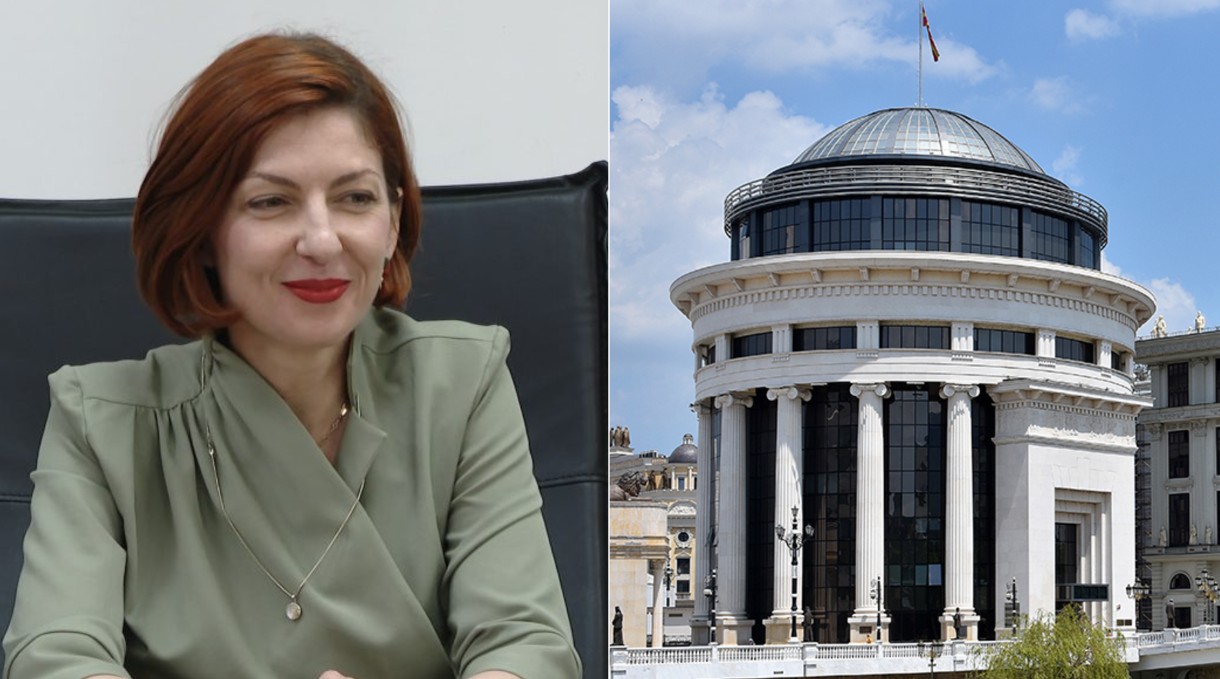
NEW LEADERSHIP, OLD SUSPICIONS AND THE PROSECUTION’S DEFINING TEST: HIGH-LEVEL CORRUPTION, INSTITUTIONAL ACCOUNTABILITY AND ONE FATHER’S QUESTION — WHERE CAN I FIND JUSTICE FOR MY SON?
By: M.Sc. Slobodan Tomić, Analyst and Publicist

Some interviews are intended to inform. Others raise political and institutional questions. And then there are interviews that, sometimes without even intending to, expose the deepest wound in a society: the loss of public faith in justice.
The first televised interview with Iskra Hadži Vasileva, the newly elected Head of the Basic Public Prosecutor’s Office for the Prosecution of Organised Crime and Corruption, was far more than a discussion about personnel changes, ongoing cases and future priorities. It was a conversation about an institution from which the public expects truth to be uncovered, crime to be prosecuted, abuses of power to be exposed and, above all, one fundamental principle to be upheld: justice must not be the privilege of the influential, but the right of every citizen.
The new head takes charge of an institution burdened by serious challenges: a lack of public confidence, insufficient human and material resources, unresolved cases, public concerns about selective enforcement and unanswered questions concerning the accountability of those entrusted for years with handling the most sensitive investigations.
Her message that she is prepared to work, introduce changes and withstand pressure is important. Yet in the administration of justice, statements are not the measure of success. Results are.
And results cannot be measured by the number of interviews given or reforms announced. They are measured by cases brought to a lawful and timely conclusion, accountability established through evidence, final court judgments, the recovery of unlawfully acquired assets and equal treatment under the law — regardless of office, political affiliation, wealth or political protection.
NEW LEADERSHIP, THE SAME INSTITUTION — JUSTICE DOES NOT BEGIN FROM ZERO
The election of Iskra Hadži Vasileva on 28 October 2026, with 64 votes out of 171 valid ballots, and her assumption of office on 16 November mark a new chapter for the Office of the Prosecutor for the Prosecution of Organised Crime and Corruption.
She succeeds Islam Abazi, who headed the institution from October 2022.
However, a change in leadership does not, in itself, amount to a change in institutional culture. Nor does it automatically mean that every case that has provoked public concern over the years will be reopened, that proceedings will accelerate or that citizens will suddenly regain confidence in the system.
For years, public criticism, questions and suspicions have surrounded the handling of certain cases, the pace of proceedings, the possibility of selective enforcement and potential influences on public institutions.
Such suspicions must never be presented as established facts without evidence. Equally, however, they must not be dismissed simply because they are uncomfortable for those institutions.
Of particular significance is the position expressed by State Public Prosecutor Nenad Saveski in the public debate: cases are assigned to individual prosecutors, the head of the office cannot simply order a case to be concealed or discontinued, and responsibility for lawful conduct rests with the prosecutor handling the particular matter.
That is an important clarification. Yet it raises another question: if every case has an assigned prosecutor, who supervises that prosecutor’s work? Who intervenes when proceedings are unjustifiably stalled? And who is held accountable when procedural failures lead to the expiry of statutory limitation periods?
Citizens are not asking institutions to accuse one another without evidence. They are asking for suspicions to be examined, facts to be established and accountability to follow wherever there are sufficient grounds.
The new leadership has an opportunity to demonstrate that this institution belongs to no individual, that no case is beyond scrutiny and that no name carries greater weight than the law.
THIRTY PER CENT FEWER PROSECUTORS — A SHORTAGE IS A PROBLEM, NOT AN EXCUSE
One of the most serious problems highlighted in the interview was the shortage of personnel. According to the figures cited, the Prosecutor’s Office operates with approximately 30 per cent fewer prosecutors than required, while administrative staff are also in short supply.
The announced recruitment of three additional prosecutors, together with the emphasis on professional competence, integrity and merit-based selection, are steps that deserve attention.
But a fundamental question must be asked: can a state genuinely claim to be committed to combating organised crime and high-level corruption when the institution expected to prosecute the most powerful networks is operating without adequate human and technical resources?
An institution cannot reasonably be expected to deliver results without the necessary working conditions.
At the same time, however, chronic understaffing cannot become a universal justification for inefficiency.
What is needed are highly qualified prosecutors, financial experts, analysts, digital investigators, administrative support and modern mechanisms for tracing complex financial transactions.
Organised crime does not operate through outdated methods. It relies on networks, intermediaries, fictitious transactions, intricate ownership structures and international financial channels.
The prosecution service must therefore possess the expertise and institutional capacity required to confront the realities of the modern world.
THE EUROPEAN COMMISSION AND THE UNCOMFORTABLE TRUTH ABOUT HIGH-LEVEL CORRUPTION
The European Commission’s 2026 report delivers a serious warning about the state of the fight against corruption.
Particularly troubling is its assessment that insufficient progress has been made in preventing and combating corruption; that high-level corruption cases are frequently delayed; that some proceedings end through the expiry of statutory limitation periods; and that final convictions and tangible results in the confiscation of unlawfully acquired assets remain inadequate.
This is not merely a European observation. It is a domestic institutional problem.
When high-level corruption cases fail to reach a judicial conclusion, the public begins to question whether the law truly applies equally to everyone.
When proceedings drag on for years and accountability ultimately fails to materialise, citizens are left with the impression that time works in favour of the accused — particularly when those involved possess political, economic or institutional influence.
When unlawfully acquired assets are identified but are not confiscated through final court judgments, a legitimate question arises: is the state genuinely recovering the proceeds of crime, or merely documenting their existence?
That is why the true success of the prosecution service cannot be measured solely by the number of investigations opened or indictments filed.
Success means well-founded indictments, compelling evidence, lawful proceedings, judicial decisions capable of withstanding scrutiny and the confiscation of unlawfully acquired assets wherever the legal requirements are met.
European reports may identify weaknesses. The responsibility for overcoming them, however, rests at home.
THE PROSECUTION AND THE JUDICIARY — WHO IS ACCOUNTABLE WHEN JUSTICE GRINDS TO A HALT?
One of the most important issues raised in the interview concerned the relationship between the prosecution service and the judiciary.
The prosecution conducts investigations, gathers evidence and presents the case. The courts adjudicate on the basis of the evidence and the law. These are distinct institutional responsibilities, yet they are closely interconnected.
The problem arises when cases are returned, proceedings are repeatedly delayed, valuable time is lost, limitation periods approach and citizens are ultimately left without a clear answer.
The prosecution cannot shift the entire burden of responsibility onto the courts, just as the judiciary cannot explain every failure by pointing to the quality of prosecutorial casework.
Each institution must be accountable for its own part in the process.
If a prosecutor failed to gather evidence in a timely manner, the reasons must be established. If a court unjustifiably delays proceedings, that delay must be examined. If a case is returned because of serious deficiencies, it must be determined who was responsible and whether those deficiencies resulted from incompetence, negligence or other circumstances.
The expiry of limitation periods must never become an institutional refuge from accountability.
Justice cannot be held hostage by bureaucratic labyrinths, mutual accusations or the endless transfer of responsibility from one institution to another.
THE NEW CRIMINAL CODE — TOUGHER PENALTIES MEAN LITTLE WITHOUT EFFECTIVE ENFORCEMENT
The interview also addressed the proposed amendments to the Criminal Code, which envisage tougher penalties for abuse of official position, irregularities in public procurement and other forms of corrupt conduct.
The proposal reportedly includes prison sentences of up to 15 years for the most serious forms of abuse.
An important distinction must be made: these are proposed amendments, not provisions of a law that has already been adopted and entered into force.
Stricter penalties may form part of the solution, but they cannot, by themselves, guarantee justice.
Without effective investigations, sound indictments, independent trials and timely proceedings, even the harshest statutory punishment will fail to achieve its purpose.
The consequences of the 2023 amendments to the Criminal Code also deserve careful examination. Those changes triggered serious public and legal debate over reduced penalties and their implications for proceedings involving corruption and abuse of official position.
The legislature must enact laws that protect public confidence and legal certainty, rather than undermine them.
Justice is not measured by the severity of a sentence written into legislation, but by whether the law is actually enforced.
THE CASE OF ЃOKO RISTOV — WHEN QUESTIONS ABOUT WEALTH RAISE QUESTIONS ABOUT THE ENTIRE SYSTEM
One of the most sensitive cases discussed in the interview concerns Judge Ѓoko Ristov.
It was publicly reported that €350,000 had been discovered concealed inside a wall at the home of his parents. The proceedings concern suspicions of the unlawful acquisition and concealment of assets and money.
The case has reached trial, where the prosecution and the defence are presenting their respective arguments and evidence.
The presumption of innocence must be respected. Suspicion is not a conviction, an indictment does not establish guilt, and every accused person is entitled to a defence.
That, however, does not deprive the public of its right to ask legitimate questions.
If unlawful acquisition of assets is established, their origin, the methods used to conceal them and any potential links to other individuals or activities must also be examined.
If evidence points to a wider network, it must be investigated. If no such evidence exists, conclusions must not be drawn on the basis of speculation.
It is particularly important that the new head of the prosecution has indicated her intention to continue overseeing the case, which is already at an advanced stage.
This is not merely a question about the origin of a particular sum of money. It also raises a broader issue concerning the integrity of the justice system.
Citizens are entitled to expect that those who interpret and administer justice will be held to the same standards of accountability under the law as everyone else.
THE CASE INVOLVING PECO VEZIROSKI — THE INVESTIGATION MUST FOLLOW THE EVIDENCE WHEREVER IT LEADS
The interview also addressed the case involving Peco Veziroski, a prosecutor from Bitola who is suspected of exerting unlawful influence on prosecutors and judges in at least four cases.
According to information made public so far, the suspicions concern attempts to influence the handling and outcome of specific proceedings.
This is an especially serious matter because it concerns not an ordinary citizen, but an individual who held prosecutorial office and was entrusted with upholding the law.
Here, too, a clear distinction must be maintained between suspicion, investigation and proven responsibility.
The new head of the prosecution stated that the investigation remains at an early stage and that she cannot disclose details about its scope at this point.
That is understandable. The confidentiality of an investigation must be respected.
Nevertheless, the public is entitled to expect a thorough, independent investigation, free from any form of influence.
If evidence establishes that attempts were made to influence prosecutors or judges, that evidence must be examined. If there is evidence that others accepted such influence, their roles must also be subject to lawful scrutiny.
The investigation must not stop at the first name if the evidence leads further. Equally, no individual should be publicly implicated without evidence.
That is the distinction between the rule of law and trial by public opinion.
ROSICA, IVANA AND KATJA — WHEN INSTITUTIONAL FAILURE CAN HAVE TRAGIC CONSEQUENCES
One of the most difficult subjects raised in the interview concerned the accountability of police officers in cases of domestic violence and their tragic consequences.
In the case involving Rosica Koceva, it was reported that charges had been brought against nine police officers over suspected failures to act appropriately on reports of domestic violence and to fulfil their official duties.
This cannot be dismissed as a mere administrative oversight.
When a citizen reports violence, the authorities have an obligation to respond. When warnings of danger exist, they must be taken seriously. When court-issued protective measures are in place, their enforcement must never depend on an individual officer’s subjective assessment of whether a case is serious enough.
The tragic cases of Ivana and Katja were also mentioned during the interview. The new prosecutor stated that she had not yet obtained a full understanding of the details and that cooperation with the Ministry of Interior and the relevant specialised units would be necessary.
This is precisely where effective institutional coordination becomes essential.
It is not enough to establish a commission after a tragedy, issue a statement and announce reforms. It is necessary to determine who knew what, who was obliged to act, what action was taken and whether the failures could have been prevented.
Domestic violence must never be treated as a private matter behind closed doors. It is an issue of public safety, human dignity and the responsibility of the state.
Any official who has failed to fulfil a legal duty must be held accountable where the evidence establishes such a failure.
THE “MAZUT” CASE — A RETURNED FILE, FURTHER EXPERT EXAMINATIONS AND THE NEED FOR ACCOUNTABILITY
The interview also addressed the “Mazut” case.
According to publicly available information, in August 2026 the Higher Public Prosecutor’s Office returned the case for further action because of weaknesses in the expert reports and the need for additional investigative steps.
The new head of the prosecution explained that she had not yet examined every detail and that the assigned prosecutor was handling the case in accordance with the instructions received.
This distinction matters: the return of a case does not establish guilt, but it does indicate that identified deficiencies must be addressed.
In complex financial and economic cases, the quality of expert analysis can be decisive. Poorly prepared evidentiary material can undermine the entire proceedings.
It is therefore essential to establish whether the deficiencies resulted from a lack of professional expertise, inadequate investigative work or other circumstances.
The case must reach a lawful conclusion. It must not become yet another symbol of institutional delay.
“ALTA BANK” — WHERE DOES REGULATORY OVERSIGHT END AND CRIMINAL LIABILITY BEGIN?
The issue surrounding “Alta Bank” raises a particularly sensitive question: the relationship between financial operations, regulatory supervision and potential criminal liability.
The new prosecutor explained that preliminary checks of financial flows are under way and that a distinction must be drawn between potential criminal elements and matters falling within the jurisdiction of regulatory institutions.
It was also indicated that, based on the information available to her at the time, no harmful consequence had been established that would provide a sufficient basis for certain criminal-law conclusions.
This is an important legal distinction.
Not every suspicious financial transaction automatically constitutes a criminal offence.
Not every regulatory decision gives rise to criminal liability. Equally, however, the absence of an already established harmful consequence does not mean that potential irregularities should not be examined where lawful grounds exist.
Financial flows, ownership structures, the origin of funds and any relevant connections must be scrutinised.
Regulatory institutions must fulfil their supervisory responsibilities, while the prosecution must act whenever indications of criminal conduct emerge.
It is particularly important that the public should not be left with the impression that financial matters can be dismissed through administrative explanations. At the same time, guilt must never be presumed without evidence.
The rule of law must take precedence over every financial or political interest.
POLITICAL PRESSURE AND THE BOUNDARY BETWEEN PUBLIC INTEREST AND INTERFERENCE IN JUSTICE
The new head of the prosecution also spoke about political pressure and the need for the institution to remain independent of party interests.
This is one of the most important issues of all.
Political parties must not turn the prosecution service into an extension of their own political battles. They must not demand selective justice, dictate whom the institution should prosecute or use criminal proceedings as instruments of political retaliation.
But there is another side to this question.
The public has the right to ask questions. The media have the right to investigate. Journalists have the right to demand answers. Citizens have the right to speak out when they believe institutions are failing to act promptly or are not treating everyone equally.
Criticism is not automatically pressure. Public scrutiny is not interference in institutional independence. Demanding accountability is not an attack on the independence of the prosecution service.
Independence does not mean immunity from scrutiny.
On the contrary, an independent institution must be prepared to explain its work, accept legitimate criticism and demonstrate that its decisions are based on law and evidence, not political calculations.
MY OWN CASE — ONE FATHER’S DETERMINATION NOT TO ABANDON THE QUEST FOR JUSTICE FOR HIS CHILD
I now come to an issue that, for me, is neither merely a professional analysis nor simply a matter of public debate.
It is personal, familial and profoundly human.
I am a parent. I am a father who has lost his son, Ѓorѓi. Alongside the pain of that loss, I am a man seeking answers and a lawful resolution to the questions raised by his case.
I am not asking for special treatment. I am not asking for anyone to be convicted without evidence. Nor am I asking institutions to act according to my personal wishes.
I am asking them to do their duty. I am asking that every document be examined, every argument considered, every legal right afforded to an injured party respected, and every decision supported by clear and reasoned legal grounds.
In my case, the appeal was rejected in less than a month.
In connection with this, a professional familiar with the case told me something that deeply troubled me:
“Slobodan, I am beginning to believe that someone is standing behind your case. Your appeal was rejected in an extraordinarily short time. It usually takes more than three months, whereas in your case it took less than a month.”
These are the words of a professional expressing a personal assessment. They are not proof that anyone actually interfered in the proceedings. I cannot, and do not wish to, turn such a suspicion into an accusation without evidence.
But I have every right to ask questions.
Why was the matter handled so quickly? Were all the arguments properly considered? Was every piece of evidence examined with due care? Was the decision fully and convincingly reasoned? Were my rights as a parent and an injured party respected?
If everything was done lawfully, the institution should be able to demonstrate that clearly through the documents and the reasoning behind its decision.
If there was a procedural failure, it must be examined.
If there was unlawful interference, it must be established through evidence and prosecuted accordingly.
And if neither occurred, that too must be clearly explained, so that a family is not left imprisoned in uncertainty and unanswered questions.
My son, Ѓorѓi, is not a statistic. His name is not an administrative entry. His family is not obliged to reconcile itself to unanswered questions simply because the proceedings have formally reached some kind of conclusion.
I am a citizen. I am a father. I am an injured party.
Where am I supposed to seek justice? To whom should I turn when I feel that the institutions have failed to provide the answers I am seeking? Who will protect the rights of my family, my grandchildren and every citizen confronted with institutional silence?
This is not a demand for preferential treatment. It is a demand for equal treatment.
I am not seeking justice because I am Slobodan Tomić. I am seeking it because I am a citizen, and because the law must apply to me and my family in exactly the same way that it applies to everyone else.
A parent’s grief cannot serve as evidence in criminal proceedings. But neither must that grief become a reason for his questions to remain unanswered.
WHAT MUST THE NEW PROSECUTOR DO?
Iskra Hadži Vasileva has an opportunity to demonstrate that a change in leadership can also bring a change in institutional approach.
Not through political statements, promises or general declarations, but through concrete institutional action.
What is needed is:
– A comprehensive review of high-level corruption and organised crime cases that have remained unresolved for unjustifiably long periods;
– An examination of the reasons for delays in each case and accountability for any established procedural failures;
– Stronger supervision of the quality of prosecutorial investigations and indictments;
– Effective cooperation with the police, financial institutions and other competent authorities;
– Independent, professional expert assessments in complex financial cases;
– Consistent action without selectivity, political privilege or untouchable individuals;
– Full respect for the rights of injured parties, including timely information and access to the legal mechanisms available to protect their interests;
– Open communication with the public, within the limits imposed by law and the confidentiality of ongoing proceedings.
It is particularly important to establish a transparent mechanism for monitoring cases: how long they have been pending, where delays occur, what investigative steps have been taken and whether objective reasons justify the time required.
Citizens must not be forced to search for the truth through endless institutional corridors.
They must know that their submissions have been received, that someone is dealing with them and that their rights have not been forgotten.
THE NEW LEADERSHIP’S FIRST TEST IS NOT THE TRUST IT SEEKS, BUT THE TRUST IT MUST EARN
The new prosecutor inherits an institution facing serious problems. That reality must not be overlooked.
But inherited problems cannot become a permanent justification for future results.
She cannot be held responsible for every decision made before her appointment, nor can she automatically be blamed for every case she has inherited. However, from the moment she assumes office, she has a responsibility to demonstrate that the institution will operate with greater transparency, efficiency and accountability.
Her willingness to engage with the media and answer questions is a positive beginning. Yet the public must not be left with nothing more than the impression created by a first interview.
The real test will be the cases brought to lawful conclusions, investigations into potential unlawful influence, proceedings in which responsibility is established and the way the institution treats citizens who seek justice.
There is another point that must be understood: trust cannot be demanded through a press statement. It is earned through consistency, professionalism and the courage to act even when an investigation leads towards powerful individuals.
The prosecution service must be independent of political influence and every other centre of power.
No political office, business interest or institutional position must serve as a shield against legal accountability.
If the new leadership succeeds in demonstrating this, it will achieve something far more important than a change of personnel. It will begin to restore public confidence in the institution.
JUSTICE IS NOT THE PROPERTY OF THE POWERFUL — IT BELONGS TO EVERY CITIZEN
One fundamental question emerges from the entire interview: can the prosecution service restore public confidence?
The answer will not be provided by a new appointment, announced reforms or the number of interviews given.
It will be provided by concrete results.
By proceedings in which no one is untouchable. By cases that are not allowed to expire through the passage of time. By prosecutors who refuse political or other forms of pressure. By courts that decide on the basis of evidence and law. And by institutions that respond to citizens, even when the questions they ask are uncomfortable.
And this brings me back to my own question.
If the prosecution service is the guardian of legality, who protects the citizen when that citizen believes the institutions have failed to answer his questions?
If justice is equal for everyone, does a parent who has lost a child not have the right to a complete, timely and reasoned institutional response?
If the state demands the trust of its people, is it prepared to demonstrate that it deserves that trust?
These are questions that cannot be answered with political slogans. They require documents, facts, accountability and a lawful resolution.
I do not wish the new prosecutor an easy term in office. I wish her a courageous, independent and professional one.
I wish her to demonstrate that no case is more important than the law, that no individual stands above the law and that no citizen’s rights may be disregarded.
For when justice is delayed, it leaves behind more than an unresolved case. It leaves disappointed families, eroded public confidence and the painful conviction that the state has failed in its most fundamental duty to its citizens.
A state without public confidence in its justice system cannot be truly stable, regardless of how many institutions it has, how many laws it adopts or how many reforms it announces.
Martin Luther King Jr. left us with a thought that retains its universal significance:
“Injustice anywhere is a threat to justice everywhere.”
This is more than a moral statement. It is a warning to every institution that forgets that its authority ultimately rests on the trust of the people.
My final message is therefore simple:
A STATE IS NOT STRONG BECAUSE ITS INSTITUTIONS DEMAND RESPECT, BUT BECAUSE THEIR WORK EARNS IT.
AND JUSTICE IS NOT A PRIVILEGE RESERVED FOR THE POWERFUL; IT IS AN INALIENABLE RIGHT OF EVERY HUMAN BEING.
Slobodan Tomić
