

By Slobodan TOMIĆ

“Geography cannot be changed, but destiny can be shaped.”
Zbigniew Brzezinski
A VISIT IN A MOMENT OF GEOPOLITICAL TURBULENCE
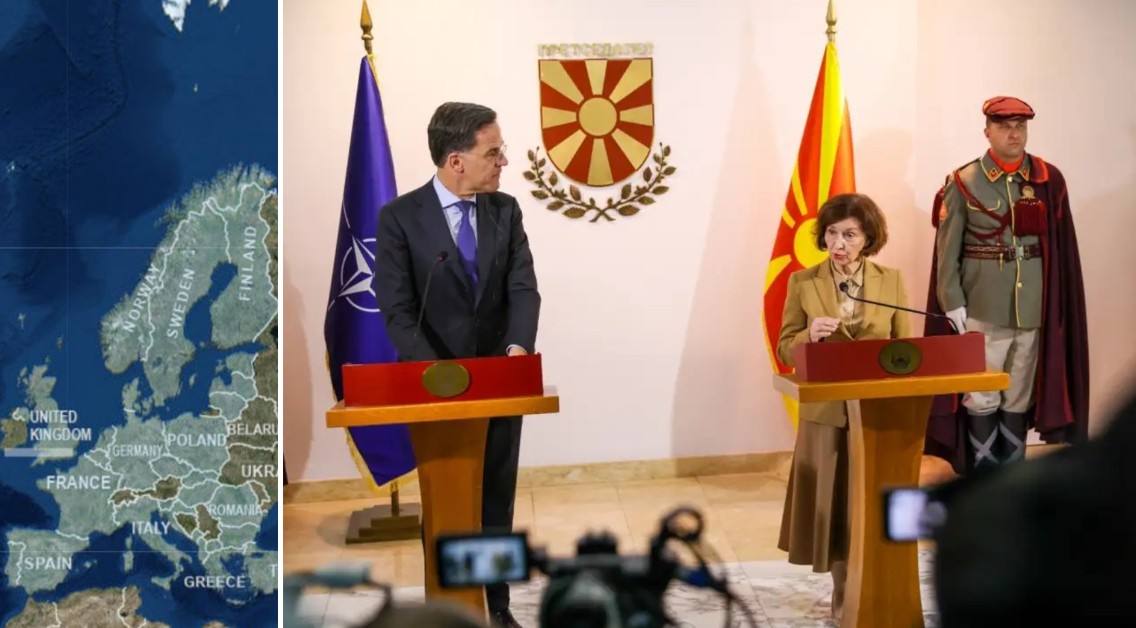
When the Secretary General of NATO, Mark Rutte, arrives in Macedonia three days after a dramatic escalation between the United States, Israel, and Iran, it is not a tourist stop.In diplomacy, the calendar is a message, and timing speaks louder than protocol.Rutte stated: “In NATO, no one stands alone.” A reassuring formula, yet one that raises a fundamental question: what does that guarantee mean when the Alliance emphasizes that it is not directly involved in the conflict?
It is the language of deterrence. Not of intervention.
MACEDONIA: FROM “UNDER NATO’S TENT” TO FULL MEMBERSHIP
Let us recall: Macedonia spent 18 years in the Membership Action Plan (MAP).
It participated in some of the most demanding missions. It maintained one of the highest per capita engagement rates among aspirant countries.It opened its airspace and infrastructure. Today, it allocates over 2% of GDP to defense.And yet, for years, it remained at the door.This created a collective sense that we were “under the tent,” but not truly inside it.Membership in 2020 formally closed that historical chapter. But institutional memory remains.
THE SHADOW OF 2018
The path toward NATO was unblocked after the signing of the Prespa Agreement.At that time, Mark Rutte was Prime Minister of the Netherlands. There is no evidence of direct interference in Macedonia’s internal political processes. However, there was unmistakable political support from Western capitals for the implementation of the agreement.For some, it was a historical necessity. For others, it felt like pressure.And that is why every visit today is interpreted through that prism.
THE PRESIDENT’S MESSAGE: NATO YES, BUT THE EU IS THE KEY
President Gordana Siljanovska-Davkova delivered a careful yet substantive message: the greatest guarantee of lasting stability in the Western Balkans is full integration into the European Union.Diplomatically translated, that means:The military shield matters. But political integration is essential.Without EU membership, the Balkans remain geopolitically protected — yet institutionally unfinished.
HYPOCRISY OR COLD REALITY?
Macedonia has met military standards. It modernized its defense budget. It supported Ukraine. It demonstrated loyalty.Yet the European door continues to open with additional conditions, often historical and identity-related in nature.There lies the tension. NATO treats us as an equal ally in defense.The EU treats us as a candidate still burdened with “homework.”This asymmetry fuels the perception of a double standard.Is that hypocrisy?Or simply harsh realpolitik in a turbulent world?
THE BALKANS ARE BACK ON THE MAP
Force deployments in the Eastern Mediterranean, increased attention to the southeastern flank, and heightened activity around Cyprus and Turkey all indicate that the Balkans are once again geopolitically relevant.In such a context, Macedonia is not a periphery.It is part of the security architecture.Rutte’s visit can also be read as a message: no vacuum will be allowed in the region.
THE SILENCE OF MOSCOW AND BEIJING
Within this dynamic, another dilemma must not be ignored.Why are Russia and China silent?As the escalation between the United States, Israel, and Iran raises the global temperature, we see neither dramatic moves nor open confrontation with the West from Moscow or Beijing.Russia remains cautious, rhetorically supporting balance and international law while avoiding direct involvement.China calls for restraint, stability, and a political solution.This is not accidental.Moscow is strategically focused on the Ukrainian front and has no interest in opening a new direct confrontation with NATO in another theater. A second parallel conflict would mean overstretching its resources.Beijing, meanwhile, plays a long and patient game. China is an economic superpower dependent on stable energy flows and trade corridors. A large regional war in the Middle East would hit the global economy, and with it, Chinese expansion.Both Russia and China maintain partnerships with Iran. But those partnerships do not imply automatic military intervention. The support is political, diplomatic, and strategic, not existential.Silence, in fact, is calculation.Controlled instability can pressure the West. Uncontrolled escalation would drag the entire world into an unpredictable spiral.In such a configuration, the Balkans once again become part of a broader chessboard.
Not as a frontline, but as a space that must remain stable while great powers measure their steps.And that is precisely why every visit by a high-ranking NATO official to Skopje is not accidental. It is part of a broader strategy to consolidate the southern flank and prevent any vacuum in the region.
WHAT SHOULD WE, AS A STATE, TAKE FROM THIS?
Our strategic value is real. NATO membership is functional, not symbolic.European integration remains unfinished business.Geopolitics recognizes no sentiment — only interest.Therefore, national policy must be cold, patient, and consistent.
MACEDONIA BETWEEN THE STORM AND STRATEGY
Mark Rutte’s visit is neither a historic turning point nor a dramatic rupture.It is a signal. A signal that Macedonia belongs within the security circle.But also a reminder that true political stability will come only with full European integration, without additional identity-based conditionality.In a world shaken by new conflicts, small states survive if they:Know their place.Understand the interests of their allies.And never lose their own strategic awareness.Today, more than emotion, we need precision.More than resentment, patience.More than illusion, strategy
