

By Slobodan Tomic

“The most dangerous condition for a state is not when crime exists, but when crime knows it will not be touched.”
Montesquieu
THE STATE THAT DOESN’T EXIST — YET DEFINES EVERYTHING
There is a version of Macedonia that never appears in official reports, political speeches, or election campaigns.
It is a state that does not function through institutions, but through delays.
A system where: cases are not lost — they are stored,
truth is not denied — it is postponed,
justice is not abolished — it is locked away.
Within this quiet bureaucratic inertia, the most persistent illusion is sustained: that the system functions.
In reality, it does not function.
It survives.
WHEN A SPEECH BECOMES AN INDICTMENT
When Prime Minister Hristijan Mickoski publicly spoke about “cases kept in drawers,” he did not deliver a political message.
He delivered an indictment.
An indictment that: the State Audit Office has produced reports for years,
institutions have registered suspicions of wrongdoing,
yet the prosecution has remained silent.
This is not administrative inefficiency.
It is an institutional choice.
A choice not to act.
A choice to wait.
A choice to let time perform the role of justice.
THERE IS NO GREATER CORRUPTION THAN SYSTEMIC SILENCE
Silence, in this context, is not neutrality.
It is participation.
When institutions choose not to move, they do not preserve stability — they preserve impunity.
SAVESKI: THE MAN
WHO MUST BREAK THE PATTERN
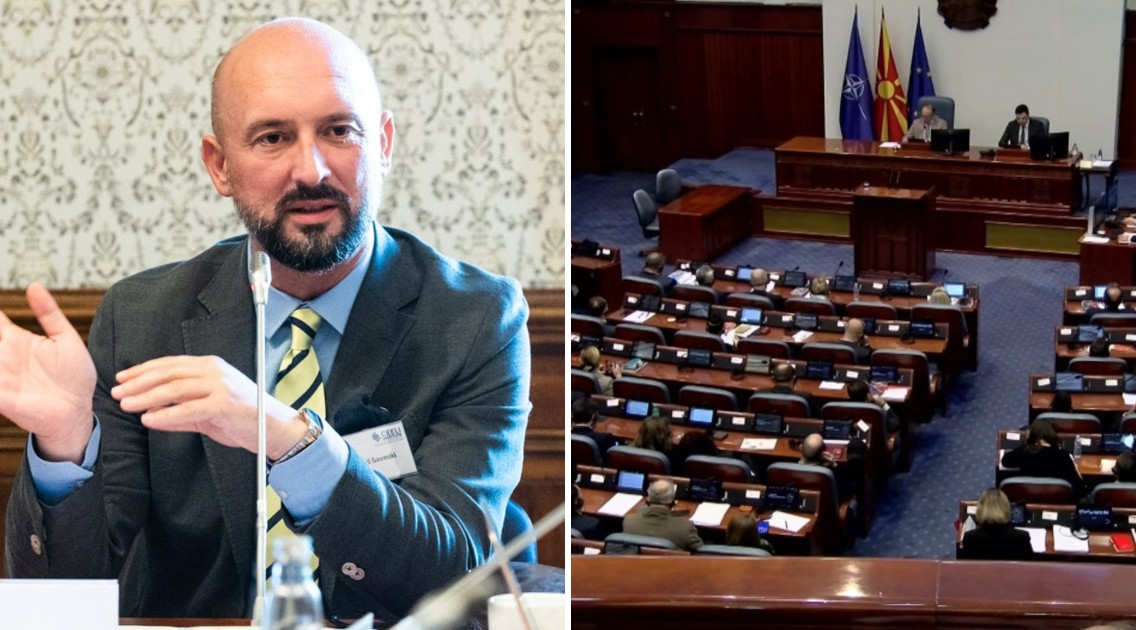
Nenad Saveski is not merely a new public prosecutor.
He represents a structural inflection point.
Before him lie two paths: to continue the inherited model,
or to disrupt it.
But disruption is not procedural.
It implies opening cases long considered untouchable,
naming actors long shielded by silence,
and dismantling a cycle that has sustained itself for years.
This is not a position of comfort.
It is a position of exposure.
THE SPECIAL PROSECUTOR’S OFFICE: A PROJECT THAT CONSUMED ITSELF
The trajectory of Katica Janeva is not merely a personal downfall.
It is an institutional case study.
An initiative launched as a symbol of accountability evolved into a symbol of doubt.
The central question is no longer what the institution intended to achieve, but what it ultimately revealed:
How does a system designed to prosecute corruption become associated with selectivity?
More critically, how is it possible for influence over judicial processes to persist even from within a detention environment?
If such questions remain unanswered, the issue is no longer error.
It becomes structural.
THE DANGOV DOCTRINE: A LEGAL FAULT LINE
Amid political narratives, one legal argument has persisted with notable consistency.
For eight years, Dimitar Dangov has argued that the integrity of entire proceedings may be fundamentally compromised.
His position is straightforward:
if evidence is unlawful, the proceedings built upon it cannot be lawful.
He points to: the Law on Privacy Protection,
the delayed submission of materials beyond statutory deadlines,
and the use of wiretapped recordings as foundational evidence.
This is not a technical objection.
It is a systemic challenge.
If validated, it would not affect isolated cases.
It would call into question the legal coherence of an entire prosecutorial framework.
The critical question, therefore, is not whether this argument exists.
It is why it has remained largely unexamined.
APRIL 27: VERDICT OR UNFINISHED PROCESS?
The events of April 27 remain one of the most sensitive chapters in the country’s recent history.
Yet the central issue today is not the event itself, but the legal processes that followed.
Were procedures conducted with full evidentiary integrity?
Were witness testimonies freely given?
Were legal qualifications proportionate and substantiated?
If reasonable doubt exists on these points, then the verdicts cannot represent closure.
They become the beginning of a deeper institutional question.
THE DRAWER AS A SYSTEM
The “drawer” is not merely a metaphor.
It is a mechanism.
It does not erase evidence.
It suspends it.
In that suspension: evidence deteriorates,
witnesses withdraw,
public attention dissipates.
Without formal decisions, without judicial conclusions, cases fade.
This is not coincidence.
It is systemic design.
ROMANIA: A PRECEDENT THAT STILL RESONATES
The experience of Laura Codruța Kövesi in Romania demonstrated that prosecutorial systems can reach the highest levels of power.
But it also demonstrated that such efforts provoke resistance.
Accountability, when applied without selectivity, becomes destabilizing not only for individuals, but for entrenched structures.
This is precisely why such models are rarely replicated in full.
INTERNAL CORRUPTION: WHEN PROXIMITY BECOMES POWER
One of the most difficult forms of corruption to address is informal influence.
When individuals leverage perceived proximity to political leadership to secure personal advantage, corruption evolves beyond formal structures.
It becomes intangible, yet deeply embedded.
Addressing this phenomenon is not optional.
It is foundational.
Without internal accountability, external reform remains incomplete.
FEAR AS AN INSTITUTION
Ultimately, the persistence of the system can be traced to a single factor:
fear.
Fear to initiate proceedings,
fear to assign responsibility,
fear to follow cases to their conclusion.
This fear sustains institutional inertia.
And inertia sustains the illusion of order.
THE FINAL CHOICE: TRUTH OR CONTROL
Macedonia is not facing a partisan dilemma.
It is facing an institutional choice:
to confront itself,
or to continue managing its own contradictions.
This decision will not be made in public discourse.
It will be made within the prosecution system.
CONCLUSION
If the drawers remain closed, it will not indicate the absence of crime.
It will indicate the presence of an understanding — that certain truths are not meant to surface.
In that case, truth will not be defeated.
It will be deliberately withheld.
