

By Slobodan Tomic

“Who controls the information controls reality.” — George Orwell
THE FALL OF Viktor Orbán – AN EARTHQUAKE OR A SCRIPT?
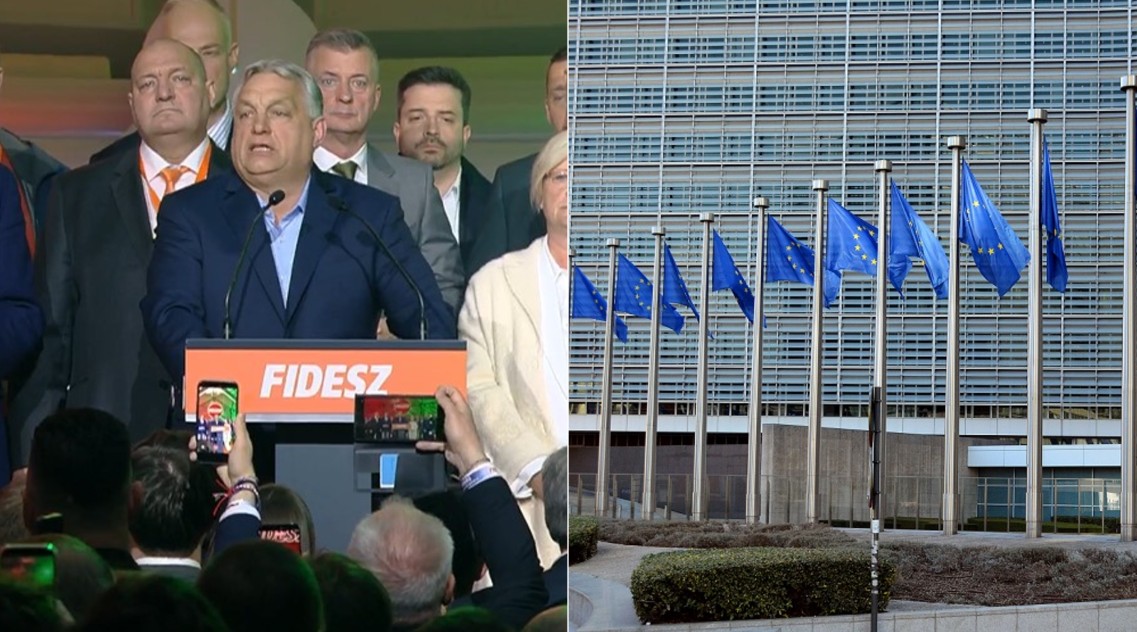
The fall of Orbán is not just an electoral outcome.
It is a geopolitical signal.
Sixteen years of power do not collapse overnight—unless there is coordinated pressure behind the scenes.
When Ursula von der Leyen declares that “Hungary has chosen Europe” and that “the European heart beats stronger,” this is not a routine congratulation.
It is a statement of victory.
But here is the uncomfortable question:
Has Europe finally learned the Copenhagen criteria—or do they apply only when convenient?
Do these criteria apply when a nation is subjected to political conditions tied to identity, history, and bilateral disputes?
Or is “Europe” a principle only when it serves power?
EUROPE’S DOUBLE STANDARD – VALUES IN THEORY, INTERESTS IN PRACTICE
Europe speaks the language of democracy.
But it operates through the logic of power.
Angela Merkel maintained deep strategic relations with Moscow for years.
Energy interdependence was not a secret—it was policy.
Today, the same Europe:
penalizes non-compliant governments,
withholds funds,
and rewards political alignment.
Orbán’s real “mistake” was not policy failure.
It was refusal to conform.
ORBÁN AS A SYMBOL – NOT JUST A LEADER
Orbán represented something larger than Hungary:
resistance to centralized EU authority,
rejection of imposed migration quotas,
defense of national sovereignty and traditional frameworks.
Agree or disagree—that is politics.
But removing such a figure is not just a change of leadership.
It is the removal of resistance.
WHO IS Péter Magyar – A LEADER OR A CONSTRUCTION?
Magyar is not a conventional opposition figure.
He is:
a former insider,
a political figure who rose with unusual speed,
a leader whose movement expanded almost exponentially.
That is not a typical democratic trajectory.
It is a rapid political construction.
And rapid constructions always have architects.
THE ROLE OF Elon Musk – A WARNING ABOUT MODERN POWER
Voices like Elon Musk have repeatedly warned about:
media manipulation,
coordinated influence networks,
and the shaping of political outcomes through non-transparent means.
Hungary increasingly resembles a case study in that model.
When media narratives, institutional pressure, and political momentum align too perfectly—
the result is rarely accidental.
THE SHADOW OF George Soros – RETURN OF THE NETWORK?
With Orbán gone, space opens for structures that were previously pushed out.
Soros is not merely an individual.
He represents a broader ecosystem of influence:
NGOs,
media ecosystems,
policy-shaping networks.
Is it coincidence that these structures regain relevance now?
Unlikely.
DOUBLE STANDARDS – WHO DEFINES “DEMOCRACY”?
When Orbán defended sovereignty—he was labeled authoritarian.
When a new leader with unresolved controversies rises—he is celebrated.
Why?
Because the standard is not values.
The standard is alignment.
THE REGIONAL IMPACT – A SIGNAL BEYOND HUNGARY
This shift is not confined to Budapest.
It sends a message across the region.
Reactions are already visible:
expectations of policy shifts,
renewed pressure narratives,
recalculations in bilateral relations.
The implications extend far beyond one election.
ATTACKS ON Hristijan Mickoski – POLITICAL ANALYSIS OR POLITICAL WISHFUL THINKING?
Statements by Venko Filipče predicting a similar “fall” elsewhere are not grounded in structural analysis.
They reflect projection.
Mickoski is not a product of Orbán’s system.
He is rooted in domestic political reality.
That distinction matters.
MICKOSKI – POLITICS OF POSITION, NOT SUBMISSION
At a time when many adjusted,
Mickoski held position.
At a time of conditions,
he raised questions of principle.
His political trajectory is not dependent on external figures.
It is anchored in internal legitimacy.
And that is precisely why he becomes a target.
Timčo Mucunski –
CALCULATED DIPLOMACY
The decision to congratulate Magyar reflects diplomatic realism.
States do not operate on emotion.
They operate on continuity and interest.
This is not weakness.
It is statecraft.
EUROPE AFTER ORBÁN – STRONGER OR MORE UNIFORM?
The essential question remains:
Is Europe becoming stronger—
or simply more uniform?
If dissenting political models are systematically removed,
what remains is not pluralism.
It is convergence.
FINAL NOTE – WHO WRITES THE GAME?
This is not the end of an era.
It is the beginning of a new phase.
A phase of:
intensified pressure,
redefined alliances,
and strategic recalibration across Europe.
But one fact stands:
Leadership that does not fit predefined frameworks
will always face resistance.
“Do not fear your enemies. Fear those who applaud when you surrender yourself.”
— inspired by George Orwell
History is not written only by those who win elections.
It is written by those who refuse to surrender their position.
