

By Slobodan Tomic

Slobodan Tomic
“The greatest lie in politics is that control is the same as trust.”
— inspired by Charles de Gaulle
THIS IS NOT A LEGAL CLASH – IT IS A CLASH OF POLITICAL PSYCHOLOGY
What is being presented as a technical disagreement over a transitional government is, in essence, something far deeper:
Is the political system ready to function without fear?
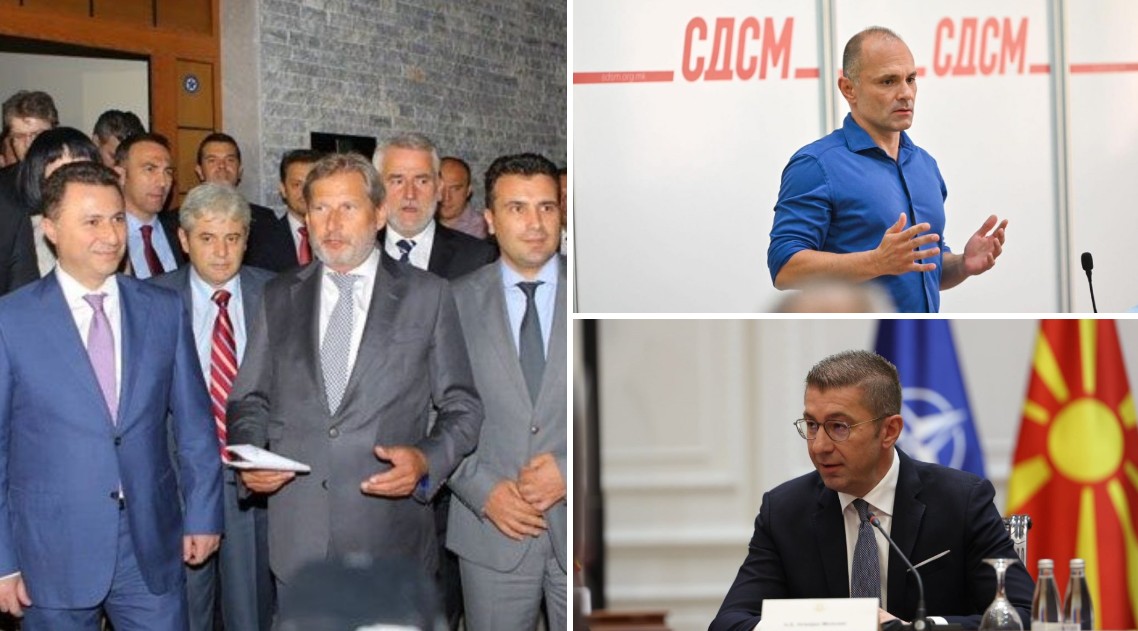
The confrontation between Hristijan Mickoski and Venko Filipce is not administrative.
It is not procedural.
It is psychological.
It is a clash between:
— a state that trusts its own institutions
— and a system that constantly seeks safeguards to compensate for its own insecurity
That is the real fault line.
PRŽINO: A CRISIS MECHANISM, NOT A DEMOCRATIC IDEAL
The model born from the Pržino Agreement was never a symbol of democratic maturity.
It was:
— an intervention
— a forced compromise
— a mechanism designed to prevent institutional collapse
The technical government carried one implicit message:
the system did not trust itself.
A decade later, the real question is not whether it should be abolished.
The real question is far more uncomfortable:
why does it still exist?
MICKOSKI AND THE PARADOX OF POLITICAL COURAGE
What the Prime Minister proposes is politically risky—but conceptually consistent.
He does not rush.
He does not destabilize.
Instead:
the technical government remains for the next elections
the opposition retains all guarantees
institutional continuity is preserved
And then—this chapter closes.
This is not improvisation.
This is not political gambling.
This is a controlled exit from a prolonged crisis regime.
The principle is simple, but powerful:
rules must apply equally to everyone—or they lose legitimacy.
THE ULTIMATUM: STRATEGY OR FEAR?
When Venko Filipce issues an ultimatum, it may appear as strength.
But in politics, ultimatums often reveal the opposite.
They can signal:
— fragile confidence
— unstable positioning
— uncertainty about electoral outcomes
Because if the mechanism remains for the next elections—why the ultimatum?
The logic collapses under its own weight.
those confident in victory do not demand extra safeguards
those demanding safeguards may already doubt victory
THE REAL BATTLE: FUNCTIONAL OR PERFORMATIVE INSTITUTIONS
The entire conflict reduces to a single, unavoidable question:
Are institutions functional—or merely performative?
If elections cannot be fair without a technical government, then:
— the problem is not the law
— the problem is the state itself
But if they can:
— the model becomes obsolete
— it transforms from necessity into a political crutch
POLITICAL AMNESIA AND SHIFTING POSITIONS
Perhaps the most revealing contradiction is this:
The same political actors who once advocated abolishing the model now defend it as indispensable.
This exposes a deeper problem:
are political positions driven by principle—or by convenience?
No system can mature if its rules shift with political interest.
Consistency is not optional in democracy.
It is foundational.
EARLY ELECTIONS OR PRE-EMPTIVE EXCUSES?
Narratives about economic pressure and early elections are not new.
They serve a familiar function:
preparing the terrain before the result is known
Across the region, such rhetoric has often preceded electoral defeat.
Statements like:
— “the system is compromised”
— “the process is unfair”
are rarely neutral.
They are political insurance policies.
DEMOCRACY IS NOT BUILT ON FEAR
A mature democracy is not defined by perfection.
It is defined by one essential capacity:
the ability to accept outcomes—even unfavorable ones
The technical government, while once necessary, carries long-term risks:
— dependency
— institutional stagnation
— normalization of crisis governance
And once crisis becomes routine—democracy begins to erode from within.
THE STRATEGIC CROSSROADS
This moment transcends party politics.
It raises a structural dilemma:
will the country continue relying on temporary fixes
or transition toward a fully functional democratic system?
A state that fears elections is not stable.
It is uncertain of itself.
FINAL VERDICT: THE END OF ALIBIS
The proposed approach—retain the model for the next elections, then abolish it—is:
— cautious
— balanced
— strategically coherent
It delivers:
continuity in the present
transformation in the future
But most importantly:
it removes excuses.
FINAL THOUGHT
Democracy does not collapse because of conflict.
It collapses when political actors lose faith in their ability to win—
and begin to rely on systems not to serve the people,
but to protect themselves from the will of the people.
