

By Slobodan Tomic

Slobodan Tomic
“A people that allows others to name it will eventually allow itself to be erased.”
Konstantin Miladinov
In diplomacy, every word carries weight.
But sometimes, one minute is worth more than years of politics.
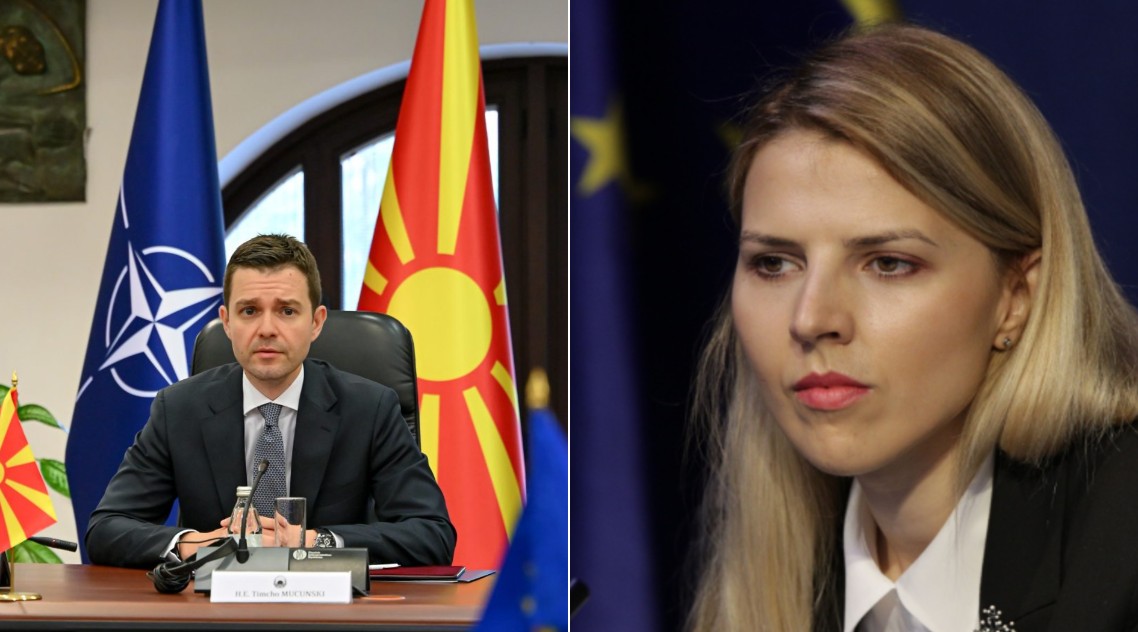
That very minute, on the margins of European meetings in Brussels, between Timcho Mucunski and Velislava Petrova-Chamova, exposed the reality to its core: this is not a misunderstanding, but a systematic strategy, both external and internal.
When the Bulgarian minister speaks of an “excellent meeting” that in reality lasted one minute, it is not a mistake; it is an attempt to create an illusion of normalcy.
When, in the same breath, she uses the term “North Macedonian,” it is not a slip; it is a political message. A message that identity can be redefined, stretched, and adjusted to fit narratives.
But this is precisely where the turning point occurred.
Mucunski did not remain silent.
He did not choose diplomatic fog. He spoke the truth, briefly, clearly, and with dignity: there was no meeting, there are no adjectives that redefine a people, and there is no compromise on identity. “Macedonians are Macedonians.” This is not a political statement, it is a civilizational line.
And that is why this reaction carries weight far beyond daily politics. It marks the end of an era of silence and the beginning of a policy that sets boundaries.
But the problem is not only in Sofia. The problem is that while a narrative of redefining Macedonia is being built externally, an environment for accepting it is being created internally.
When Venko Filipce says he “has not heard” of any denial of Macedonian identity, that is not merely a political mistake, it is a dangerous message.
At a time when official representatives of Bulgaria openly use terminology that alters the identity context, to claim that “there is no problem” means either deliberate manipulation of the public or complete detachment from reality. Even more concerning is the insistence that constitutional changes are the only path, without a clear and unequivocal will of the people.
And not only that, he openly accepted the thesis that the inclusion of Bulgarians in the Constitution is not a Bulgarian issue, but a “European one,” thereby effectively legitimizing the very narrative being imposed from outside.
Let us be precise: a Constitution is not changed under pressure.
A Constitution is not changed as a condition.
A Constitution is the foundation of the state.
If that foundation is altered without the people, then the state becomes a project, not a sovereign community.
This is where the essence of the crisis lies.
For years, Macedonia has been guided by the principle: “accept in order to move forward.” That policy, associated with the period of Zoran Zaev and the agreements that followed, opened a door that is now difficult to close.
There is no accountability for the Prespa Agreement. There is no accountability for the protocols signed by Bujar Osmani.
There is neither political nor moral reckoning for the steps that brought the state into a position where it must defend itself from itself.
And where there is no accountability, there is continuity.
A continuity that today manifests itself through Filipce’s rhetoric, presenting the acceptance of conditions as “European maturity.” But maturity is not silence in the face of injustice.
Maturity is naming it.
In politics, the most dangerous moves are not always malicious ones, but absurd logics presented as rational. Like in the film Dumb and Dumber (“Глуп и поглуп”), where two characters, with complete self-confidence, make decisions without understanding the reality around them, convinced they are doing something significant, while in fact deepening their own delusion.
The difference is that in the film, the consequences are comedic. In politics, they are historical.
On the other side stand the positions of Hristijan Mickoski and the support from VMRO-DPMNE, reflecting something long missing, a clear line.
Not against Europe, but against a policy of conditionality that erodes the essence of the state.
Because Europe must not become an alibi for self-erasure.
What happened in Brussels is more than a diplomatic moment. It is a symbol.
A symbol of a clash between two visions: one that sees Macedonia as a variable category, and another that defends it as continuity.
And that is why this is not a struggle for dates, negotiations, or procedural steps.
This is a struggle for identity.
Will Macedonia remain what it is, or become what others want it to be?
Because a people that allows its name, language, and history to be changed will eventually have nothing left to defend.
And Macedonia, no matter how much pressure it faces, has one thing it must never lose: itself.
