

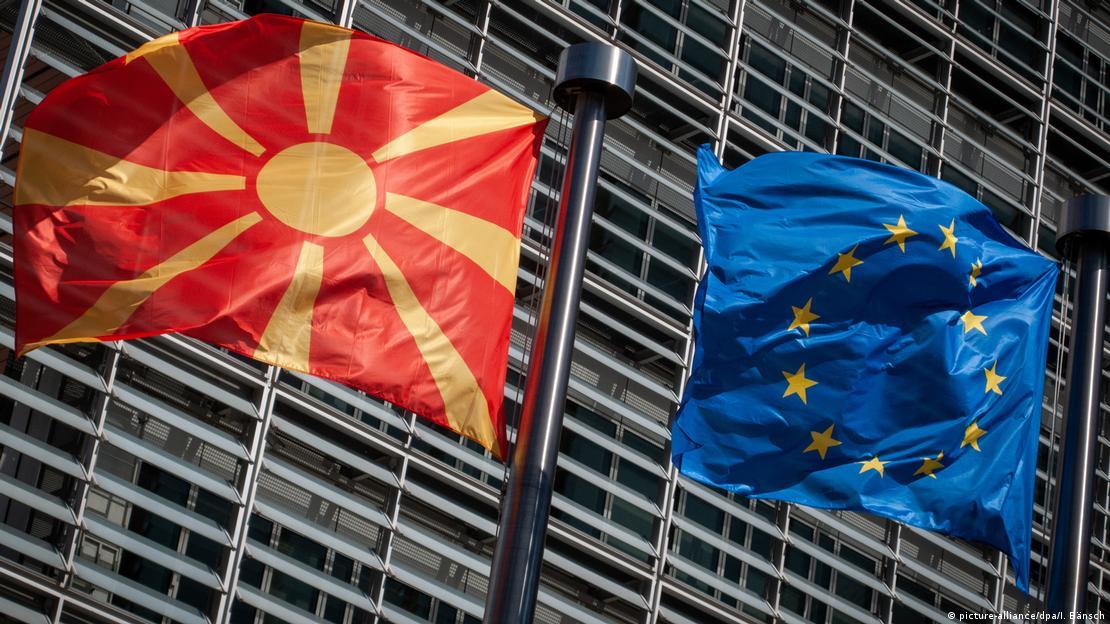
(an interpretation inspired by Winston Churchill)
By Slobodan Tomic

In functioning states, politics serves as an instrument for protecting the national interest.
In fragile ones, it deteriorates into a battleground for personal ambitions and external agendas.
Macedonia today is drifting dangerously from the former toward the latter, not due to a lack of opportunity, but due to a deficit of statesmanship within parts of its political class.
When Foreign Minister Timčo Mucunski called for national consensus on reforms linked to the European agenda, it was not a routine political gesture. It was a test.
A test of political maturity.
A test of whether party interests can be separated from the national interest.
A test of whether the fundamental lesson has been learned, that no country can move forward if every strategic issue is reduced to partisan confrontation.
The appeal was straightforward: set aside daily political calculations and work jointly on reforms that strengthen the state, the judiciary, the electoral framework, and institutional resilience.
It was not a call for submission, but for partnership.
Not a call for silence, but for accountability.
The response, however, reflected the opposite of what statesmanship requires.
Venko Filipče did not simply reject the initiative, he ridiculed it. Through rhetoric more akin to a political pamphlet than a serious policy argument, he turned consensus into a target of mockery and a state-building effort into a повод for attack.
Instead of arguments, dismissals.
Instead of vision, pressure.
Instead of unity, deeper polarization.
This is not political competition.
It is political irresponsibility.
Filipče presents himself as the sole interpreter of the European path, as if Europe were a singular narrative with a single gatekeeper.
But Europe does not function that way.
Europe is not an ideology imposed by force. It is a system of governance built on institutions, trust, and, above all, consensus. That is precisely why it is paradoxical that those who speak most loudly in its name simultaneously undermine its core principle, dialogue.
Insisting on constitutional changes without clear guarantees and without broad national agreement is not a vision.
It is coercive politics, an “either-or” framework that eliminates space for rational debate. And when politics is reduced to ultimatums, democracy becomes procedural rather than substantive.
What is particularly concerning is that such rhetoric emerges at a time when even Nikola Dimitrov, a key figure in earlier negotiations, publicly warns that the French proposal represents a “debacle” and that the second protocol with Bulgaria creates room for renewed conditionality and pressure.
This is not a marginal voice.
It is an internal alarm.
Yet instead of opening a serious national discussion, the response has been to ignore these warnings, escalate rhetoric, and move forward as if the destination were clear, even though its consequences remain undefined.
While this internal confrontation unfolds, external signals continue to reinforce concern.
Bulgaria’s Foreign Minister, Velislava Petrova Chamova, once again employed the derogatory term “Macedonians” in a contested and politically loaded context. This is not a slip of the tongue. It reflects a consistent policy posture, one that signals not compromise, but consolidation of demands.
Every concession is interpreted not as closure, but as precedent.
The broader reality is even more complex.
What began as a bilateral dispute has evolved into a multilateral mechanism of pressure, shaped with the involvement of international actors. Bulgaria has functioned as an instrument. Greece as a precedent. Macedonia as a case study, illustrating how a small state can be drawn into negotiating matters of identity under sustained external pressure.
This trajectory has little precedent in modern international relations.
From the alteration of the constitutional framework to debates over language, history, and education, the process will undoubtedly be examined in the future — not as a model of success, but as a cautionary example.
Because Macedonia is not an administrative construct.
It is a state founded on the explicit will of its citizens. On September 8, 1991, the people voted for independence and sovereignty under the constitutional name Republic of Macedonia — a decision subsequently recognized by more than 140 countries within the United Nations system. That foundation is not subject to reinterpretation.
Yet today, that very foundation is being challenged, both externally and internally.
The question facing Macedonia is therefore not merely geopolitical.
It is existential.
Will the state continue to act as a sovereign субъект with a defined position, or will it become an object shaped by external strategies?
Will institutions be built through consensus, or weakened through persistent political antagonism?
Filipče may continue to speak of Europe, reform, and progress.
But without respect for public sentiment, without an understanding of political limits, and without a genuine commitment to dialogue, such language remains hollow.
Europe is not attained through declarations.
It is constructed through trust, and trust cannot be built on arrogance.
History is not a passive observer.
It judges.
And when it does, it does not distinguish between those in power and those in opposition.
It distinguishes between those who defended the state and those who negotiated at its expense.
Macedonia still has an opportunity to demonstrate that it has learned from its past.
But that requires something increasingly rare, the courage to say “enough.”
That is precisely the line being drawn today by Hristijan Mickoski and his government.
Because a state that fails to define its boundaries will ultimately lose them.
