

(Thucydides)
By Slobodan TOMIĆ

Slobodan TOMIĆ
There are moments in history when a state is no longer negotiating merely about membership, funds, or political procedures.
There are moments when a state negotiates for its very soul. Macedonia today once again stands at precisely such a moment.
Not on a battlefield of tanks, trenches, or gunpowder, but on a front line where identity collides with political conditioning, dignity with humiliation, reform with blackmail, and Europe as a civilization of values clashes with Europe as a bureaucratic mechanism of coercion.
From Ohrid to Brussels, this week a message was sent that the Macedonian people had long waited to hear without calculation, servility, or fear:
Reforms — YES.
Identity concessions — NO.
This was not merely a political statement. It was a historic line of demarcation.
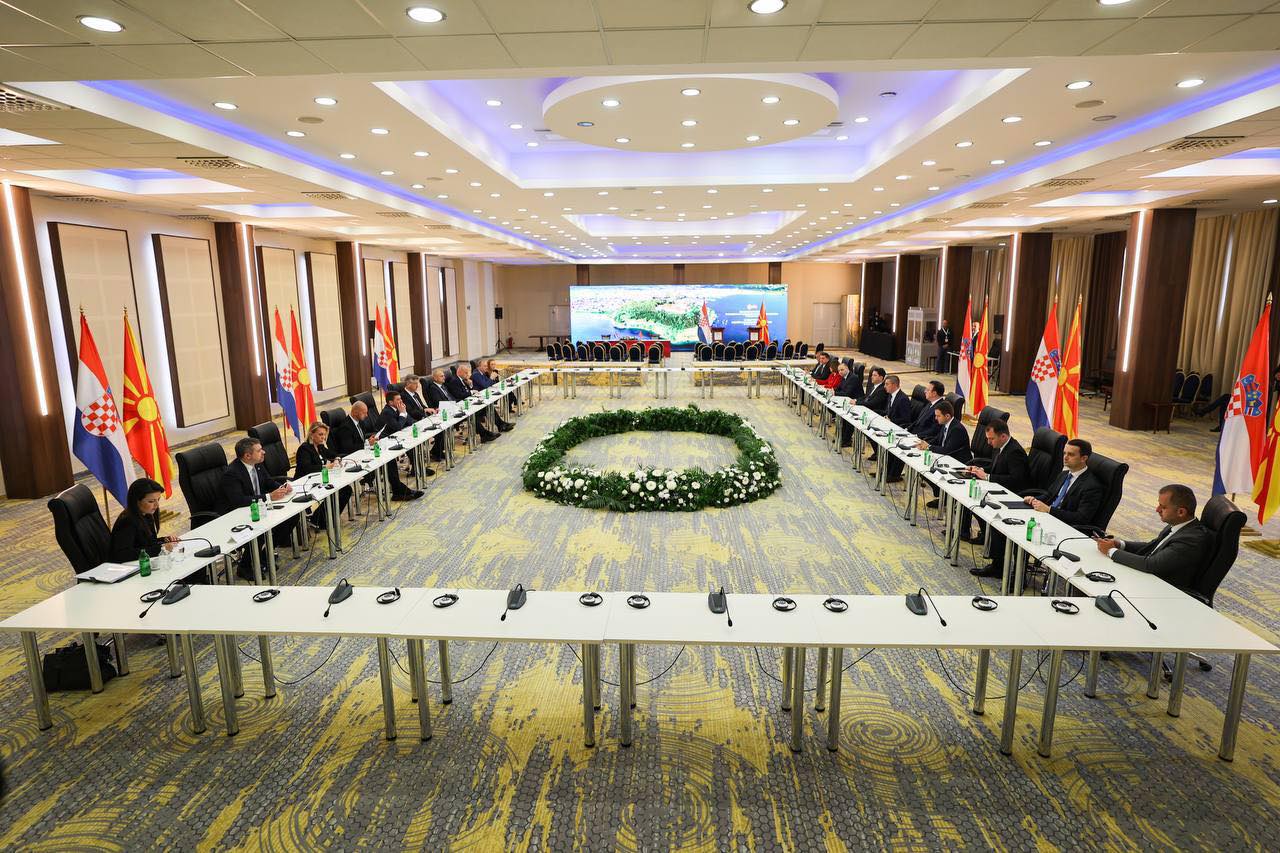
Standing beside Croatian Prime Minister Andrej Plenković, Hristijan Mickoski did not speak as a man begging for mercy. He spoke as the Prime Minister of a country that has endured European double standards for far too long.
That is why the Ohrid meeting was far more than a protocol photograph or diplomatic courtesy.
It represented a clash between two visions of Europe:
Europe of values versus Europe of pressure.
Macedonia today may be the only country in Europe forced to prove its own existence before negotiations can even truly begin.
Forced to prove it has a language.
Forced to prove it has a history.
Forced to prove it has the right to national dignity.
And all this after three decades of humiliations, agreements, concessions, compromises, and promises that “just this one more sacrifice” would finally open the European door.
But a nation constantly forced to kneel will eventually either disappear, or become a rock.
Macedonia is clearly choosing to become a rock.
The Ohrid message was not anti-European. On the contrary, it may have been the most genuinely European message possible.
Because Europe without principles ceases to be Europe and becomes merely a marketplace of political influence.
If accelerated geopolitical models can exist for Ukraine, if strategic urgency can apply selectively to others, then Macedonia cannot be subjected to endless humiliation for three consecutive decades.
That is why Andrej Plenković’s words echoed like a political slap to all those who spent years convincing the Macedonian public that the problem lies within Macedonia itself.
The Croatian Prime Minister openly acknowledged that the injustice inflicted upon Macedonia has no justification.
That sentence matters historically.
Not simply because it came from friendly Croatia, but because for the first time a European leader so directly named the essence of the issue:
Macedonia has become a victim of unprincipled bilateralization.
And it is precisely here that panic begins within SDSM and the entire network of ideological structures that for years survived on the narrative that Macedonia must endlessly surrender and retreat.
Because their real goal was never integration.
Their goal was the psychological capitulation of the Macedonian people.
To create a sense that Macedonia is guilty simply for existing.
To convince the nation that self-denial is somehow “modern.”
To transform patriotism into an insult and servility into a “European value.”
That is why SDSM today increasingly resembles a political force in decline.
Not merely because it lost elections, but because it lost its connection with the people.
People can forgive poverty.
They can forgive political mistakes.
But nations rarely forgive humiliation.
And humiliation is precisely what Zoran Zaev, Bujar Osmani, Nikola Dimitrov, and their entire political framework normalized — creating the perception that Macedonia must continuously apologize for being Macedonia.
Today Venko Filipče attempts to sell the same narrative in new packaging.
But the public already recognizes the deception.
One cannot spend seven years bending the state and then suddenly present oneself as the savior of its European future.
What kind of European future?
One in which Macedonia must negate itself in order to be considered a “good student”?
That is why panic within these structures is growing.
Because for the first time in many years, Macedonia has a government that does not reject Europe, yet refuses to approach Brussels crawling on its knees.
The geopolitical context of this story is equally important.
While sections of the domestic opposition spread defeatism, Washington is sending an entirely different message.
The U.S. State Department’s report to Congress effectively positions Macedonia as an important partner within the new American strategic architecture in the Balkans.
That is no small matter.
At a time when the global order itself is being reshaped, Macedonia is no longer viewed as a problematic periphery, but increasingly as a stable NATO ally and strategic partner.
This means the world is beginning to take Macedonia far more seriously than its domestic opposition is willing to admit.
More importantly, the old political framework — according to which Macedonia had to function as an experimental laboratory for external agendas — is beginning to collapse.
It is no coincidence that voices are now emerging from Germany and across Europe — including Doris Pack, Michael Roth, and other European figures, openly stating that the Bulgarian blockade is irresponsible and harmful.
This is not an accidental shift in tone.
It is a sign that Europe itself is beginning to understand how much damage has been inflicted upon its own credibility through the Macedonian question.
But let us also be completely honest.
No one will save Macedonia if Macedonia does not fight for itself.
Not Brussels.
Not Washington.
Not Budapest.
Not Zagreb.
History is unforgiving toward nations waiting for others to fight their battles.
That is why today’s struggle is not merely diplomatic.
It is internal.
A struggle against the mentality of defeat.
Against entrenched structures that drained the state for decades.
Against elites that created a system where honest citizens merely survive while parasites rule.
Macedonia today cannot afford new betrayals.
This is the moment when the state must confront political manipulators, corrupt networks, and media machinery that spent years convincing the people they had no right to dignity.
Because there is nothing more tragic than a nation taught to be ashamed of its own roots.
That is why Macedonia must not retreat.
Not out of stubbornness.
Not out of defiance.
But because a nation without self-respect becomes nothing more than geography.
And Macedonia has never been merely geography.
It is the grave of revolutionaries, the prayer of mothers, the silent tear of emigrants, the oath of ancestors, and the responsibility owed to future generations.
And so today, as the question once again emerges whether Macedonia will exist as a nation or merely as a project, the country must answer with calm but iron determination:
Reforms — yes.
Europe — yes.
Humiliation — never again.
For as the ancient philosopher Heraclitus once wrote:
“A people must fight for its laws as for its city walls.”
And that is precisely what Macedonia is doing today:
defending its walls.
