

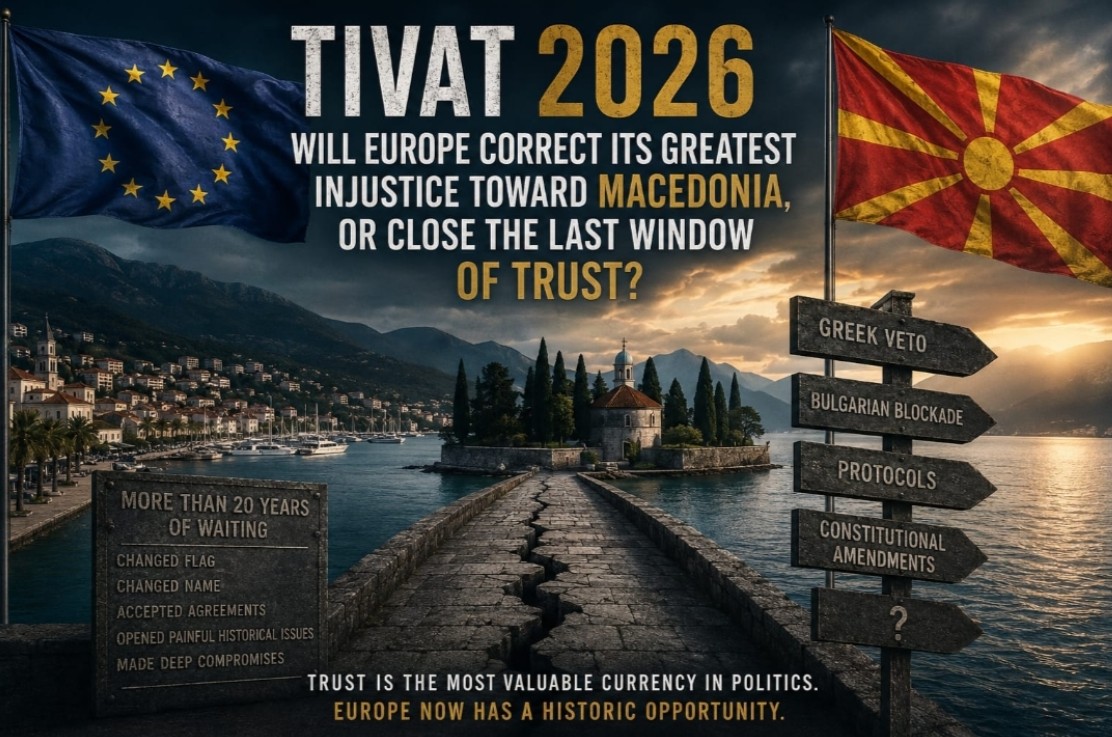
“When a people wait too long for justice, they begin to doubt whether it exists at all.”
( Cicero)
By: Slobodan TOMIC
Slobodan TOMIC
Tivat has never been merely a tourist jewel of the Adriatic. For centuries, it has been a place where empires, trade routes, and major political strategies of the Mediterranean intersected. Nearby lies the famous Island of Flowers, a symbol of encounters, spirituality, and historic transitions between different civilizations.
That is why it is no coincidence that Tivat has been chosen as the venue for the new gathering of European leaders and the leaders of the Western Balkans.
Yet the question echoing today from Skopje to Brussels is simple and fundamental:
Will Europe finally demonstrate that its word carries weight, or will it once again produce another declaration destined for the archives of unfulfilled promises?
For more than two decades, Macedonia has been waiting.
Waiting for praise that never turns into results.
Waiting for promises that are endlessly repeated but rarely accompanied by a clear deadline or concrete outcome.
Waiting for justice that is constantly postponed.
During these more than twenty years, Macedonia has done something no other candidate country has done.
It changed its flag.
It changed its name.
It accepted agreements.
It opened painful chapters of its own history.
It made compromises that penetrated deeply into the national fabric and left lasting marks on the collective consciousness of its people.
Yet every time the country approached its European goal, a new condition emerged.
First came the Greek veto.
Then the Bulgarian blockade.
Then the protocols.
Then the constitutional amendments.
And the same question has remained unanswered:
Where is the final destination?
Who can guarantee that a new demand will not emerge tomorrow?
Who can guarantee that constitutional amendments will not be followed by another blockade?
Who can guarantee that bilateral disputes will not once again be transformed into European conditions?
That is precisely why Tivat is far more than an ordinary summit.
Tivat is a test of the European Union’s credibility.
Meanwhile, Europe is increasingly discussing accelerated mechanisms for the integration of Ukraine and Moldova. Ideas of associate membership, gradual integration, and new models of accession are being actively considered.
This raises an obvious question:
If creative solutions and accelerated pathways are being explored for new candidates, why has Macedonia remained trapped in a labyrinth of ever-changing conditions for more than two decades?
Why is political flexibility sought for some, while endless patience is expected from others?
The citizens of Macedonia are not asking for privileges.
They are not asking for gifts.
They are not asking for shortcuts.
They are asking for equal rules for everyone.
They are asking for principles instead of double standards.
They are asking Europe to be what it claims to be.
At the same time, fierce political debate continues within Macedonia regarding the country’s European path. Some argue that the state must not once again enter an open-ended process without clear guarantees. Others insist that every delay pushes the country further away from the European Union.
But the essential question is not partisan.
It is a matter of state.
Should Macedonia continue along a road where the destination is constantly moved further away?
Or should Europe finally demonstrate that enlargement is not a political instrument, but a genuine and achievable policy?
Across the Western Balkans, fatigue is already visible.
In Bosnia and Herzegovina, skepticism is growing.
In Serbia, enthusiasm for the European idea has significantly declined.
In Albania and Montenegro, questions are increasingly being raised about whether reforms truly lead to membership.
That is why Tivat matters.
Not because of the conference halls.
Not because of the protocol.
Not because of the official photographs.
But because of trust.
Trust is the most valuable currency in politics.
And trust in European promises throughout the Balkans is weaker today than at any point in recent memory.
Europe now has a historic opportunity.
To demonstrate that enlargement remains a living policy.
To show that the promises made to Macedonia still carry weight.
To prove that sacrifices and compromises were not made in vain.
If this does not happen, Tivat will be remembered as yet another summit of elegant words, diplomatic phrases, and carefully drafted statements.
But if Europe finally demonstrates courage, vision, and principled leadership, Tivat may become the place where trust between Brussels and the Balkans began to be restored.
For no great idea can survive indefinitely on promises alone.
Eventually, the day must come when words are transformed into action.
And that is precisely the day that Macedonia has been waiting for, for more than two decades.
