

“The most dangerous hypocrisy is the one that speaks about justice while producing injustice.
Plato
Written by: Slobodan Tomic

There are moments in the history of a nation when it is not enough simply to transmit the statements of politicians.
There are moments when the task of journalism is to connect words with actions, promises with results, and messages with consequences.
That is exactly why the visit of European Commissioner for Enlargement Marta Kos deserves much more than an ordinary daily political reaction.
As a journalist who has followed Macedonia’s European path for more than two decades, I believe I have both a professional and moral responsibility to raise the key question:
Is Macedonia truly moving towards the European Union today, or is it once again facing a new political obstacle?
The answer is not simple.
Because the message we heard from Skopje was a double one.
On one side, recognition.
Recognition that Macedonia is implementing reforms.
Recognition that there is progress.
Recognition that Macedonia is among the candidate countries with positive results.
Recognition that a European perspective exists.
But on the other side, the same message again:
Without constitutional amendments, there will be no opening of the next step in the negotiations.
And this is exactly where the dilemma felt by many Macedonian citizens appears.
If reforms are successful, if the country is advancing, if European standards are being fulfilled, why is the greatest obstacle once again not a reform issue, but a political one?
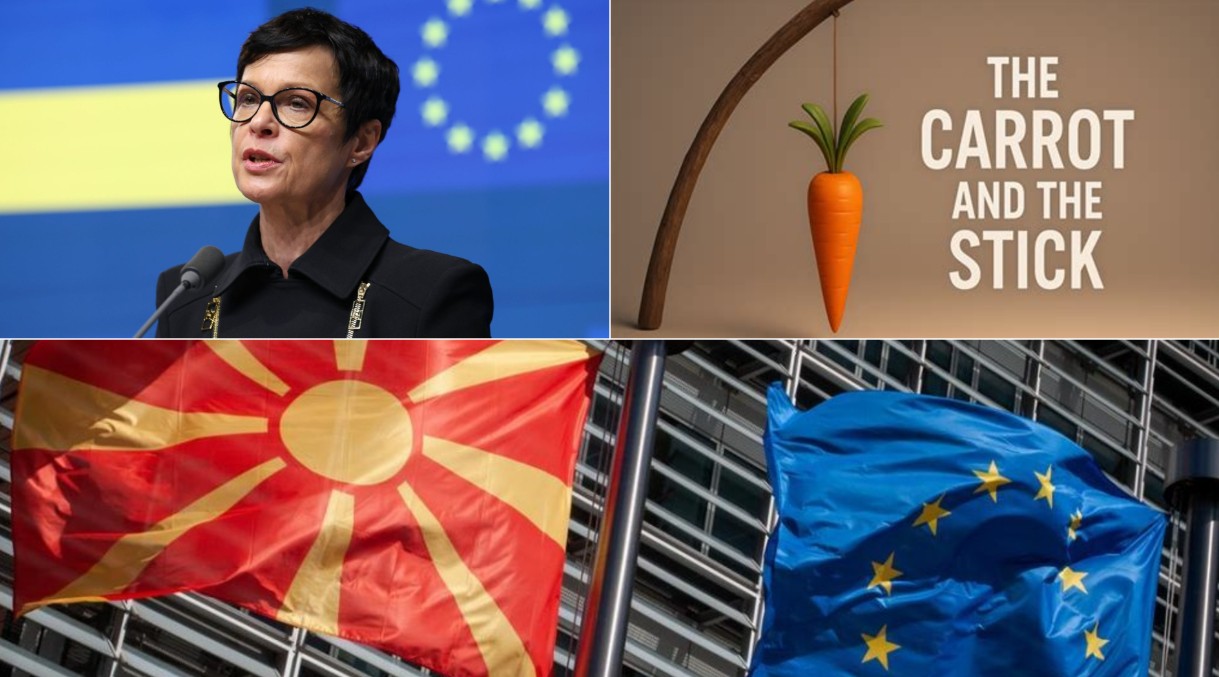
That is why a perception is growing among part of the public that Macedonia is again receiving a carrot in front of its eyes, but a stick behind its back.
On one side there are words of praise.
On the other side there remains a condition.
On one side there is talk about partnership.
On the other side there remains a feeling of uncertainty.
And trust, as in every relationship, cannot be built only with words.
It is built with predictability.
With equal rules.
With the feeling that the same criteria apply to everyone.
Therefore, today it is not enough only to say that Macedonia has a European future.
It must be demonstrated that the European path truly leads towards a clear goal, and not a process in which the finish line is constantly being moved.
FROM CANDIDATE COUNTRY TO “ETERNAL CANDIDATE” – TWO DECADES OF WAITING
The history of Macedonia’s European path did not begin yesterday.
It is a story longer than two decades.
In 2001, the Stabilisation and Association Agreement was signed.
In 2004, Macedonia submitted its application for European Union membership.
In 2005, it received candidate status.
It was a moment when citizens believed that the future was clear.
If the country fulfilled the criteria – the next step would naturally follow.
But the years passed.
One year.
Five years.
Ten years.
Two decades.
And Macedonia remained in the waiting room.
During that period, European institutions, commissions and strategies changed.
But one feeling remained the same – that every fulfilled condition opened a new question.
First came the dispute with Greece.
Macedonia made a major political compromise, believing that this would open the European path.
Then came a new obstacle – the dispute with Bulgaria.
Again conditions.
Again demands.
Again uncertainty.
And precisely here the question arises:
Is the problem in reforms, or in political circumstances that constantly change the path?
WHEN BILATERAL ISSUES BECOME EUROPEAN CONDITIONS, THE COPENHAGEN CRITERIA AND THE MACEDONIAN DILEMMA
“Justice is not justice if it does not apply equally to everyone.”
(Charles de Montesquieu)
The European Union has always built its strength on the principle that candidate countries should advance according to their own merits.
That is why the Copenhagen criteria were created.
Rule of law.
Independent institutions.
Fight against corruption.
Functional democracy.
Respect for human rights.
A market economy.
These were the foundations upon which the readiness of a country for membership was supposed to be evaluated.
But Macedonia’s experience during the past two decades has raised a fundamental question:
Is the European process today evaluated only through reforms, or does it increasingly depend on political issues beyond the classic criteria?
This is not a question against the European Union.
On the contrary.
This is a question about whether the European Union remains consistent with its own principles.
Because equality before the rules is the foundation of every community.
When a country fulfils certain conditions, it is natural to expect that this progress will be recognised.
When a country makes difficult political decisions, it is natural to expect that those decisions will have a clear result.
And this is precisely where the greatest disappointment among Macedonian citizens was created.
Not because Macedonia does not want Europe.
Quite the opposite.
The European future has for years been one of the strongest strategic commitments of the country.
But the problem lies in the feeling that the road towards that goal is constantly being extended.
That every major compromise brings new uncertainty.
That every agreement reached does not mean the end of conditions.
This creates fatigue.
It creates distrust.
And it creates a question that is increasingly being asked by the public:
Where does the process of fulfilling criteria end, and where does political conditioning begin?
BETWEEN THE EUROPEAN IDEA AND POLITICAL REALITY
The European Union has the right to expect reforms from every candidate country.
That is normal.
No country can become a member without meeting European standards.
But at the same time, the European Union has a responsibility for the process to be fair, transparent and predictable.
Because European integration is not only a technical process.
It is also a process of building trust.
And trust is lost when citizens feel that the rules are not the same for everyone.
Macedonia in recent years was not merely an observer of the European process.
It was an active participant that made difficult decisions.
There were reforms.
There were political agreements.
There were changes.
There were compromises.
But every compromise also carries the expectation that the other side will respect the spirit of the agreement.
That is why today the question is not whether Macedonia should continue with reforms.
It should.
The question is whether the European path will be a path with clear rules or a path where every new stage brings new uncertainty.
MARTA KOS AND THE TWO SIDES OF THE EUROPEAN MESSAGE
The visit of
Marta Kos showed precisely this duality.
On one side, encouragement.
On the other side, a condition.
On one side, a message that Macedonia is important for the European perspective.
On the other side, a message that without a certain political step, the process cannot move forward.
And this is where the essential dilemma lies.
If reforms are the true measure, then they must be the main criterion.
If there are other political conditions, then citizens have the right to clearly know where the boundaries of the process are.
Because the greatest danger is not only stagnation.
The greatest danger is the loss of faith.
And without faith, no great idea can survive for long.
Europe is not only an institution.
Europe is a value.
Europe is a promise that small and large countries are measured according to the same principles.
That is why Macedonia’s European path today is a test for Macedonia, but also a test for Europe’s credibility.
”.
MACEDONIA BETWEEN STRATEGIC INTEREST, NATIONAL DIGNITY AND THE NEW GEOPOLITICS
“Nations that forget their history risk losing their future.”
The European perspective of Macedonia is not only a political issue.
It is a question of strategic determination, economic development, security and the future of generations to come.
But at the same time, every country has the responsibility to preserve its own dignity.
Precisely in this balance lies the greatest challenge for Macedonian politics today.
On one side, Macedonia has a clear interest in becoming part of the European Union.
European integration brings opportunities for economic development, stronger institutions, greater legal security and better conditions for citizens.
On the other side, the European path must not become a process in which one country is constantly forced to prove itself, while its arguments are not being heard.
A mature European policy must be based on partnership.
And partnership means respect.
THE POLICY OF TRUST, A TWO-WAY STREET
In this context, the policy of the Government led by Prime Minister Hristijan Mickoski should also be viewed.
The essence of the message sent by the Government is not a rejection of the European future.
Quite the opposite.
The message is that Macedonia remains committed to the European path, but expects that path to be based on clear rules and predictability.
That is the essential difference.
A country can be pro-European and at the same time demand a fair relationship.
A country can seek membership in the European Union and at the same time insist on respect for its own national interests.
These are not contradictions.
They represent the normal position of every sovereign state.
Therefore, the real question is not whether Macedonia must choose between Europe and dignity.
The real question is:
Can Europe prove that dignity and European integration are not opposing values?
THE NEW GEOPOLITICAL REALITY, WHY DOES EUROPE NEED MACEDONIA?
The world today is not the same as it was ten or twenty years ago.
The war in Ukraine, security challenges, energy issues and global competition among major powers have changed the geopolitical picture.
In such circumstances, the Western Balkans are not only a matter of internal reforms.
They are a matter of European security and stability.
A stable Macedonia, with strong institutions and a clear European orientation, is also in the interest of the European Union itself.
Therefore, enlargement should not be viewed only as a reward for candidate countries.
It is also an investment in Europe’s stability.
Today, the European Union has a historic opportunity to show that its policy towards the Western Balkans is based on principles, not only on temporary political circumstances.
MACEDONIA IS NOT ASKING FOR PRIVILEGES, IT IS ASKING FOR FAIRNESS
The essence of Macedonia’s position is simple.
Macedonia must continue with reforms.
The fight against corruption must be strong.
Institutions must become more effective.
Justice must be equal for everyone.
This should not be done only because of Brussels.
It should be done because of Macedonian citizens.
But at the same time, the European Union must show that the European door is truly open.
Because the greatest risk is not only political stagnation.
The greatest risk is the loss of hope.
Nations can endure difficult reforms.
They can accept challenges.
But they find it difficult to accept the feeling that the rules are not the same for everyone.
The European idea is strong precisely because it is based on belief in equality and fairness.
If that belief weakens, the consequences will not be only for candidate countries.
They will also be consequences for Europe itself.
FINAL IMPACT, MACEDONIA AND EUROPE: A QUESTION OF TRUST, PRINCIPLES AND THE FUTURE
After more than two decades of the European path, one thing is clear.
Macedonia has not abandoned Europe.
Despite all disappointments, all obstacles and all difficult political decisions, the European commitment has remained part of the country’s strategic vision.
But today, perhaps more than ever, it is not enough for Macedonia alone to prove its European dedication.
Europe must also show that it believes in its own principles.
Because European integration cannot be only a series of demands placed before candidate countries.
It must be a partnership.
A partnership in which there are obligations, but also respect.
And Macedonia has its own obligations.
Reforms must continue.
Institutions must be strengthened.
The fight against corruption must be uncompromising.
The rule of law must be the foundation of the state.
But at the same time, the European process must be fair, predictable and based on clear rules.
Because no country can live indefinitely in a situation of new conditions and new uncertainties.
The history of Macedonia’s European path is a history of hopes, but also of great challenges.
There were reforms.
There were agreements.
There were compromises.
There were decisions that left deep marks on society.
Every step was taken with the expectation that it would bring the country closer to the European goal.
Therefore, today the most important question is not only what Macedonia must do next.
The most important question is:
Will the European process remain a process of clear rules, or a process in which the goal is constantly moving further away?
EUROPE AS AN IDEA, NOT ONLY AS AN INSTITUTION
The European Union was not created only as an economic project.
It was created on the idea that after great historical divisions, nations can build a common future based on peace, democracy and respect.
That is why its greatest strength is not only funds, investments or institutions.
Its greatest strength is trust.
And trust is built when principles apply equally to everyone.
Small countries may not have great political power.
But they have the right to equal treatment.
And this is exactly the great test for European policy towards Macedonia.
Not only whether Macedonia will fulfil expectations.
But also whether Europe will show that it respects its own promises.
THE FINAL MESSAGE:
The visit of Marta Kos should not be viewed only as another diplomatic visit.
It is a reminder that Macedonia’s European path still stands between hope and uncertainty.
Between praise and conditions.
Between promises and reality.
Therefore, today two key questions remain:
Is Macedonia ready for Europe?
The answer must be demonstrated through reforms, responsibility and strong institutions.
But there is also a second question:
Is Europe ready to show fairness towards Macedonia?
The answer to that question will not determine only the future of one nation.
It will also determine the credibility of a great European idea.
Because Europe is not defended only through declarations.
Europe is defended through principles.
And the strongest principle is simple:
The same rules must apply to everyone.
