

“Responsibility is the price of freedom.”
— Winston Churchill
By Slobodan Tomić

Sometimes reality delivers messages far more powerful than political speeches.
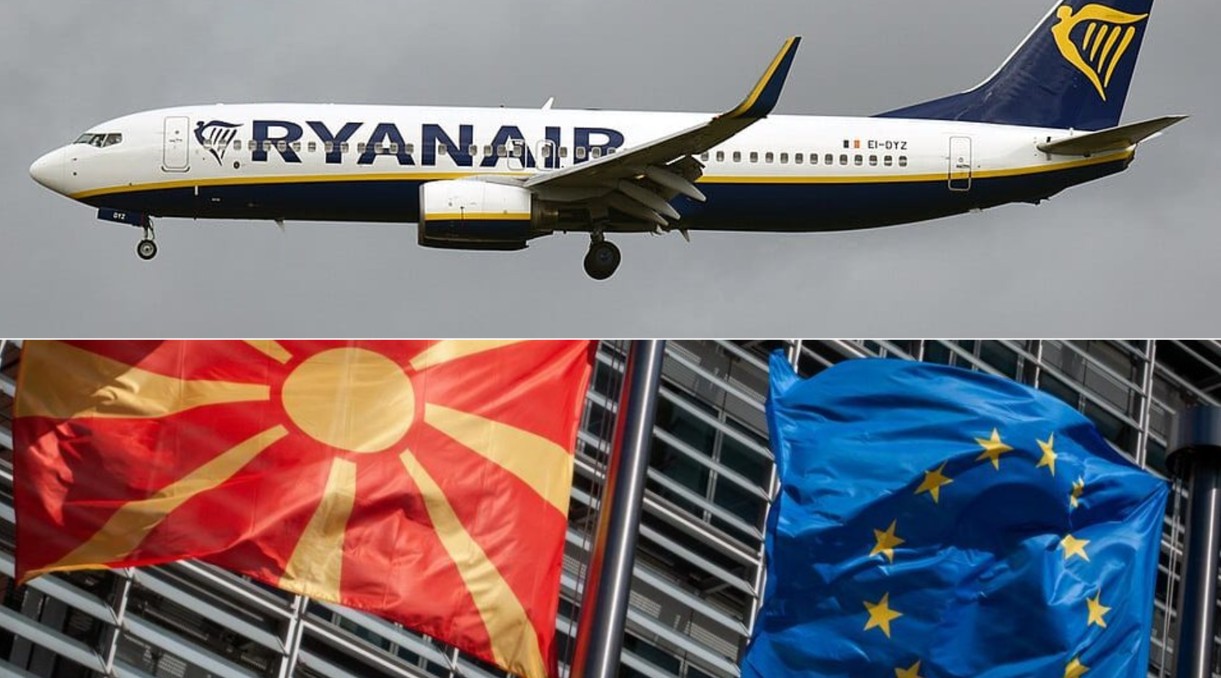
Only a few days ago, Europe once again witnessed a dramatic aviation incident. A Ryanair flight traveling from Thessaloniki to Germany was forced to turn back after a serious in-flight emergency. According to published reports, a 61-year-old Serbian passenger traveling with his wife was injured. A tragedy was narrowly avoided thanks to the professionalism of the crew, the assistance of fellow passengers, and, many would say, God’s grace.
The incident raises a fundamental question: does absolute certainty exist anymore?
If even Europe’s most advanced transportation and safety systems cannot guarantee complete security, then who can guarantee Macedonia that after implementing every requested reform, adopting possible constitutional amendments, and making difficult political compromises, it will finally become a full member of the European Union?
Who can guarantee that new conditions, new demands, and new political obstacles will not emerge once again?
God protected the passengers on that aircraft.
But who will protect Macedonia if Macedonians do not protect it themselves?
Macedonia undoubtedly needs reforms. Not because Brussels demands them, but because the country itself needs them.
Strong institutions, an independent judiciary, a determined fight against corruption, better education, a stronger healthcare system, and an economy capable of creating opportunities for young people are not gifts from Europe. They are responsibilities Macedonia owes to its own citizens and future generations.
If tomorrow Macedonia successfully completes every reform expected of it, that should not be viewed primarily as a victory for Brussels.
It should be regarded first and foremost as a victory for Macedonia.
Yet this is precisely where the greatest dilemma begins.
For more than two decades, Macedonia has followed the European path. Every government has delivered something. Every generation has carried its share of the burden. Each time the destination appeared within reach, another condition emerged, another requirement was introduced, another political hurdle appeared.
It is therefore understandable that many citizens now ask a simple question:
Where does this road actually end?
Who can guarantee that constitutional changes, if adopted, will truly conclude the process rather than open the door to additional demands?
Who can assure Macedonian citizens that the finish line will not once again be moved further away?
Trust cannot be built solely through conditions and expectations.
It also requires predictability, consistency, honesty, and mutual respect.
The same principle applies to Macedonia’s Electoral Code.
The voting rights of the Macedonian diaspora should never become a matter of day-to-day political calculations.
Macedonian citizens living across Europe, North America, Australia, and around the world remain an inseparable part of the country. They work, invest, support their families through remittances, and represent Macedonia internationally.
Their right to vote should not depend on partisan interests.
It is a democratic right.
Many established European democracies allow their diaspora to participate in elections. The real debate is therefore not whether they should vote, but how to organize that process in a manner that is transparent, secure, and trusted by everyone.
Electoral rules do not belong to governments or opposition parties.
They belong to democracy itself.
Behind all these debates lies an even larger issue.
Have Macedonia’s political elites finally learned that the state itself cannot remain an object of daily political bargaining?
A country is not a fountain from which every new government takes whatever it wants.
It is not a branch from which pieces can be broken off whenever politically convenient.
It is not the trophy awarded to election winners.
Nor is it the property of any political party.
The state belongs to its people.
Politicians are merely temporary custodians of the public trust entrusted to them by citizens.
Their responsibility is not to consume the state but to leave it stronger than they found it.
Over the past three and a half decades, Macedonian citizens have repeatedly watched party interests prevail over national interests.
Governments changed.
Political leaders changed.
Strategies changed.
Yet one question remained unanswered:
Where is accountability?
Who accepts responsibility when the state loses?
Who answers for poor political decisions?
Who is accountable when national interests are weakened?
Every serious democracy rests on one simple principle: the law must apply equally to everyone.
Ordinary citizens cannot be expected to bear the full weight of the legal system while those entrusted with the greatest responsibilities remain politically untouchable.
That is precisely why public frustration continues to grow.
Not only because of broken promises.
But because many citizens increasingly believe that the rules are not applied equally to all.
Macedonia’s European journey must not become an endless runway on which the aircraft keeps accelerating but never actually takes off.
The government has a responsibility to deliver reforms.
The opposition has a responsibility to offer credible alternatives.
Institutions have a responsibility to function independently.
And citizens have every right to demand accountability from all of them.
Because Macedonia is greater than any government.
Greater than any political party.
Greater than any individual politician.
Ultimately, the flight called “Macedonia–European Union” does not belong to one administration.
It does not belong to one opposition.
Nor does it belong to a single political generation.
It is the flight of an entire nation.
The passengers have long since boarded.
The people are waiting.
History is watching.
And so the final boarding announcement is clear:
Passengers for Flight “Macedonia–European Union,” please proceed to your seats.
But before the aircraft finally leaves the runway, one question remains above all others:
Is there a pilot on board?
Because Macedonia does not need perfect politicians.
It needs statesmen.
Leaders who understand that a nation is not political spoils but a sacred trust.
That political power is temporary, while the state endures.
And that the aircraft does not belong to those sitting in the cockpit.
It belongs to the people.
