

“Those who cannot remember the past are condemned to repeat it.”
— George Santayana
By Slobodan Tomic

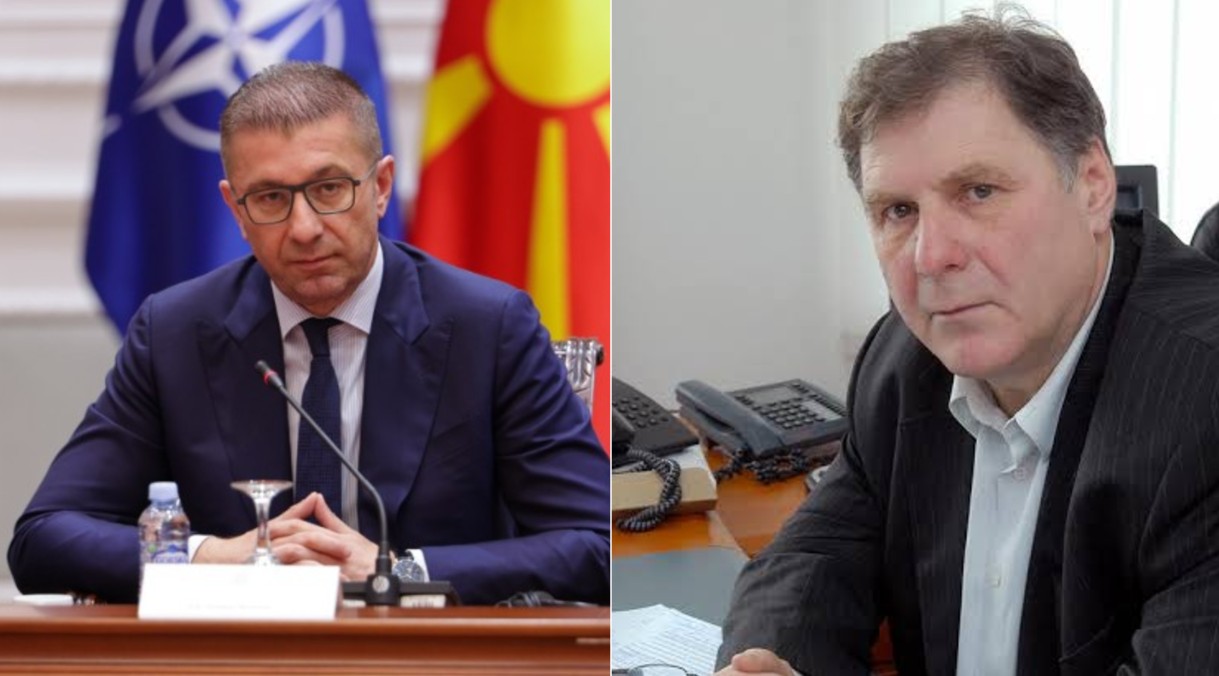
EROL RIZAOV CRITICISES MICKOSKI OVER HISTORY, BUT WHO WILL ANSWER WHY EUROPEAN FUTURE IS SO OFTEN DEFENDED THROUGH FORGETTING MACEDONIAN PAST?
Sometimes the greatest political illusion is not a lie.
The greatest illusion appears when an ideal is presented as reality, while anyone who dares to question that reality is portrayed as an obstacle to the ideal.
That is precisely why journalist Erol Rizaov’s criticism of Prime Minister Hristijan Mickoski deserves a serious response.
Not because Rizaov does not have the right to criticise the Prime Minister.
He does.
Not because he does not have the right to disagree with the government.
He does.
Not because he does not have the right to question every word spoken by the Prime Minister.
He does.
But if the debate is about history, democracy, Europe and Macedonia’s future, then the discussion must include the entire picture.
And the entire picture is far more complex than the one presented by Rizaov.
MICKOSKI CAN BE CRITICISED — BUT HE DOES NOT HAVE TO APOLOGISE FOR SPEAKING ABOUT MACEDONIA
In his article, Erol Rizaov presents Mickoski’s speech on Ilinden and ASNOM as a kind of historical and political manifesto.
But one simple question must be asked:
What exactly is controversial about a Macedonian Prime Minister speaking, on a Macedonian national holiday, about Macedonian statehood, Macedonian history, Macedonian dignity and the future of the Macedonian state?
Mickoski did not invent Ilinden.
Mickoski did not invent ASNOM.
Mickoski did not create Macedonia’s historical memory.
A Prime Minister cannot be accused of “politicising history” simply because he interprets historical events from the perspective of the current state leadership.
History does not belong to any political party.
But history cannot become a forbidden subject for a government, a Prime Minister or an entire nation.
ILINDEN IS NOT A PARTY PROPERTY — BUT NO ONE HAS THE RIGHT TO ERASE THE VMRO TRADITION FROM HISTORY
Here we must be precise.
The Ilinden Uprising does not belong to today’s VMRO-DPMNE.
ASNOM does not belong to today’s SDSM.
History is not a party membership card.
History is the heritage of an entire nation.
However, no one has the right to erase the VMRO tradition from Macedonian history simply because today there is a political party carrying that name.
History did not begin with the creation of modern political parties.
Ilinden is much older than VMRO-DPMNE.
ASNOM is much older than SDSM.
The Macedonian state idea is older than all current political elites.
That is why the biggest mistake is reading history exclusively through party lenses.
WHO HAS THE RIGHT TO DEFINE “BETRAYAL”?
Rizaov strongly criticises Mickoski because of the use of harsh political language.
But precisely here another question emerges:
Are the standards always the same?
When the Prime Minister uses strong words, it is often described as dangerous political rhetoric.
When government critics use strong words against those in power, it is presented as democratic analysis.
But democracy must apply equally to everyone.
Mickoski has the right to his political position.
Rizaov has the right to his position.
And citizens have the right to decide which argument they find more convincing.
That is the essence of a free society.
(Продолжувам веднаш со делот: THOMAS MORE AND “UTOPIA”: WHEN IDEALS COLLIDE WITH REALITY, па потоа Голи Оток, Идризово, Европа, Преспа и завршниот заклучок.)
THOMAS MORE AND “UTOPIA”: WHEN IDEALS COLLIDE WITH REALITY
This is precisely where Thomas More becomes relevant.
In his famous work “Utopia”, More created an imagined ideal society through which he criticised the political reality of Europe of his time.
The lesson is simple:
Ideals are important, but politics always takes place in the real world.
The European Union is not a utopia.
The European Union is a political reality.
A reality where interests exist.
Where power exists.
Where compromises exist.
Where different national positions exist.
Where conditions exist.
Where geopolitics matters.
Therefore, Macedonia can aspire to become a member of the European Union, while at the same time having the right to ask a fundamental question:
WHERE DOES THE EUROPEAN INTEREST END, AND WHERE DOES MACEDONIA’S NATIONAL INTEREST BEGIN?
That question is not anti-European.
It is a question asked by a sovereign state.
EUROPE IS OUR STRATEGIC GOAL, BUT IT MUST NOT REPLACE OUR OWN NATIONAL AWARENESS
Macedonia should become part of the European Union.
But European integration must not become a new form of political conformity.
A society must not move from one slogan:
“Everything must be accepted because the system demands it”
to another:
“Everything must be accepted because Europe demands it.”
Europe does not ask nations to stop thinking.
Europe should not replace political maturity.
And even less should everyone who raises questions about European processes automatically be labelled anti-European.
A mature European society is built precisely on debate, different opinions and democratic dialogue.
LISBON, FYROM AND PRESPA: A HISTORY THAT CANNOT BE ERASED
In 1992, Macedonia faced serious international challenges and conditions.
The Lisbon Declaration became part of that period.
Then came the temporary reference FYROM.
Then followed years of negotiations.
Then came the dispute with Greece.
Then came compromises.
Then came the Prespa Agreement.
And after that?
New questions.
New conditions.
New dilemmas.
Therefore, today the entire debate cannot be reduced only to the question of whether someone demonstrates enough “European enthusiasm”.
History is much more complicated.
Macedonia did not reach its current position because it rejected Europe.
On the contrary.
For many years, it paid a political price on its European path.
The desire for European integration and the defence of historical identity have existed side by side throughout the country’s modern history.
GOLI OTOK AND IDRIZOVO: HISTORY MUST NOT BE BURIED IN SILENCE
When we speak about Europe, democracy and Macedonia’s future, we must also have the courage to speak about the most difficult chapters of the past.
History is not only holidays, ceremonies and great dates.
History is also injustice.
History is also human suffering.
History is also moments when freedom of thought was restricted.
Goli Otok and Idrizovo remain part of the historical memory of periods when political differences were often not resolved through open dialogue, but through pressure, punishment and repression.
These issues should not be used to create new divisions.
But they must not be erased either.
Because a nation that forgets the suffering of people who paid a price for their beliefs risks underestimating the value of freedom.
Throughout history, there were people who dreamed of a freer, more dignified and more democratic Macedonia.
Some were punished because they thought differently.
Some paid a heavy price because they held different political views.
Those pages must remain part of historical memory.
THE BURDEN OF THE PAST MUST NOT COVER HISTORICAL MEMORY
Every country has difficult periods in its history.
But mature societies do not hide them.
They analyse them.
They learn from them.
They draw lessons.
That is why questions about political persecution, restrictions on freedom of speech and attitudes toward different opinions are not merely questions of the past.
They are questions about today’s values.
Because freedom is not something that is gained once and then guaranteed forever.
Freedom must constantly be defended.
MICKOSKI HAS THE RIGHT TO OPEN HISTORICAL QUESTIONS
That is precisely why Hristijan Mickoski has the right to speak about these issues.
He has the right to remind citizens that freedom, democracy and national dignity have their own historical price.
He has the right to raise questions about periods when people could not freely express their opinions.
He has the right to argue that the future cannot be built on forgetting.
This does not mean returning to the past.
It means having a mature relationship with history.
Just as every journalist has the right to criticise the government, a democratically elected government has the right to speak about the historical experiences of its people.
History must not become anyone’s forbidden
FREEDOM OF SPEECH CANNOT BE MEASURED BY DOUBLE STANDARDS
Democracy does not mean only the right to criticise those in power.
Democracy also means the right of those in power to respond.
It means the right to open uncomfortable topics.
It means the right of different generations to interpret history through different experiences.
But one principle must remain common:
Historical facts must not be forgotten.
Because a nation that forgets the moments when freedom was restricted can easily forget how valuable freedom truly is.
MICKOSKI IS NOT PERFECT, BUT HE CANNOT BE BLAMED FOR EVERYTHING THAT HAPPENED IN RECENT DECADES
This is the essence of the debate.
Hristijan Mickoski should be judged.
The government should be judged.
Every minister should be judged.
That is the democratic right of citizens.
But the entire burden of the last 35 years cannot be placed on one Prime Minister and one government.
The past decades included different political elites.
Different governments.
Different decisions.
Different agreements.
Different compromises.
And different mistakes.
If we want an honest analysis, then we must look at the entire picture.
Not only the part that fits a particular political position.
A NATIONAL HOLIDAY CANNOT BECOME A TRIAL AGAINST ONE PRIME MINISTER
Ilinden and ASNOM are far greater than any current politician.
Precisely because of that, the debate about them must be conducted with dignity.
A national holiday cannot become only a battlefield for daily political confrontation.
Mickoski has the right to offer his interpretation.
His critics have the right to offer theirs.
Citizens have the right to decide which vision they believe is closer to their own.
That is democracy.
PATRIOTISM BELONGS TO NO ONE EXCLUSIVELY
Patriotism is not the property of VMRO-DPMNE.
But it is not the property of its critics either.
No one possesses a certificate proving greater love for Macedonia.
No one has a monopoly over the state.
But every citizen has the right to expect politicians to defend the interests of their own country.
This is the core of the dispute.
Mickoski does not receive support because he is flawless.
He receives support because he raises a question that, according to his supporters, has been avoided for too long:
CAN MACEDONIA MOVE TOWARD EUROPE WITHOUT CONSTANTLY BEING ASKED TO GIVE UP PART OF ITS OWN IDENTITY?
The answer must be:
Yes.
Macedonia can be in Europe.
Macedonia should be in Europe.
But Macedonia must enter Europe as an equal state.
With its name, its history and its dignity.
THERE IS NO EUROPEAN FUTURE WITHOUT MACEDONIAN DIGNITY
Erol Rizaov has the right to criticise Mickoski.
But Mickoski has the right to respond.
And Macedonian citizens have the right to decide who offers the stronger vision for the future.
But when we speak about history, we must speak about all of it.
Ilinden.
ASNOM.
Independence.
Lisbon.
FYROM.
The name dispute.
Prespa.
European promises.
New conditions.
All of these are parts of one broader story.
A nation cannot be asked to forget its past in order to accept its future more easily.
Because a future without memory is not a real future.
It is simply forgetting.
CONCLUSION: EUROPE SHOULD NOT MEAN AMNESIA — EUROPE SHOULD MEAN FREEDOM
Europe should not mean the loss of historical memory.
Europe should mean freedom.
Freedom to be part of the European family.
But also freedom to remain yourself.
Therefore:
MICKOSKI DOES NOT HAVE TO BE PERFECT IN ORDER TO DEFEND MACEDONIA.
HE DOES NOT HAVE TO BE ANTI-EUROPEAN IN ORDER TO DEMAND EQUALITY.
HE DOES NOT HAVE TO REMAIN SILENT ABOUT HISTORY IN ORDER TO BUILD THE FUTURE.
And Rizaov?
Let him criticise.
Let him write.
Let him analyse.
That is his democratic right.
But no single column can become the only permitted truth.
Macedonia is not anyone’s column.
Macedonia is not anyone’s utopia.
Macedonia is a state.
And history should be the judge.
Not political parties.
Not temporary political interests.
Not daily agendas.
But time itself.
Because a nation that remembers its history does not fear the future.
And a nation that knows its own value does not ask permission to be itself.
