

“A nation can survive its fools, and even the ambitious. But it cannot survive treason from within. An enemy at the gates is less formidable, for he is known and carries his banner openly. But the traitor moves amongst those within the gate freely, his sly whispers rustling through all the alleys, heard in the very halls of government itself.”
— Marcus Tullius Cicero (106 BC – 43 BC), Roman statesman, lawyer, and scholar
By: Slobodan TOMIC

Slobodan TOMIC
Five Historic Partitions and Diplomatic Cynicism in Bucharest 1913
If geopolitics has a recurring matrix, then August 10 is the date where that code is written in blood and diplomatic ink for the Macedonian nation. History records five pivotal dates when Macedonia faced state-level division and dismemberment at the hands of foreign empires and treaties:
- 168 BC (Battle of Pydna): The Romans defeat King Perseus and divide the ancient kingdom of Macedonia into four separate client republics.
- 1014–1018 AD (Fall of Samuil’s Empire): Following the Battle of Belasica, Byzantium subjugates Macedonia and divides it into military administrative themes.
- 1395 AD (Ottoman Conquest): Macedonia falls under centuries of Ottoman rule, partitioned into administrative sanjaks and pashaliks.
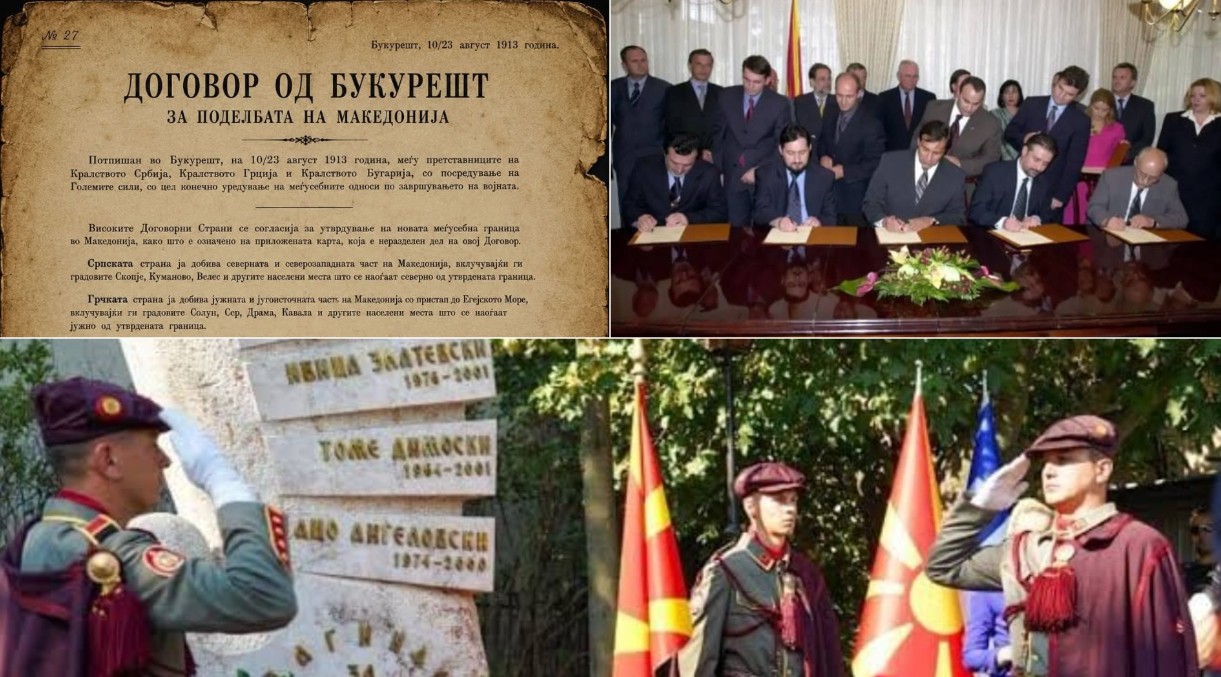
- August 10, 1913 (Treaty of Bucharest): Macedonia is partitioned among neighboring Balkan states into four main parts—a division whose geopolitical aftermath persists today.
- 1941–1944 AD (Fascist Occupation): During WWII, Macedonia is partitioned again under Bulgarian fascist occupation and Italian-controlled Axis Albania.
Among these historic turning points, August 10, 1913, stands out for its diplomatic cynicism. Behind the closed doors of the Bucharest conference lay a tragic plot that continues to define the fate of the Balkans.
Few in historical memory emphasize the fact that just days prior to the signing, on August 5, 1913, the United States diplomatic envoy in Bucharest, John B. Jackson, transmitted a direct note from the U.S. Government. In that document, official Washington requested that the final treaty explicitly include a provision guaranteeing “full civil and religious liberty to the inhabitants of any territory awarded to any participant.” Although Romanian Prime Minister Titu Maiorescu initially accepted the initiative, it was explicitly rejected and blocked by Greek Prime Minister Eleftherios Venizelos and the other Balkan allies.
The outcome was devastating: with the rejection of the U.S. note for the protection of basic civil rights, Macedonians were erased from the international legal map, and their homeland was partitioned without any safeguard against assimilation and persecution. While Dimitrija Chupovski and the Macedonian Colony in Petrograd presented cartographically precise ethnographic and geographical maps of a unified Macedonia in London, the Great Powers decided that the law of force superseded the force of law.
The American Constitutional Model vs. The Macedonian Experiment
The irony of history becomes even starker when comparing the American constitutional framework with what was imposed upon Macedonia in 2001.
The United States—whose constitutional foundations were laid by statesmen like John Adams (the second President of the United States) and Thomas Jefferson—is built upon the absolute principle of unitary sovereignty and civic equality under a single flag. Neither in the U.S., nor in leading European democracies like Germany (home to over four million Turks), France, or the United Kingdom, does a mechanism exist where an ethnic, religious, or linguistic minority can execute a territorial and institutional redefinition of a sovereign state.
In these nations, the Constitution acts as an impenetrable shield of unitarism. Yet in 2001, orchestrated through external diplomatic engineering, an unprecedented model was forced upon Macedonia:
- The constitutive Macedonian people were downgraded and equated in constitutional standing to ethnic communities.
- A dual-decision-making mechanism (Badinter majority) was introduced, stifling the sovereign will of the majority.
- The security architecture was subjected to party-ethnic quotas, undermining the state’s monopoly on legitimate physical force.
A Deadly Chain: Karpalak and Ljubotenski Bachila — Treason Behind the Scenes?
Within this dramatic historical continuum, commemorating 25 years since the ambush and sacrifice of eight army reservists at Ljubotenski Bachila on August 10, 2001,
Tome Badarovski, Goce Chankulovski, Branko Janev, Tomislav Nastevski, Marjancho Boshkovski, Ivica Zlatevski, Tome Dimovski, Rade Jankovski, alongside Aco Angelovski—cannot be reduced to mere protocol.
The tragedy at Ljubotenski Bachila occurred just 48 hours after the Karpalak massacre on August 8. Military analysts and critical experts have long asserted that this sequence of military tragedies carried heavy indicators of internal betrayal and high-level coordination within the defense ministry and army staff of the era.
- Tactical Anomalies: How were military transports carrying dozens of reservists dispatched into hostile zones without prior engineering clearance, air cover, or reconnaissance, despite clear intelligence that the route was mined and controlled by paramilitary formations?
- Political Pressure for Capitulation: Numerous analysts openly point out that these military losses were enabled by internal power centers to cultivate an atmosphere of panic and defeatism, directly accelerating the signing of the Ohrid Framework Agreement just days later on August 13, 2001.
Modern Constitutional Dictates: Resolve vs. Political Subservience
The historical pattern of coercion and concessions did not end in 2001.
Today, Macedonia stands at a new historical crossroads, facing external demands for unconditional constitutional amendments under the guise of European integration—the so-called “Bulgarian dictate.”
At this critical juncture, two opposing political philosophies have emerged:
- Persistence and Sovereign Dignity: The firm stance of Prime Minister Hristijan Mickoski and the current administration to reject unilateral ultimatums serves as an essential bulwark for national integrity. Refusing to alter the constitution under external pressure is not an obstruction of the European path, but a defense of the fundamental sovereign right of a nation to safeguard its own identity and constitutional order.
- The Capitulatory Stance of SDSM: In contrast, the opposition SDSM continues to push a narrative demanding unconditional acceptance of external demands at any cost.
- This policy of perpetual concession devalues national leverage and repeats the mistakes of the past, where every forced compromise generates ever-larger demands.
Legacy and Honor
The Macedonian defenders who fell at Ljubotenski Bachila and Karpalak were not victims of superior enemy military capability, but of geopolitical engineering and internal political maneuvering.
Their sacrifice was a duty carried out in defense of the Constitution and the homeland.
As history records those who signed imposed agreements and those who advocate new concessions today, one principle remains clear: a state that sacrifices its defenders and constitutional integrity for short-term diplomatic ease eventually forfeits both its peace and its sovereignty. The sacrifice of heroes remains an unyielding stone in the nation’s foundation—one that must withstand every new dictate.
