

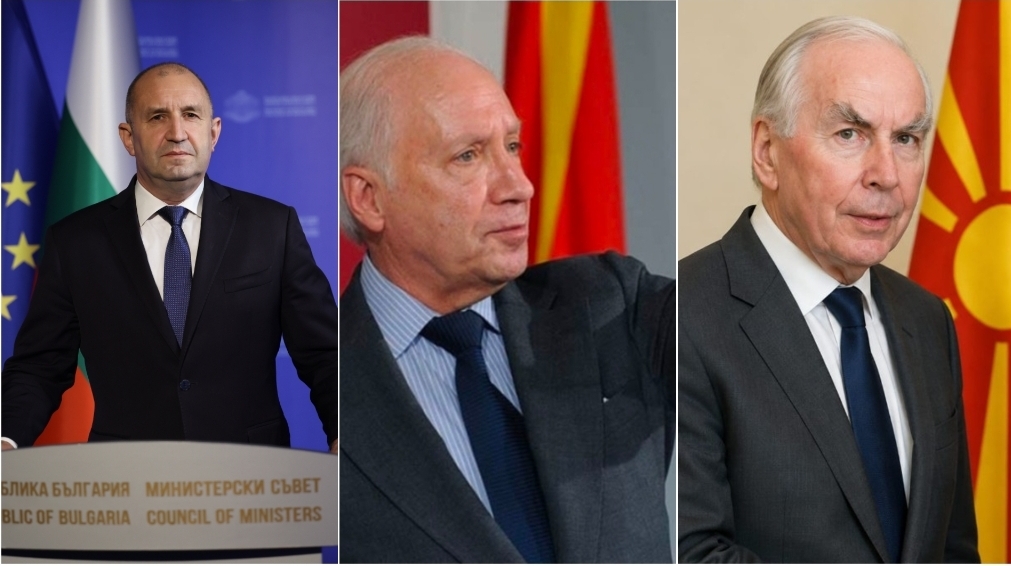
The Bulgarian strategy, O’Neill’s warning, the Protocols, and the final line of the constitutional state
Author: Slobodan TOMIC

There are moments when a state must stop merely reacting to events and must begin writing its own strategy.
Macedonia once again finds itself at precisely such a moment.
Sofia is projecting its foreign policy up to the year 2030.
Brussels expects the fulfillment of assumed obligations.
Bulgaria remains firm in its positions, and Skopje once again faces the very same grand question that has followed the country for more than three decades:
Will Macedonia be a state that determines its own European future, or a state whose European path will be conditioned by the historical and political positions of its neighbors?
Yet today, there is another institution that must not be bypassed in this story.
That is the Constitutional Court.
Because when politics reaches the boundary of the Constitution, the final word must belong neither to Sofia, nor to Brussels, nor to any foreign capital.
The final word must belong to the Macedonian constitutional order.
O’NEILL RECOGNIZES THE OLD BALKAN MATRIX
In the exclusive interview I conducted for “Glasot na Narodot with Slobodan Tomić” on Vistel Television, British diplomat Robin O’Neill uttered a sentence that carries new weight today:
“I am sorry that in a way, the position Greece held 35 years ago is repeating itself.”
He was speaking about Bulgaria.
Yet O’Neill is not a political commentator discovering the Macedonian-Bulgarian issue today from a television studio.
He was the man directly involved in 1992 in the diplomatic efforts surrounding the dispute between Macedonia and Greece.
He was there.
He knew the diplomatic atmosphere.
He knew Kiro Gligorov.
He knew the Greek positions.
And that very man today recognizes something Macedonia must not ignore:
the danger of the historical question once again becoming an instrument of political pressure.
FROM THE GREEK NAME TO BULGARIAN HISTORY
Thirty years ago, the question was:
“What will Macedonia be called?”
Today, the question is:
“How will Macedonia interpret its own history?”
Yet behind both questions lies one and the same dilemma:
How far can a neighboring state go in defining the internal affairs of the Macedonian state?
In the interview, O’Neill does not shy away from the answer.
Regarding the Bulgarian position, he states:
“I think Bulgaria is quite wrong in its stance.”
And he adds:
“A broader and more sensitive approach is needed from Bulgaria.”
That is diplomatic language.
But the message is exceptionally clear.
THE PROTOCOLS — THE LEGAL ISSUE THAT MUST NOT BE BURIED UNDER POLITICS
And here we arrive at the most sensitive part.
The Second Protocol from the second meeting of the Joint Intergovernmental Commission with Bulgaria, held in Sofia on July 17, 2022, is today the subject of proceedings before the Constitutional Court.
The Constitutional Court has officially established case U.no.44/2025, in which precisely the Protocol from the second meeting of the Joint Intergovernmental Commission with Bulgaria of July 17, 2022, is challenged.
In February 2026, the Court also published information regarding the initiative in this case.
This is fundamentally important.
Why?
Because now the question is not merely political.
The question is:
Can such an act produce effects that encroach upon the sphere of the constitutional order, the competencies of state institutions, and the essential matters of the state, while its legal nature, form, and content remain outside the strictest constitutional-judicial review?
That is precisely what the Constitutional Court needs to examine.
And that is precisely why no one should dictate its decision in advance.
Nor should its historic responsibility be taken away.
THE CONSTITUTIONAL COURT IS NOT A DECORATION OF THE STATE
The Constitutional Court plays an essential role in reviewing constitutionality and legality, and in safeguarding the constitutional order.
This means its role in this matter cannot be merely protocolary.
The Court cannot be turned into an institution that simply registers what politicians have agreed upon.
The Constitutional Court exists precisely to draw the line:
where politics ends, and where the Constitution begins.
And therefore, if after a thorough legal analysis the Court determines that the provisions or actions arising from the Protocols are contrary to the Constitution or the laws, it must act in accordance with its constitutional powers.
That would not be a political act.
That would be the rule of law.
THE PROTOCOL CANNOT BE “ABOVE THE CONSTITUTION”
This must be the red line.
No protocol.
No treaty.
No political declaration.
No European recommendation.
No diplomatic formula.
No foreign government.
Can be above the Constitution.
If something agreed upon internationally produces consequences within the domestic legal order, then there must be a clear legal basis for those consequences.
The political phrase does not help here:
“That is an assumed international obligation.”
International politics and constitutional law must align.
Not the other way around.
WHAT IS UNJUST CANNOT BECOME CONSTITUTIONAL MERELY BECAUSE IT IS OCTROIATED
And here I would present the sharpest authorial thesis.
A state cannot be confronted with a fait accompli, have that act presented politically as inevitable, and then expect the state itself to accept it as a new reality.
That is not the European spirit.
Europe is not a space where the stronger dictates and the weaker simply signs.
Europe is a space of law.
Of institutions.
Of procedure.
Of democratic legitimacy.
Of constitutionality.
Of respect for the citizen.
Therefore, anything unconstitutional, undemocratically imposed, or legally unfounded—if such conflict is determined by the competent authority—must be removed from the legal order.
And here the word is not:
“disobedience.”
The word is:
CONSTITUTIONALITY.
AND WHERE IS THE CITIZEN IN ALL OF THIS?
This is the question that political elites often forget.
The state does not exist for itself.
The Constitution is not a decorative book.
Democracy is not just voting every four years.
The citizen is the source of democratic legitimacy.
In 2018, a referendum was held with a question related to EU and NATO membership through the acceptance of the Agreement with Greece.
According to official data, out of 1,801,965 registered voters, 664,210 voted, representing approximately 36.9 percent.
Therefore, to be legally precise:
the referendum did not reach the required turnout threshold to produce a decision with the intended referendum effect.
Yet the political message of that event cannot simply be erased from historical memory.
It demonstrated a deep divide within society regarding the issue.
And precisely for that reason, any political process that touches upon identity, statehood, and the constitutional order must possess exceptionally strong democratic legitimacy.
IT CANNOT NOW BE PRETENDED THAT THE PEOPLE DO NOT EXIST
Democratic legitimacy does not end with elections.
Elected authorities have a mandate.
But they do not have a mandate to stand above the Constitution.
They do not have a mandate to stand above the citizen.
They do not have a mandate to suspend institutional oversight.
And here lies the significance of Hristijan Mickoski’s current policy.
His strongest political stance should not be:
“I am against Bulgaria.”
That would be far too minor.
His stance should be:
“I am for a European Macedonia, but a European Macedonia that enters Europe as a constitutional, democratic, and equal state.”
That is far stronger.
And that is a stance that can carry legitimacy both before the Macedonian public and before European partners.
MICKOSKI AND THE NEW STATE LOGIC
Mickoski should not portray himself as a politician blocking the European path.
On the contrary.
He should establish the thesis that European integration itself demands respect for European principles, which means:
reforms — yes;
rule of law — yes;
fight against corruption — yes;
good neighborliness — yes;
dialogue with Bulgaria — yes;
European integration — yes;
but political pressure on the Macedonian constitutional order — no.
That is the difference between isolationism and statesmanship.
LET THE CONSTITUTION SPEAK, NOT THE ULTIMATUM
Here Macedonia needs to be brave.
If someone considers the Protocols constitutional — let them prove it.
If someone considers them lawful — let them prove it.
If someone considers that they produce legal effects — let them show the legal basis.
If someone considers that they do not infringe upon identity questions — let them demonstrate it.
But the response should not be a political quarrel.
The response should be:
THE CONSTITUTIONAL COURT.
And that is why it is important that the case already exists.
In this situation, the most important thing is for the Court to decide without political calculation and without external pressure.
No calculation.
No political measuring.
No fear of Sofia.
No fear of Brussels.
No fear of Washington.
Only the Constitution.
O’NEILL AND THE PROTOCOLS — TWO LINES THAT INTERSECT
And here we return once again to Robin O’Neill.
On one side, we have a man who, from diplomatic history, tells us:
“History is once again being used as an instrument of political pressure.”
On the other side, we have a Macedonian institution that must determine whether specific acts are in compliance with the domestic constitutional and legal order.
These are two different planes.
Yet they meet at a single point:
the state must have a legal mechanism through which it protects its constitutional autonomy.
That is the very essence of the rule of law.
BULGARIA DOES NOT HAVE TO BE AN ENEMY
This must also be stated.
Bulgaria should not be an enemy of Macedonia.
Bulgaria is a neighbor.
An EU member state.
A state with which Macedonia must have normal, European, and good-neighborly relations.
Yet precisely for that reason, relations must be freed from the logic:
“I am a member, you are a candidate, therefore I decide how fast you move.”
Such logic creates distrust.
European logic should be:
“I am a member, therefore I carry an even greater responsibility to bring the candidate into the system.”
That would be European leadership.
SOFIA UNTIL 2030, BUT MACEDONIA MUST NOT WAIT UNTIL 2030
Bulgaria can set its own strategic goals.
That is its right.
But Macedonia must have its own strategy.
And that strategy should not be a strategy against Bulgaria.
It should be a strategy for Macedonia.
Macedonia must become a state that:
does not beg;
does not blackmail;
does not threaten;
does not give up;
does not isolate itself;
but negotiates from a position of clearly defined national interest.
EUROPE MUST NOT BECOME A SYSTEM OF BILATERAL VETOES
Here O’Neill is closest to the essence.
He warns that the EU risks losing its credibility in the Western Balkans if it follows the political interests of individual member states instead of the broader European goal.
That is a massive warning.
Because Macedonia is not the only test.
If today one state can be blocked because of history, tomorrow another can be blocked because of a border.
A third over a minority.
A fourth over language.
A fifth over a historical event.
And then European integration will become an endless series of bilateral arbitrations.
That is not the Union the Balkans wishes to enter.
THE GREATEST PARADOX
There is something paradoxical in the whole situation.
Bulgaria wants Macedonia to be European.
Macedonia wants to be European.
The European Union wants the Western Balkans to be European.
Yet all three sides are stuck in questions originating from the past.
That is the Balkan paradox:
everyone talks about Europe, yet everyone is dragged back into history.
O’Neill recognizes precisely this.
And therefore his:
“We are now living in the 21st century”
is not merely a comment on history.
It is a call for political maturity.
A MACEDONIAN VICTORY IS NOT A BULGARIAN DEFEAT
This must become fundamental Macedonian European policy.
If Macedonia becomes an EU member, Bulgaria does not lose.
If Macedonia preserves its identity, Bulgaria does not have to lose its own.
If Macedonia respects Bulgarians as citizens, Bulgaria has no need to fear Macedonia.
If Bulgaria respects Macedonians and their right to self-determination, Macedonia has no need to view Bulgaria as a threat.
That is the only European way forward.
AND THE CONSTITUTIONAL COURT?
It now holds an historic responsibility.
Not to resolve politics.
Not to resolve history.
Not to resolve diplomatic relations.
But to resolve law.
To establish the legal nature of the challenged acts.
To examine their constitutionality and legality.
To determine whether they fall within the powers of the institutions that issued them.
And if it finds unconstitutionality or illegality — to exercise its constitutional authority.
That should not be perceived as an attack on Bulgaria.
It is the protection of the Macedonian constitutional state.
And if the Court finds that the acts comply with the Constitution and the laws, that too must be respected.
That is precisely why institutions exist.
LET THERE BE NO MORE OCTROIATED SOLUTIONS
Macedonia must no longer allow itself to be brought into a situation where political pressure is presented as the sole reality.
No “proposal.”
No “protocol.”
No “framework.”
No “compromise formula.”
Must become an untouchable object simply because it comes from the outside.
Every act that produces legal consequences must have a legal basis.
Every institution must remain within its competence.
Every democratic process must possess legitimacy.
And every citizen must know that an institution stands between political interest and the Constitution.
That is the Constitutional Court.
MICKOSKI AND THE CHANCE FOR A NEW STATE DOCTRINE
Here lies the historic chance for Hristijan Mickoski.
Not merely to be a prime minister who says:
“No.”
But a prime minister who will say:
“Yes to Europe. Yes to reforms. Yes to good-neighborliness. Yes to dialogue. But yes also to a constitutional, democratic, and sovereign Macedonia.”
That is a statesmanlike position.
That position is not anti-Bulgarian.
It is not anti-European.
It is not anti-Western.
On the contrary.
It is pro-European because Europe means the rule of law.
And therefore, Mickoski has a legitimate right to demand that the European path not be a road of endless additional conditions, but a path with clear rules.
HISTORY HAS RETURNED — BUT THIS TIME MACEDONIA HAS INSTITUTIONS
In 1992, Macedonia lacked many of today’s institutional mechanisms.
It was a new state.
Uncertain.
Economically vulnerable.
Under heavy international pressure.
Today it is a NATO member.
It has 35 years of statehood.
It has its institutions.
It has a Constitutional Court.
It has democratic elections.
It has its own foreign policy.
It has experience.
It has a generation that has already learned the most expensive lesson:
every compromise must have a boundary.
AND THEREFORE THIS IS NOT JUST A BATTLE FOR THE PROTOCOLS
This is not merely a dispute over a single document.
It is not merely a dispute over two protocols.
It is not merely a dispute with Bulgaria.
This is the question:
IS MACEDONIA A CONSTITUTIONAL STATE?
If it is — then the Constitution is the final line.
Not Sofia.
Not Brussels.
Not Washington.
Not any political leader.
The Constitution.
FINALE: WHEN A STATE SAYS “ENOUGH” — THAT IS WHERE STATESMANSHIP BEGINS
Macedonia should not fear Europe.
It should not fear Bulgaria.
It should not fear its own history.
But it must not fear its own Constitution either.
Therefore, today we must say something very simple.
If the Protocols are constitutional — let it be proven.
If they are lawful — let it be proven.
If they are within institutional competencies — let it be proven.
But if the Constitutional Court determines otherwise, then the state must have the courage to respect its own Constitution.
Not because Skopje likes it.
Not because Brussels will like it.
Not because Sofia will be angered by it.
But because a state that does not respect its own Constitution cannot seriously demand that others respect its sovereignty.
Robin O’Neill gave us the historical lesson.
He saw Macedonia in its most difficult years.
He saw the Greek blockade.
He saw diplomatic powerlessness.
He saw missed opportunities.
And today he sees something that reminds him of that past.
His message is:
“We are now living in the 21st century.”
I would extend his sentence:
Yes, Mr. O’Neill. But Macedonia no longer has the right to repeat the mistakes of the 20th century.
Nor to allow history to become its prison once again.
Nor to allow foreign strategies to become its domestic Constitution.
Nor to allow political protocols to stand higher than institutions.
Nor to allow Europe to become an infinite waiting room.
And therefore today, the most important question is not:
“What will Sofia say?”
Nor is it:
“What will Brussels say?”
The question is:
“WHAT WILL THE CONSTITUTION SAY?”
If the answer to that question is delivered independently, courageously, and with sound legal argument, Macedonia will gain something far more important than a political victory.
It will gain institutional maturity.
It will show that European Macedonia is not a Macedonia without a stance.
Rather, a Macedonia with institutions.
With law.
With democracy.
With dignity.
With European orientation.
And with a clear boundary of where compromise ends.
Because compromise is a virtue only as long as it does not destroy the essence.
And when a state stops defending its constitutional boundary, it is no longer negotiating.
It is surrendering.
Macedonia must not surrender.
It must move toward Europe.
But as a state.
Not as an object.
As a partner.
Not as a hostage.
As an equal European nation.
Not as a historical footnote.
And perhaps precisely for that reason, today the greatest Macedonian victory would not be to defeat the Bulgarian.
Nor the Greek.
Nor Brussels.
The greatest victory would be for Macedonia to finally learn not to defeat itself.
That is the path from protocol to Constitution.
From pressure to statesmanship.
From past to future.
From Balkan blockade to European maturity.
And from a state that waits to a state that decides.
