

By Slobodan Tomic

“He who lives only in the past has no right to dictate the future.”
Seneca
Sometimes a single political sentence carries more weight than an entire diplomatic note.
“I will not engage in daily political arguments with people who are stuck in the last century.”
With this message, Prime Minister Hristijan Mickoski was not responding only to Iliana Iotova.
He was sending a message far broader than a daily political dispute with Sofia: Macedonia will no longer allow its future to become hostage to someone else’s interpretation of its past.
And this is where the essence of the matter begins.
This is not only about Iotova.
Nor is it only about Bulgaria.
It is about a model under which Macedonia spent years being pushed into an endless Balkan room filled with the same disputes, the same conditions and the same demands — only expressed in different formulas.
One door led to Athens.
The other led to Sofia.
And Macedonia stood between them, constantly expected to give something away in order to move forward.
Mickoski is now trying to break that circle.
Not through isolation.
Not through abandoning Europe.
But by shifting the center of gravity.
From a state that asks for permission to a state that builds alliances.
PRESPA AND THE TREATY WITH BULGARIA ARE NOT JUST AGREEMENTS — THEY ARE A POLITICAL LEGACY
To understand Mickoski’s position today, we must look back.
The policies of the previous government, led by SDSM and supported by DUI, chose a logic of major concessions in exchange for the promise that Europe was just around the next corner.
The Prespa Agreement was presented as a historic step toward a European future.
The Treaty of Friendship, Good-Neighbourliness and Cooperation with Bulgaria was presented as a new European framework.
But time raised an uncomfortable question:
What did Macedonia actually receive after all those concessions?
The answer cannot today be reduced to a political slogan.
But one fact remains undeniable: EU membership did not come.
On the contrary, after the dispute with Greece was resolved, a new problem emerged — Bulgaria.
Then came new conditions, new procedures, new interpretations and another period of waiting.
That is why Mickoski’s statement in his Breitbart interview that Macedonia was “betrayed and lied to” should not be read merely as an attack on Brussels.
It is a political assessment of an entire model of European policy toward the Western Balkans.
And here the most important question emerges:
Has Macedonia finally understood that European integration must not be a policy of capitulation, but a policy of national interest?
BRUSSELS IS CHANGING — AND THAT IS THE MOST IMPORTANT DETAIL
Ironically, at the very moment when Mickoski is criticizing European policy, Brussels itself is sending a signal that something is changing.
European Commissioner for Enlargement Marta Kos, speaking at the conference of Croatian ambassadors in Zagreb, declared:
“The world has changed. Enlargement must change with it.”
She announced a reassessment of the enlargement model, gradual integration, stronger democratic safeguards and changes in the way the Union functions as it moves toward more than 30 members.
This is not a minor development.
One of the greatest weaknesses of European policy so far has been precisely the logic:
Either you are inside, or you are nowhere.
Kos is now speaking about something different: gradual integration, access to certain European mechanisms even before full membership, including SEPA and European energy networks.
That is an acknowledgement that the old methodology has not produced results quickly enough.
And when a system changes its methodology, it means the system itself recognizes that something in the previous model did not work.
AND THIS IS WHERE MICKOSKI RAISES THE AMERICAN QUESTION
Mickoski is not saying:
“We do not need the EU.”
Quite the opposite.
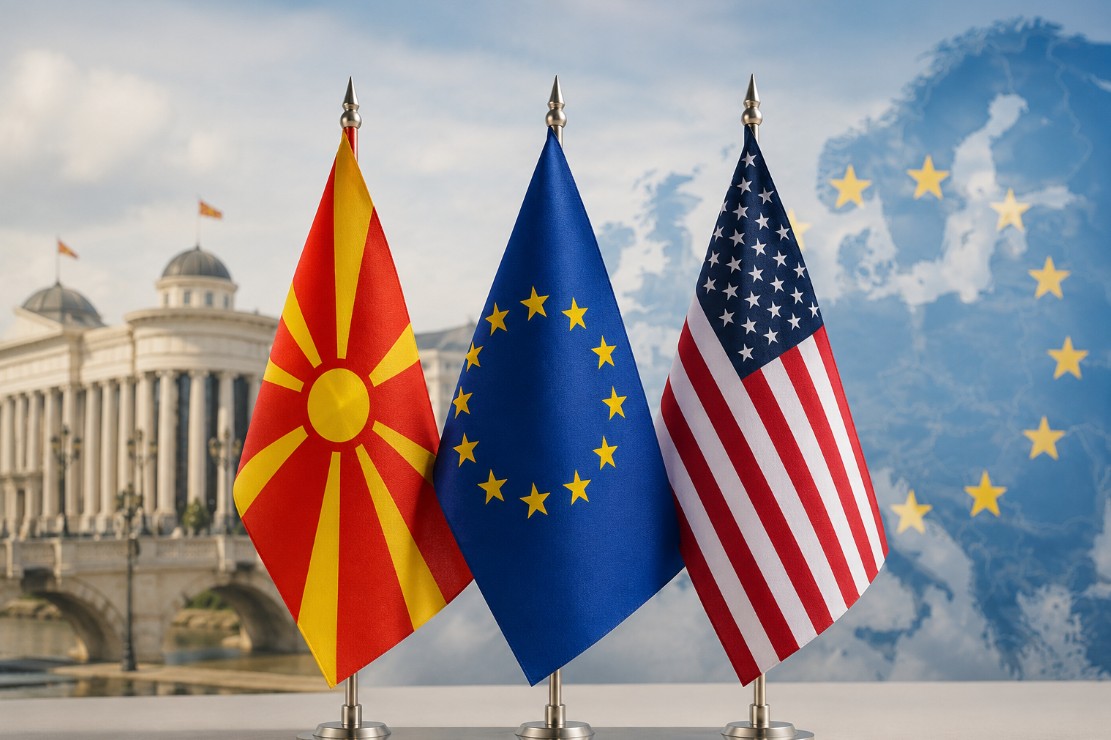
He clearly says that membership in the European Union is one of Macedonia’s major strategic objectives, alongside the strategic partnership with the United States.
That is the essential difference.
This is not a policy of:
“Brussels or Washington.”
It is:
Brussels and Washington — but Macedonia must know what it wants from both.
And this is where Donald Trump enters the picture.
In his Breitbart interview, Mickoski confirmed that his government established contacts with members of Trump’s team during the 2024 campaign and later sent a delegation to Trump’s inauguration.
This is not merely symbolism.
Mickoski is trying to build a political architecture in which Macedonia will not be merely a consumer of security, but an active ally offering geopolitical, infrastructural and economic value.
That is a far more mature policy than:
“Tell us what we have to sign so you will open the door for us.”
TRUMP IS NOT JUST A NAME — HE IS A POLITICAL SIGNAL
For me, as a journalist, supporting Trump is not a question of party affiliation.
It is a question of political direction.
Trump brought into American politics a powerful challenge to the established political establishment, bureaucratic structures and a system in which institutions can sometimes become more important than results.
That is precisely why his politics has had such a strong resonance.
Not because everyone must agree with every decision he makes.
But because he raised a fundamental question:
Whom should the state ultimately serve — its own citizens or its own system?
That question is relevant to Macedonia as well.
That is why I understand and support Mickoski’s strategic orientation toward Washington.
Especially because Macedonia spent years being treated as a country expected to fulfill other people’s conditions, rather than as a country with interests of its own.
ZERO TARIFFS ARE MORE IMPORTANT THAN TEN DIPLOMATIC PHOTOGRAPHS
The most interesting part of Mickoski’s interview is neither Trump, Grenell nor Guilfoyle.
It is the economic dimension.
Mickoski speaks about a common basis for a zero-tariff arrangement between Macedonia and the United States and the expectation that the agreement could be formalized during the upcoming UN General Assembly.
If this is officially established in treaty form, then we are talking about something much more concrete than a political declaration.
We are talking about:
exports, investment, American companies, energy, infrastructure and a new economic space.
A state is not defended through speeches alone.
It is defended through a strong economy.
Through infrastructure.
Through energy security.
Through a strong military.
Through alliances.
And above all, through a state policy that knows where it wants to go.
BRUSSELS MUST NOT LOSE MACEDONIA
This may be the greatest mistake European bureaucracies could make:
To believe that Macedonia has no alternative.
It does.
Not as a replacement for Europe, but as an additional space for strategic maneuvering.
The American partnership does not make Macedonia less European.
Quite the opposite.
If Macedonia becomes economically stronger, more secure and better connected through infrastructure, it will also become a stronger partner of the European Union.
That is precisely why Marta Kos’s new message is so important.
If the EU truly wants a new era of enlargement, it must stop allowing bilateral disputes to become endless political mechanisms of blockade.
Kos has also spoken about reducing the number of areas in which one country can block all the others.
That may be the most significant sentence in the entire new European story.
Because if one country can indefinitely block another, the process is no longer integration.
It becomes hostage-taking.
IOTOVA LOOKS TO THE PAST. MICKOSKI WANTS TO MOVE THE FUTURE.
That is why his reference to “people stuck in the last century” is politically more precise than it may initially appear.
History must be respected.
But history must never become a weapon with which one state dictates the future of another.
The Macedonian people have a history.
They have a cultural heritage.
They have their own language.
They have their own national consciousness.
They have statehood.
And they have the right to interpret their own historical experience.
That does not mean that we should hate Bulgaria.
It does not mean that we should hate Bulgarians.
Quite the opposite.
The best good-neighbourly relationship is one in which two states do not attempt to write each other’s identity.
WHAT REMAINS OF THE POLICY OF SDSM AND DUI?
The lesson remains.
Macedonia must not return to the path of:
concession → promise → new condition → new concession.
That is the political cycle that must end.
Because a state that constantly pays in advance while the reward never arrives does not purchase a future.
It purchases uncertainty.
And this is the difference between the old and the new politics.
The old politics believed Macedonia had to make itself smaller in order to be accepted.
The new politics must demonstrate that Macedonia can be accepted as it is — a sovereign state with interests of its own.
MY SUPPORT IS FOR A POLICY, NOT A CULT OF PERSONALITY
As a journalist, I am not obliged to be anyone’s political decoration.
But I am obliged to recognize a policy that I believe is beneficial for the country.
That is why I support Prime Minister Hristijan Mickoski’s strategic orientation:
a strong partnership with the United States, strong cooperation with President Trump, EU membership, but without new humiliations and without endless conditionality.
That is a policy of dignity.
And that is precisely why Macedonia should speak to Brussels as a partner.
With Sofia — as a neighbour.
With Washington — as an ally.
And with its own people — as a responsible government.
IDENTITY IS NOT DEFENDED THROUGH FEAR, BUT THROUGH A STRONG STATE
In the end, this entire story is not really about Iotova, Kos, Trump or Mickoski.
They are actors in a much larger geopolitical transformation.
The question is:
Will Macedonia remain an object over which others negotiate — or will it become a subject that negotiates for itself?
I choose the second Macedonia.
A Macedonia that does not run away from Europe.
But does not kneel before Europe.
A Macedonia that respects Bulgaria.
But does not surrender its identity.
A Macedonia that is a NATO member.
But also wants to become economically, energetically and infrastructurally stronger.
A Macedonia that builds a strategic partnership with the United States.
And a Macedonia that finally understands that the strongest diplomacy is not the diplomacy that promises the most, but the diplomacy that can deliver the most.
Mickoski now has that opportunity.
Not to close Macedonia inside an anti-European policy.
But to take it out of the European waiting room.
Not to turn it against Bulgaria.
But to end a policy in which Bulgaria determines the pace of Macedonia’s European future.
Not to choose between Europe and America.
But to make Macedonia a European state with a strong American strategic partnership.
If he succeeds, we will be able to say that Macedonia has finally broken its most expensive political habit:
paying in advance for something others continually postpone.
And therefore, today, the most important political message comes neither from Sofia nor from Brussels.
It comes from Macedonia itself:
We do not ask for privilege. We ask for respect.
We do not ask for a gift. We ask for fair rules.
We are not running away from Europe.
But we are no longer running away from ourselves either.
