

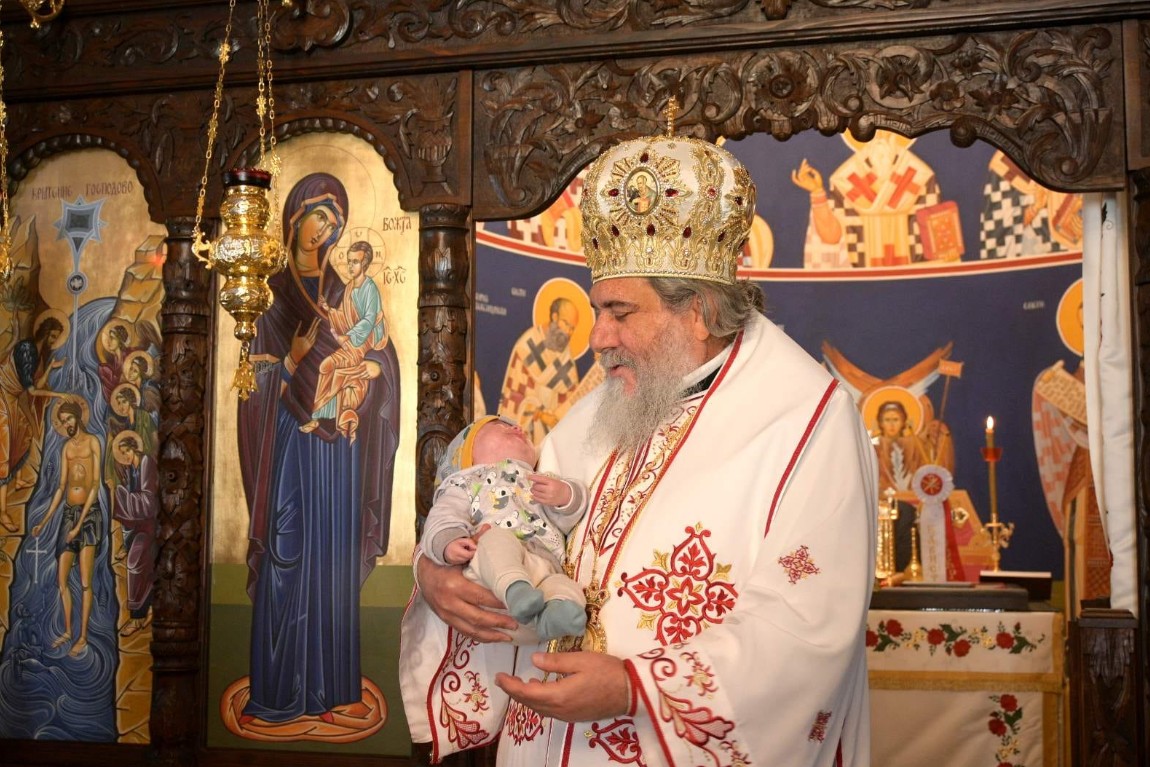
By Slobodan Tomic

THE MACEDONIAN WHO NEVER ABANDONED HIS ROOTS
There are people for whom Macedonia is a word.
There are people for whom Macedonia is a flag.
There are people for whom Macedonia is a song.
And then there are people for whom Macedonia is inseparable from who they are.
For them, Macedonia is not merely an idea.
Not merely a political position.
Not merely a declaration.
It is memory.
It is faith.
It is language.
It is family.
It is prayer.
It is the homeland carried within the human soul.
Such a figure in the spiritual and national life of the Macedonian people is His Grace Agathangel, Metropolitan of Povardarie.
His life cannot be understood merely through ecclesiastical titles.
To understand him, one must look beneath the vestments and beyond the mitre — to the child, the son, the priest, the monk, the bishop and, ultimately, the metropolitan.
And perhaps the most precise description is also the simplest:
Do not try to measure a man’s love for his homeland. Some loves cannot be measured. They can only be recognised.
FROM CHAIR TO THE ARCHIERARCHAL THRONE
Behind every hierarch stands a human story.
Before the vestments stands a man.
Before the mitre stands a child.
Before the episcopal throne stand a family, a childhood, sacrifices, trials, prayers and decisions made long before the world learns the person’s title.
Agathangel, born Atanas Stankovski, was born on 11 March 1955 in Chair, Skopje, into the family of Ivan and Elica Stankovski.
His childhood was marked by hardship.
His mother died while he was still young.
As the eldest of three brothers, he encountered responsibility early.
His father instilled in him faith, piety and courage — qualities that would later become inseparable from his spiritual journey.
In 1976, he completed his education at the Macedonian Orthodox Theological School “St. Clement of Ohrid.”
On 7 January 1979, he was ordained a deacon.
Two days later, on 9 January, he was ordained a priest at the Church of the “Holy Great Martyr George” in Chair.
Until 1983, he served as a parish priest.
Then came Australia.
For some, emigration means distance.
For a priest serving a dispersed people, distance can become a vocation.
In Australia, he served Macedonian Orthodox communities at the Church of the “Holy Mother of God” in Brisbane, the Church of the “Holy Great Martyr Demetrius” in Springvale and the Church of “St. Nicholas” in Preston.
Thousands of kilometres from the homeland, Macedonians were preserving something that borders alone could never contain:
their faith,
their language,
their customs,
their memory,
their sense of belonging.
The Church became not only a place of prayer, but a place where memory survived.
In 1988, Agathangel was appointed episcopal deputy to Metropolitan Timotej and was elevated to the rank of archpriest.
Upon his return to Macedonia, he served as a librarian at the Orthodox Theological Faculty and as an official in the Synodal Office.
In 1995, he returned to parish ministry at the Cathedral Church of “St. Clement of Ohrid” and graduated from the Orthodox Theological Faculty.
But another calling had remained within him:
the monastic calling.
It had been postponed because of his responsibilities toward his widowed father and younger brothers.
After the death of his wife, Mica, that calling returned with renewed force.
On 5 February 1998, he was tonsured a monk and received the name Agathangel, in honour of the Holy Venerable-Martyr Agathangel of Bitola.
On 24 June 1998, the Holy Synod elected him a hierarch.
On 12 July 1998, he was consecrated Auxiliary Bishop of Skopje, with the title Bishop of Velika.
On 13 February 2000, he was elected and enthroned Metropolitan of Povardarie.
Later that year, in November, he was elected Metropolitan of Bregalnica and enthroned in Shtip on 26 November.
After serving in the Diocese of Bregalnica, he returned to the Diocese of Povardarie.
On 8 October 2006, he was again enthroned as Metropolitan of Povardarie at the Church of “St. Panteleimon” in Veles.
The journey is extraordinary in its simplicity:
From Chair.
To Australia.
From parish priest.
To monk.
From monk.
To bishop.
From bishop.
To metropolitan.
Yet through every transformation, one word remains constant:
service.
Service to God.
Service to the Church.
Service to the faithful.
And service to a spiritual heritage that generations have inherited and are obliged to preserve.
WHEN FAITH BECOMES MEMORY
There is a difference between remembering one’s heritage and merely talking about it.
Heritage is not a slogan.
It is what survives when slogans disappear.
It survives in churches.
In prayers.
In hymns.
In language.
In books.
In families.
In the stories grandparents tell their grandchildren.
This is why the educational and publishing work of Metropolitan Agathangel matters.
He served as rector of the Macedonian Orthodox Seminary in Drachevo.
In 2008, he founded the publishing activity “St. George of Polog” and participated as editor-in-chief in the publication of numerous ecclesiastical and spiritual works.
More than seventy books and brochures stand behind this work, covering Orthodox teaching, holy canons, Orthodox encyclopaedia, church music, biblical events and the lives of saints.
A sermon disappears into the air.
A written word can remain for centuries.
And that is why publishing is also a form of service:
to preserve,
to transmit,
to educate,
to remember.
THE ROOTS THAT CANNOT BE SEEN
National identity is often misunderstood.
Some believe it must constantly be shouted.
Others believe it must be hidden in order to appear sophisticated.
Both are mistakes.
A mature identity does not need hatred.
It needs roots.
The roots of an ancient tree are invisible.
Yet when the storm arrives, the tree reveals precisely how deep they are.
The same is true of identity.
And in the public life and spiritual testimony of Metropolitan Agathangel, Macedonian identity appears not as a temporary political emotion, but as something deeply rooted.
Something carried within.
Something remembered.
Something lived.
A HIERARCH IS MORE THAN A TITLE
A hierarch is not merely a man in vestments.
He is entrusted with people.
And people are not abstractions.
They are mothers and fathers.
Children and grandparents.
The healthy and the sick.
The joyful and the grieving.
The confident and the frightened.
Those whose faith is strong.
And those who come to the Church precisely because their faith has been shaken.
That is why spiritual leadership requires presence.
To listen.
To understand.
To comfort.
To encourage.
And sometimes, when injustice threatens dignity, simply to stand beside one’s people.
Not against another people.
Not through hatred.
But through the courage to say:
Do not forget who you are.
WHEN SILENCE IS NO LONGER ENOUGH
History contains moments when silence is wisdom.
But history also contains moments when silence becomes surrender.
When a people’s name is questioned.
When its language is diminished.
When its identity is treated as negotiable.
When its faith and institutions are placed under pressure.
When dignity itself is placed on the table.
Then the question is no longer:
“What is easiest?”
The question becomes:
“What is right?”
That is where character begins.
Not when there is applause.
Not when everyone agrees.
But when the easier path is silence.
AGATHANGEL AND PETER — TWO HIERARCHS, ONE PEOPLE
There is a powerful symbolism in the image of His Grace Peter and His Grace Agathangel standing together.
Two hierarchs.
Two different biographies.
Two different temperaments.
Yet one common concern:
the spiritual dignity of the Macedonian people.
Their presence together carries a message larger than either individual.
They are not politicians.
They are not party officials.
They stand as men of the Church.
As spiritual leaders.
As Macedonians.
And before them stands a people asking for something profoundly simple:
to be remembered.
To have its language respected.
To preserve its faith.
To protect its spiritual heritage.
To retain the dignity of its name.
FAITH DOES NOT REQUIRE HATRED
There is an important distinction that must never be lost.
To love Macedonia does not require hatred of another country.
To love the Macedonian language does not require contempt for another language.
To defend one’s identity does not require denying another person’s identity.
To protect one’s rights does not require taking away someone else’s rights.
This is not weakness.
It is maturity.
Christian love does not demand that a person erase himself.
It demands that he remain human while defending what he believes to be true.
That is perhaps one of the greatest challenges of our time:
to defend truth without losing love.
THE CHURCH EXISTS FOR THE HUMAN SOUL
The Church does not exist for titles.
It does not exist for ceremony alone.
It does not exist for protocol.
It exists for the human being.
For the wounded.
For the hopeful.
For those who pray.
For those who struggle to pray.
For those searching for forgiveness.
For those searching for meaning.
For those standing at the edge of despair and hoping that someone will tell them that there is still a path forward.
That is why the authority of a spiritual leader cannot be manufactured.
It is earned.
Year after year.
Through presence.
Through sacrifice.
Through trust.
Through humanity.
And believers remember.
They remember the person who stood beside them when the world became difficult.
THE LANGUAGE OF HOME AND PRAYER
For a Macedonian, language is much more than grammar.
It is the voice of the mother.
The words of the grandmother.
The stories of the grandfather.
The first song.
The first blessing.
The first prayer.
The sound of home.
And when that language enters the church, it becomes something even deeper:
the language of worship.
The language of sacred song.
The language of memory.
The language through which a person speaks to God.
That is why preserving language is also preserving memory.
And preserving spiritual memory is preserving the continuity of a people.
THE DIASPORA — A HOMELAND CARRIED IN THE HEART
Macedonia does not end where a border begins.
There is also a Macedonia that lives in the hearts of people.
In Canada.
In Australia.
Across Europe.
In America.
Across the world.
Some left decades ago.
Some were born far from the homeland.
Yet the Church often remains the place where memory survives.
There, children hear the Macedonian language.
There, families celebrate the great feasts.
There, church hymns are heard.
There, a child learns that his ancestors came from somewhere.
The diaspora therefore is not merely a demographic reality.
It is a living archive of memory.
And caring for it means caring for the continuity of that memory.
THE DANGER OF FORGETTING
Betrayal is a painful word.
But sometimes betrayal does not arrive dramatically.
Sometimes it begins quietly.
With silence.
With fear.
With indifference.
With forgetting.
With accepting someone else’s definition of who you are because it is more convenient.
The first battle for identity is therefore often an internal one.
It is the courage to say:
I am who I am.
And to say it without hatred.
Without humiliation of others.
Without shame.
Simply with dignity.
INJUSTICE DOES NOT BECOME JUSTICE
Injustice does not become justice because it is pronounced by someone powerful.
It does not become justice because an institution endorses it.
It does not become justice because people are afraid to challenge it.
Justice must remain justice.
Injustice must be called injustice.
But Christianity imposes a second responsibility:
do not allow the fight against injustice to destroy the love within you.
This is perhaps the hardest spiritual discipline of all.
To defend the truth without losing your soul.
A MAN IS REVEALED WHEN THE WIND BLOWS AGAINST HIM
That is why Metropolitan Agathangel should not be viewed merely through his title.
He should be viewed through his principles.
And principles are tested when circumstances become difficult.
When there is no applause.
When there is pressure.
When standing alone becomes possible.
When silence would be easier.
That is when a person reveals who he truly is.
And that is why his Macedonian commitment, as presented through his life and public testimony, is best understood as continuity.
Not fashion.
Not convenience.
Not a passing emotion.
But a root.
A JOURNALIST’S MEMORY
I had the honour, as a journalist and television host, to welcome both His Grace Peter and His Grace Agathangel to my programme “The Voice of the People,” during the period of Radio Free Macedonia.
That encounter was more than a broadcast.
It was a document of a time.
A journalist sitting across from two hierarchs.
A conversation about Macedonia.
About the Church.
About faith.
About identity.
About language.
About injustice.
About memory.
About what must be preserved.
Broadcasts eventually end.
Cameras are switched off.
Microphones fall silent.
But certain conversations remain.
They remain in archives.
And, more importantly, they remain in memory.
THE WISDOM OF SAINT CLEMENT OF OHRID
If one spiritual thought could serve as the crown of this portrait, it would be the wisdom associated with the educational mission of Saint Clement of Ohrid:
The teacher must illuminate the path of those whom he teaches.
That is the essence of spiritual leadership.
Not to walk before people because you believe you are greater than them.
But to walk before them so they can see the path.
To become light.
To become support.
To become a spiritual father.
And to understand that every word spoken before the people carries responsibility.
SAINT JOHN CHRYSOSTOM — TRUTH AS LIGHT
The spirit of the teaching of Saint John Chrysostom offers another profound lesson:
Truth is powerful — but truth must never become a weapon of humiliation.
Truth is light.
It does not exist to blind another human being.
It exists to reveal the road ahead.
This distinction is essential.
Because a person can defend truth and still lose his humanity.
Or he can defend truth while preserving compassion.
The second path is harder.
But it is also the Christian path.
THE LESSON FOR OUR TIME
Perhaps the deepest lesson that can be drawn from the life and spiritual testimony of Metropolitan Agathangel is this:
Do not abandon your roots simply to be accepted.
Do not hide your language out of shame.
Do not conceal your name out of fear.
Do not abandon your faith for comfort.
Do not forget your homeland because you have travelled far away.
Do not forget your ancestors.
But also:
Do not hate the person who is different.
Do not humiliate him.
Do not deny his dignity.
Do not take away his right to remember his own history.
Be yourself.
And remain human.
THE MACEDONIAN WITHIN HIM
Perhaps this is where the deepest thought begins.
You cannot describe Macedonia in another person unless you understand what Macedonia means to the person himself.
Love cannot be measured by numbers.
Faith cannot be measured by titles.
Sacrifice cannot be measured by words.
But they can be recognised.
In a gaze.
In a voice.
In a prayer.
In the way a person pronounces the name of his homeland.
The Macedonian within Metropolitan Agathangel is therefore not merely a word.
It is a feeling.
Not merely a political position.
A root.
Not merely a declaration.
A part of his being.
Like blood moving through the veins,
Macedonia, according to his spiritual and national testimony, lives deep within him.
BELIEVERS WILL REMEMBER
One day the books will close.
The cameras will stop.
The microphones will fall silent.
Political arguments will disappear into the past.
And one question will remain:
What kind of man were you before your people?
Were you with them?
Did you listen?
Did you encourage?
Did you defend their dignity?
Did you restore hope?
Did you show them a path?
Because believers remember.
They remember the hand that reached toward them.
The voice that encouraged them.
The person who remained beside them when the days were darkest.
A FINAL PRAYER
Lord Jesus Christ,
grant Your servant, Metropolitan Agathangel, health, strength, wisdom and spiritual fortitude.
Keep him upon the path of his ministry.
Grant him peace in his heart.
Give him strength to carry the burdens entrusted to him by the Church.
Grant him wisdom when he must speak.
Humility when he must remain silent.
Courage when strong winds arise.
And love for every person he encounters along his path.
Bless the Macedonian people.
Bless Macedonians wherever they may live.
Bless our churches.
Our families.
Our children.
Our elders.
Our diaspora.
Our language.
Our spiritual heritage.
And preserve the Church in peace, unity, love and truth.
THE PATH OF TRUTH TO ETERNITY
H.G. AGATHANGEL
Hierarch. Spiritual father. Macedonian.
A man who does not wish to forget his roots.
A man who wants his people to preserve their faith.
A man who wants the Macedonian language to live.
A man who wants Macedonians across the world to remember where they come from.
A man who believes that the Church must stand with its people.
A man who does not want injustice to become a norm.
And a man whose Macedonian identity cannot be reduced to a slogan.
Because some things cannot be explained.
Some things are felt.
Like a mother’s voice.
Like the scent of one’s childhood home.
Like the first prayer.
Like the bells of one’s native church.
Like the word Macedonia when spoken with love.
And therefore, my Macedonian brother:
Do not forget.
He who forgets his roots loses his path.
He who preserves his faith preserves his soul.
He who preserves his language preserves memory.
He who loves his homeland protects it from oblivion.
And the person who carries all of this within himself does not need to constantly explain who he is.
It can be seen.
It can be felt.
It can be recognised.
And therefore:
THE PATH OF TRUTH TO ETERNITY
H.G. AGATHANGEL
One life.
One faith.
One people.
One spiritual root.
And Macedonia — deep in the veins.
Written by: Slobodan Tomic
