

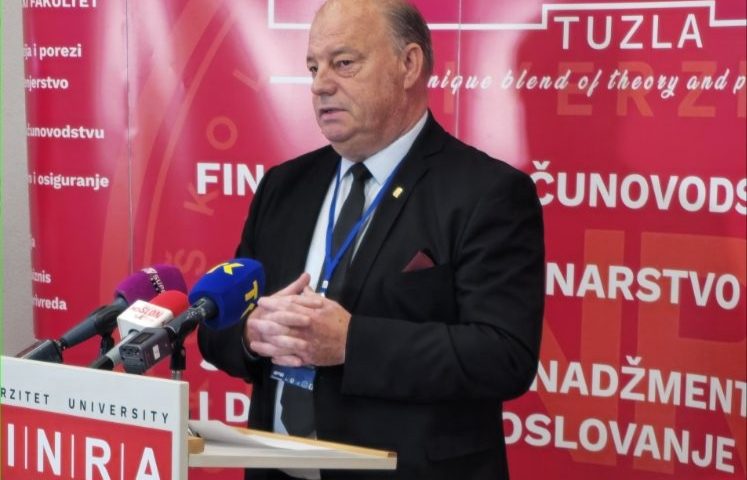
PORTRAIT VIII
PROF. JORDAN GJORCHEV, Ph.D.
THE MAN WHO TRANSFORMED AN IDEA INTO AN EDUCATIONAL MISSION
Written by: Slobodan TOMIĆ

“Look slowly. Everything is there.”
FROM SVETI NIKOLE TO AN ACADEMIC MISSION
There are those whose lives unfold merely as biographies.
Yet there are others whose lives endure as indelible marks.
Prof. Jordan Gjorchev, Ph.D., firmly belongs to the latter. His personal and professional journey defies the narrow boundaries of a single position, a single profession, or a title alone. It flows seamlessly through law, science, education, corporate management, public affairs, literature, and the fine arts.
From Sveti Nikole, through legal studies in Skopje and postgraduate education abroad, a path emerged that slowly led toward his most significant institutional legacy: the founding and development of the International Slavic University.
At that stage, it ceased to be a matter of individual ambition. It became a matter of a higher purpose.
- An idea that knowledge must possess its own home.
- That the youth deserve the opportunity to learn, to explore, and to perceive the world beyond the horizon of their daily routines.
- And that an idea—backed by unyielding perseverance—can rise into an institution.
FROM CONCEPT TO INSTITUTION
A university is far more than bricks and mortar. It is not defined by lecture halls, faculties, student indices, examinations, or printed diplomas.
A university is its people:
- The professors.
- The scholars.
- The researchers.
- The students.
- And the ideas that outlast them all.
The true measure of an educational institution lies not in the volume of degrees it confers, but in the character of the minds it shapes. It is measured by their knowledge, their intellectual autonomy, and their capacity for critical thought—to question, to harbor justified doubt, to seek answers, and to forge something original.
Thus, the passage from an idea to an institution is not merely architectural; it is a movement from thought into action, from action into generations, and from generations into the future. When an idea hardens into an institution, it no longer belongs solely to its creator—it becomes part of time itself.
THE CREATOR WHO RETAINED HIS ARTISTIC SOUL
Behind the academician, the jurist, the scientist, and the builder of institutions, stands another Jordan Gjorchev: The Creator.
Since his youth, he has engaged in caricatures, graphic arts, poetry, and prose, later extending his expression onto the canvas. This is no mere ornamental addition to his resume—it is the core of his spirit.
- The legal mind learns to discern structure and order.
- The scientist learns to defend the argument.
- The educator learns to construct the future.
- The artist learns to seek meaning.
Here, the multi-faceted nature of Gjorchev converges: Law, Science, Education, Literature, Painting, and Illustration. Not as conflicting forces, but as distinct dialects of a singular human imperative: TO CREATE.
THE DIVINE GIFT OF CREATIVITY
No two human beings behold the world through the exact same lens.
- Where one sees a face—another sees a story.
- Where one sees an object—another sees form, color, and symbolism.
- Where one sees the present—another foresees the future.
This is the artist’s grace: to capture what others glance past, to feel what remains unnoticed, and to bring forth that which did not exist before.
Creative energy is fundamentally a divine endowment. Yet every gift carries a profound duty. If one is blessed with talent, the obligation is to manifest it into something enduring—not to let it wither within, but to transform it into a book, a canvas, a scientific contribution, an institution, or a doorway for others to pursue their own journey.
When the creative spark merges with intellectual rigor and institutional foresight, a profession ceases to be mere labor: it becomes a crusade.
ART AS A WAY OF PERCEPTION
The seminal art movements of history—Futurism, Impressionism, Expressionism, and Abstract Art—are far more than stylistic choices. They represent fundamental shifts in human perception.
- Futurism pursues the horizon of tomorrow.
- Impressionism captures the fleeing moment, light, and sensation.
- Expressionism manifests the inner resonance.
- Abstract Art frees thought from literal constraints.
Precisely here, art intersects with education once more. True education should not merely teach a person what is, but inspire them to envision what could be.
One eye contemplates reality as it exists. The other foresees what it might become. Vision is born in the space between those two perspectives.
“LOOK SLOWLY. EVERYTHING IS THERE.”
In March 2026, at the “Bezisten” Art Gallery in Štip, Gjorchev introduced his solo exhibition with the guiding principle: “Look slowly. Everything is there.”
This was not merely a title; it was a philosophical stance.
In a world consumed by relentless haste, art demands that we pause. To look deeply. To feel. To reflect. There remains a profound abyss between merely observing something and truly understanding it. One may glance at a canvas and miss its essence, hear a word without sensing its weight, or pass by a fellow human without ever recognizing their story.
Therefore:
Look slowly. Everything is there.
Provided you possess the vision to see it, and the soul to perceive it.
THE MAJESTY OF KNOWLEDGE
In “Portraits of Power,” authority is not evaluated purely through the prism of politics. Genuine power resides in knowledge—in the scholar, in the written word, in scientific thought, and in the mentor who tells a young mind: “Persevere. You are capable.”
This is often a far greater power than any administrative title.
- A political tenure holds a fixed mandate—knowledge carries none.
- An office expires—an idea endures.
- An institution that cultivates generations outlives its architect.
In this light, Jordan Gjorchev represents a distinct form of influence: the power of knowledge, the power of purpose, the power of institutions, and the power of artistic creation.
FROM CIVIC LEADER TO EDUCATIONAL BUILDER
From 2000 to 2005, Gjorchev served as the Mayor of Sveti Никоle. Yet his public narrative did not terminate with his political term. On the contrary, it transitioned into higher education, research, and institutional development.
This marked a crucial evolution:
- Politics operates within mandates—education builds across generations.
- A political office has an expiry date—an institution offers permanence.
- A mayor governs a city—an educational pioneer shapes the minds that will one day govern their own destiny.
Here lies the distinction between holding a position and leaving a legacy. Positions belong to resumes. Legacy belongs to time.
THE UNIVERSITY AS A WINDOW TO THE WORLD
A true university must never be a secluded fortress of knowledge. It must be an open window to the world.
The International Slavic University continuously expands its academic and international ties, hosting scientific conferences with professors and researchers across continents—most notably through the international conference “International Dialogue: East – West.”
This open posture invites rigorous discourse across diverse fields:
- Economics
- Security Studies
- Computer Science
- Law
- Political Science
- Philosophy
- Psychology
- Pedagogy
- Culture
Yet the overarching aim remains unchanged: A university must not merely produce graduates; it must nurture intellects capable of profound thought, keen inquiry, global dialogue, and an open mind toward diversity.
AT THE CROSSROADS OF SCIENCE AND ART
At first glance, science and art appear as separate realms. In truth, they are deeply intertwined.
- Science asks: How?
- Art asks: Why?
- Science demands evidence.
- Art seeks meaning.
- Science dissects the world.
- Art feels its essence.
Wisdom begins when a person asks both questions simultaneously: How? and Why?
In Gjorchev, these worlds do not conflict; they harmonize:
- The legal scholar seeks order.
- The scientist seeks explanation.
- The institutional founder seeks the future.
- The artist seeks the soul.
THE CREATOR
When a life is summarized on paper, it is easy to list titles: years, accolades, degrees, mandates, and awards. Yet a biography should never be a mere ledger. A biography is a testament.
When viewing Jordan Gjorchev’s journey through this lens, the most accurate description is neither a title nor a position, but simply:
THE CREATOR.
A creator of institutions. A creator of scientific and academic thought. A creator of books. A creator of art. A architect of spaces where others can rise and flourish.
Perhaps this is the most demanding human task: to construct something that will endure long after one’s own name steps out of the spotlight.
THE ENDURING LEGACY
Ultimately, a life can be evaluated through two measures: as a biography or as a legacy.
- A biography recounts what a person achieved.
- A legacy reveals what remains behind.
A building can be measured, a degree counted, and a title recorded. But that which is truly created lives on within people, books, paintings, ideas, and coming generations.
Thus, we return to that simple yet profound realization:
“Look slowly. Everything is there.”
Everything a person has left behind. Everything they created, touched, and imparted to others.
It only requires us to look slowly, to read deeply, and to realize that a person’s ultimate worth is found not only in what they have personally attained, but in how many others they have helped to find their own path.
That is perhaps the greatest legacy of all:
- To nurture a mind that will tomorrow inspire another.
- To spark an idea that will give rise to new visions.
- To establish an institution that will continue to educate.
- To channel talent into art, knowledge into a mission, and divine grace into lasting achievement.
Therefore, this profile is not merely a portrait of an office holder. This is a portrait of an idea. The conviction that a human being can leave an enduring mark if they possess the courage to create, to build, to think, to express, and to believe that what begins today will be carried forward by generations yet to come.
PROF. JORDAN GJORCHEV, Ph.D.
- Founder of the International Slavic University
- President of the Board of Directors
- Jurist and Doctor of Science
- Author, Artist, and Creator
PORTRAITS OF POWER
THE FACE BEHIND THE OFFICE
Written by: Slobodan TOMIĆ
PORTRAIT VIII
