

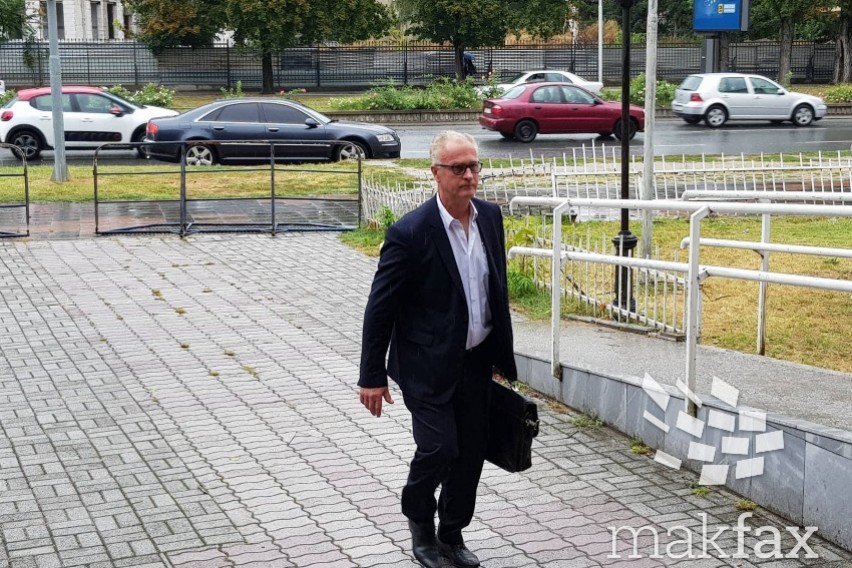
THE ATTORNEY WHO ENTERS WHERE THE LAW JUDGES ITSELF
By: Slobodan TOMIĆ

“Law is reason free from passion.”
— Aristotle
What happens when passion spills into the courtroom?
When politics inches closer to the indictment?
When the public renders a verdict long before the bench?
When an accusation turns into a headline, while the evidence remains buried in the files?
And what happens when an individual stands entirely alone against the colossal machinery of the state?
That is where the true test of a trial lawyer begins.
That is where the story of Dimitar Dangov takes shape—not merely because he is an attorney, but because for years he has stepped directly into the arena where Macedonian society fights its most grueling legal and political battles.
AN ATTORNEY IS NOT MEASURED BY WHOM HE DEFENDS
This is the fundamental principle the public must grasp.
An attorney is not an extension of the prosecution.
He is not a judge.
He is not a political party.
He is not the media’s audience.
His duty is to defend the legal standing of his client. Precisely for that reason, an attorney must sometimes represent the very person whom the public has already condemned.
This does not imply the client is innocent. It means the state bears the burden of proving guilt.
The distinction appears simple, yet in practice, it is profound. For between “I accuse” and “I have proven guilt” lies the entire civilization of law.
DANGOV AT THE CENTER OF THE MOST COMPLEX CASES
Dimitar Dangov’s professional trajectory continually intersects with Macedonia’s most high-profile and sensitive criminal cases: “Titanic,” “TNT,” “Violence in Centar,” “Transporter,” and “Plots on Vodno.”
These are trials where the prosecution and defense do not merely clash—competing interpretations of statecraft, power, accountability, evidence, legality, and political influence collide.
And above all, they confront the defining question:
WHERE DOES POLITICS END, AND WHERE DOES THE LAW BEGIN?
This is precisely why Dangov is a compelling subject for Portraits of Power. He does not hold political office; rather, he appears before those who do. In the courtroom, office yields to evidence, and power ceases to be an argument.
“TITANIC” — WHEN POLITICS ENTERS THE COURTROOM
The “Titanic” case symbolized the era when the Special Public Prosecutor’s Office initiated a wave of proceedings against senior officials and political figures.
Dangov served on the defense team. Yet the true significance lies beyond client identity—it resides in the legal question: Does political accountability automatically equate to criminal liability?
It does not. Criminal liability must be personal, concrete, proven, and tied directly to a specific act or omission satisfying the legal elements of an offense.
That is the essence. Here, the defense attorney poses the exact demand the state often resists hearing:
PROVE IT.
Do not explain.
Do not persuade.
Do not invoke the political climate.
PROVE IT.
“TNT” — CAN A POLITICAL DECISION CONSTITUTE A CRIME?
In “TNT,” Dangov again found himself at the legal forefront of the defense, confronting one of the most delicate questions in politically charged litigation: When does a political decision cross the threshold into abuse of office?
Where lies the boundary between policy and criminal liability?
In a democratic state, an erroneous policy choice cannot inherently constitute a crime. Otherwise, every transition of power would trigger a fresh wave of indictments. The law must remain far stricter than politics. The defense attorney’s mandate is to rigorously separate political evaluation from criminal responsibility.
“VIOLENCE IN CENTAR” — WHEN EVIDENCE OVERRIDES THE NARRATIVE
In “Violence in Centar,” Dangov moved for the dismissal of charges, asserting that the evidence failed to substantiate the prosecution’s theory.
Once again, the crux remains the evidence. Without proof, an indictment is merely an assertion—and an assertion is not a judgment.
“TRANSPORTER” — FROM DOMESTIC COURTS TO STRASBOURG
A key dimension of Dangov’s professional profile is his work on cases with a European legal footprint. In “Transporter,” his litigation extended to matters reaching the European Court of Human Rights.
Strasbourg operates on a different plane. It does not merely question whether a domestic court applied a statute correctly; it poses the broader inquiry:
DID THE STATE RESPECT THE INDIVIDUAL?
Was the trial fair? Was there an effective remedy? Was the defense granted a meaningful opportunity to safeguard the accused’s rights? Did the state exceed its lawful bounds?
That represents the ultimate European test of legality.
“PLOTS ON VODNO” — THE BATTLE BEYOND THE VERDICT
In “Plots on Vodno,” Dangov stepped into another legal battle of enormous political gravity.
Yet the same rule applies: legal proceedings do not conclude with news headlines. Appeals exist. Extraordinary legal remedies exist. The Supreme Court exists. European standards exist. Strasbourg exists.
An attorney utilizing these tools is not “delaying justice”—he is employing the system as designed. Exercising a statutorily guaranteed remedy is not an attack on justice; it is the exercise of the law itself.
THE MACEDONIAN AFFLICTION IS NOT MERELY CORRUPTION
Corruption is devastating, but an even greater danger exists: loss of trust.
When citizens cease to believe the judiciary is independent…
When they presume indictments are politically dictated…
When they assume verdicts are predetermined…
When they believe the powerful will always evade consequences…
The state begins to fracture from within. Not from a lack of institutions, but because those institutions have lost public confidence.
In this context, the defense bar plays a crucial institutional role: acting as a corrective, demanding evidence, testing procedures, and compelling the state to obey its own laws.
A RIGGED TRIAL? AN UNCOMFORTABLE YET NECESSARY DILEMMA
Discourse surrounding “fabricated trials” has persisted in Macedonia for years. However, a rigorous journalist and a seasoned trial lawyer must distinguish between political impressions and legal proof.
Not every trial resulting in a conviction is rigged.
Not every defendant is innocent.
Yet equally:
- AN INDICTMENT IS NOT PROOF.
- A POLICE THEORY IS NOT THE TRUTH.
- CIRCUMSTANTIAL INFERENCE IS NOT CONCLUSIVE EVIDENCE.
- A POLITICAL NARRATIVE IS NOT LEGAL VERDICT.
The defense attorney’s duty is to detach emotion from the law.
WHAT OF THE JUDICIARY?
A judge is the most formidable figure in a courtroom. Precisely for that reason, judicial authority must remain strictly bounded by law.
Judicial independence does not imply arbitrary discretion; it means the freedom to decide free from political, financial, or personal pressure. Criticizing judicial decisions does not undermine independence—reasoned criticism strengthens it. Only a judiciary capable of enduring scrutiny can command public trust.
MILLIONS IN THE WALLS? LET THE EVIDENCE SPEAK
Rumors often circulate regarding hidden wealth, illicit assets, and political influence. Yet journalism and law must draw the line between suspicion and fact.
If millions exist—let financial investigations uncover them.
If property exists—let its origins be audited.
If wealth was unlawfully acquired—let an indictment be brought.
If a crime was committed—let proof be presented.
Without evidence, summary judgment cannot be rendered. If we condemn others without proof today, that same mechanism can be turned against anyone tomorrow. That is the core of the rule of law.
DANGOV AND NEW LEGAL FRONTIERS
In recent matters, notably those arising from the tragedy in Kočani, the complexity of criminal liability is once again laid bare.
Who held jurisdiction?
Who knew?
Who was obligated to know?
Who could have intervened?
Who bore the legal duty?
Who breached it?
And most critically:
CAN INDIVIDUAL CRIMINAL LIABILITY ATTACH TO A CONEQUENCE WITHOUT DIRECT LEGAL AND FACTUAL CAUSATION BEING ESTABLISHED?
These are formidable legal questions solved not by slogans or public fervor, but through trial transcripts, evidence, statutory texts, expert testimonies, jurisdictional boundaries, and strict procedure.
THE ATTORNEY AS THE LAST LINE OF DEFENSE
In a constitutional state, an individual stands alone against the sovereign power.
The prosecution commands a team.
The police command authority.
The state commands an apparatus.
The individual has an attorney.
An attorney is therefore more than a practitioner; he is a structural safeguard ensuring state power does not become absolute.
John Locke framed political philosophy around the limitation of government power. Montesquieu conceptualized the separation of powers. Beccaria demanded that criminal justice be rational, proportionate, and humane. Modern European law places human dignity at its apex.
These doctrines converge on a fundamental truth:
A STATE IS ONLY AS STRONG AS THE LEGAL LIMITS PLACED UPON ITS POWER.
WHY DANGOV?
Because his professional career is not defined by an appointed office, but by trial records, courtrooms, legal arguments, motions, and appellate practice across domestic and European jurisprudence.
His name emerges during periods when Macedonia has faced deep political fractures and trials that continue to evoke intense public reaction. He does not sit at the apex of the political pyramid; he frequently stands opposite it—law in hand.
TRUE POWER IS NOT THE ABILITY TO CONVICT THE WEAK
The true strength of a state lies not in defeating an accused individual, but in guaranteeing a fair trial.
Power is not measured by the ability to convict, but by the ability to prove guilt.
Not by the capacity to detain, but by proving the process was lawful.
Not by silencing the defense, but by permitting it to be heard.
Not by intimidating the public, but by convincing it with evidence.
That is the distinction between a state governed by the rule of law and a state that merely uses law as an instrument of power.
DIMITAR DANGOV — THE MAN BEHIND THE SHIELD
Ultimately, a defense attorney cannot guarantee an outcome, command a ruling, or alter the facts.
He can, however, do something essential:
HE CAN FORCE THE SYSTEM TO ACCOUNT FOR ITSELF.
- Why are you indicting?
- On what grounds?
- Which piece of evidence?
- Which statutory provision?
- Which specific act caused the result?
- What is the degree of culpability?
- Is the process fair?
- Was the evidence lawfully obtained?
- Were human rights respected?
When these questions are pressed relentlessly, the courtroom ceases to be a place where charges are merely read—it becomes the forum where the state must render an account.
THE FINAL JUDGMENT OF THE PORTRAIT
Dimitar Dangov requires no idealization. Like any trial lawyer, he should be evaluated by professional standards, legal reasoning, and case outcomes.
Yet one matter remains clear: his presence in many of Macedonia’s most delicate judicial proceedings renders him a central figure in understanding the contemporary legal and political landscape.
His portrait should not prompt the question: “Whom did he defend?”
It should prompt the far more critical inquiry:
“WHAT KIND OF STATE DO WE WISH TO BE?”
A state where an indictment suffices? Or one where proof is imperative?
A state where political power dictates the outcome? Or one where the law limits power?
A state where the citizen fears the institution? Or an institution that respects the law?
The answer extends far beyond any single attorney. Yet it is often the attorney who insists on asking the question where it matters most: inside the courtroom.
FINAL THOUGHT
“It is better that ten guilty persons escape than that one innocent suffer.”
— Blackstone’s Ratio
This is not a flaw in the administration of justice; it is its greatest safeguard.
A state capable of restraining itself from unjust convictions proves it is stronger than its own authority. A state that insists on proof before punishment demonstrates that it does not fear the truth.
That is where the rule of law begins.
And directly on that thin, crucial line between charge and evidence, state power and individual rights, politics and justice—stands Dimitar Dangov.
Not as a judge.
Not as a prosecutor.
Not as a politician.
Rather, as a trial lawyer—whose profession exists to confront authority with the single most challenging demand it can face:
PROVE IT.
